BALDA BALDI
The Balda Baldi is a compact, folding 127 film camera produced by the German manufacturer Balda Werke in the late 1930s. Designed for amateur photographers seeking portability and ease of use, the Baldi captures 3×4 cm images on 127 roll film, offering a balance between image quality and compact form.
Overview
Introduced in 1938 and manufactured until 1940, the Balda Baldi emerged during a period of growing demand for lightweight, user-friendly cameras aimed at the consumer market. Balda, based in Dresden, Germany, was known for its high-quality folding cameras and later 35mm models, but the Baldi represented a strategic move into the popular 127 film format, which was gaining traction due to its convenience and smaller camera designs. The Baldi was marketed as a simple, reliable camera for snapshot photography, emphasizing portability and straightforward operation over advanced technical features.
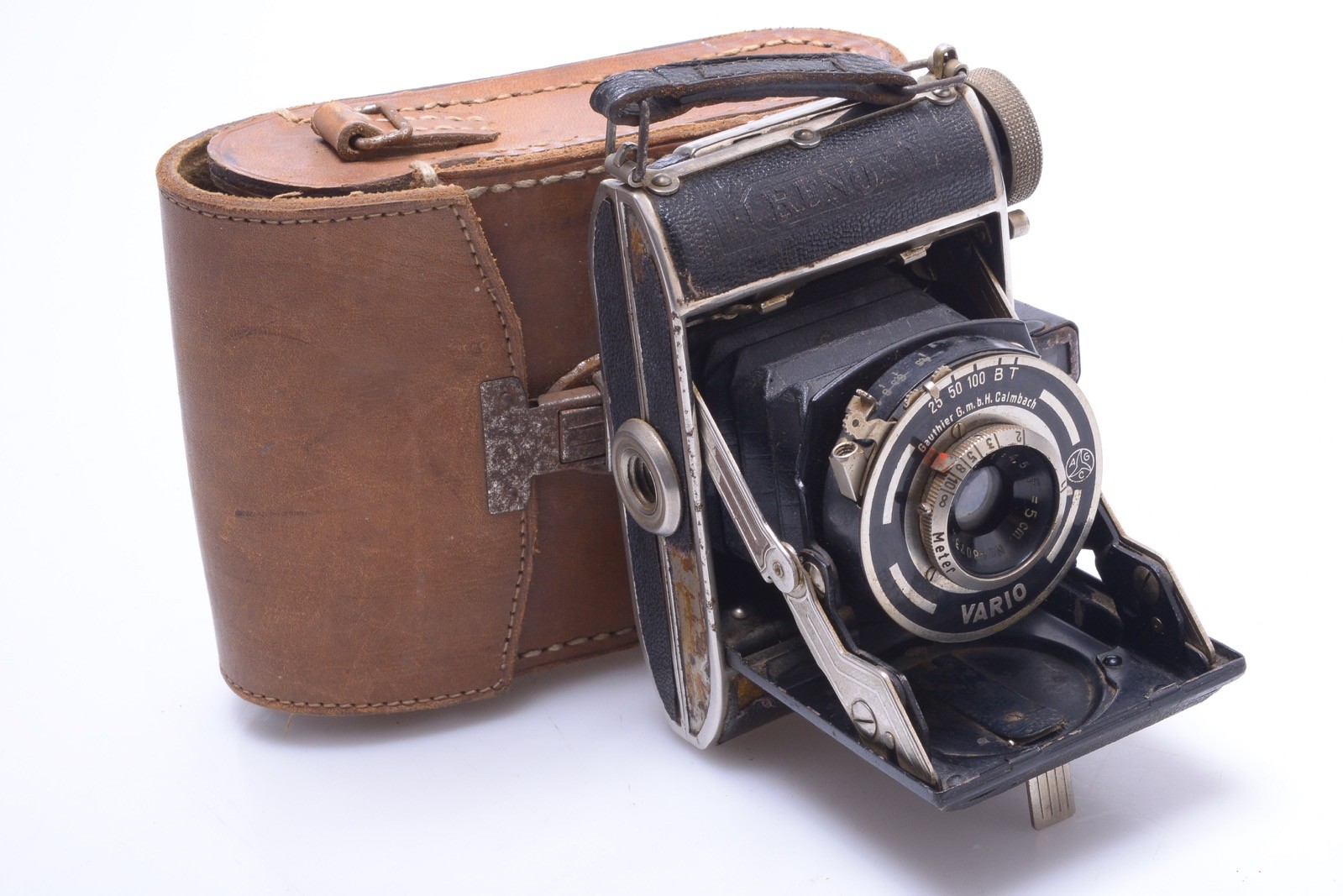
The Baldi features a folding design with a collapsible front lens standard, allowing the camera to be compact when not in use. It is constructed primarily of metal with leatherette covering, typical of mid-tier German cameras of the era. The camera lacks rangefinder coupling and relies on scale focusing, with distance settings estimated by the user based on scene judgment. It was available with a range of lenses depending on the model variant, including the Goerz Doppel Anastigmat and the more modest Steinheil Culminar, typically in f/4.5 or f/6.3 apertures. Shutter options included the Compur or Prontor-SVS, both respected German-made leaf shutters.
Within Balda’s product lineup, the Baldi occupied a position below the more sophisticated Baldax and Baldatessa models, serving as an entry-level offering. It reflected the company’s commitment to precision engineering while catering to budget-conscious consumers. Though overshadowed by larger format and 35mm cameras, the Baldi exemplified the trend toward miniaturization and accessibility in pre-war photography.
Specifications
| Specification | Value |
| Type | Folding view camera / scale-focus |
| Film Format | 127 roll film |
| Image Size | 3×4 cm (40×30 mm nominal) |
| Years Produced | 1938–1940 |
| Lens Mount | Fixed lens, non-interchangeable |
| Lens Options | Goerz Doppel Anastigmat 75mm f/4.5, Steinheil Culminar 75mm f/4.5 or f/6.3, or Schneider Xenar 75mm f/4.5 (varies by production batch) |
| Aperture Range | f/4.5 to f/16 (or f/6.3 to f/16 depending on lens) |
| Shutter | Compur or Prontor-SVS leaf shutter |
| Shutter Speeds | B, 1–300 seconds (Compur); B, 1–200 seconds (Prontor-SVS) |
| Focus | Scale focusing, zone-focused via distance markings (3 ft to ∞) |
| Viewfinder | Optical direct-vision frame finder (pop-up or integral) |
| Metering | None (no built-in exposure meter) |
| Exposure Modes | Manual only (shutter speed and aperture set manually) |
| Film Advance | Manual knob wind, red window on back for frame numbering |
| Frame Count | 12 exposures per 127 film roll |
| Construction | Metal body with leatherette covering, folding bed |
| Dimensions (closed) | Approx. 10 × 7 × 3.5 cm |
| Weight | Approx. 450–550 g (depending on lens/shutter combination) |
Key Features
- Compact folding design – Collapsible lens standard allows for pocketable size when not in use, ideal for travel and casual photography.
- High-quality German optics – Equipped with respected lenses such as the Goerz Doppel Anastigmat or Schneider Xenar, ensuring sharp image rendition for its format.
- Precision shutters – Fitted with either Compur or Prontor-SVS leaf shutters, known for reliability and accurate timing.
- Simple red-window film advance – Utilizes a red window on the back for aligning frame numbers, a common but effective method for 127 film cameras.
- Durable metal construction – Built with robust materials typical of pre-war German engineering, contributing to longevity when well-maintained.
Historical Context
The Balda Baldi was launched in 1938, a time when 127 film was becoming increasingly popular for amateur photography due to its smaller camera size and ease of handling compared to 6×6 or 35mm systems. The 127 format, introduced by Kodak in 1912, saw a resurgence in the 1930s with European manufacturers embracing it for compact, stylish cameras. The Baldi was part of this wave, competing with models like the Kodak Baby Brownie, Wirgin Edinex, and Agfa’s Karat series.
Balda positioned the Baldi as a no-frills yet well-built camera for the middle-class photographer. It lacked rangefinders or automatic exposure, relying instead on simplicity and quality optics to appeal to users who valued portability and reliability. The outbreak of World War II in 1939 disrupted production, and by 1940, civilian camera manufacturing in Germany was severely curtailed. As a result, the Baldi had a short production run, contributing to its relative rarity today.
Collectibility & Value
The Balda Baldi is a sought-after model among collectors of pre-war German cameras, particularly those interested in 127 film formats and folding designs. Due to its limited production period and the impact of WWII on manufacturing, surviving examples in good condition are uncommon. Values typically range from $150 to $400 USD, depending on lens quality, shutter functionality, and overall condition. Models equipped with the Goerz Doppel Anastigmat or Schneider Xenar lenses command higher prices than those with more basic optics.
When purchasing a Baldi, collectors should inspect the shutter operation across all speeds, as lubricants often dry out or gum up over time, especially in Compur shutters. The leather bellows should be free of cracks or light leaks, and the red window should be intact and transparent. The focusing mechanism should move smoothly without binding. As the camera uses no batteries and has no electronic components, functionality depends solely on mechanical integrity. Restorations are possible but require specialized tools and knowledge, particularly for shutter servicing.
Similar Cameras
- Kodak Baby Brownie Special – A comparable 127 film camera with similar 3×4 cm format, though typically with simpler optics and plastic construction.
- Agfa Karat 36 – A slightly later German 127 camera with more advanced features, including a built-in rangefinder in some models.
- Wirgin Edinex 127 – A German-made folding camera with interchangeable lenses and scale focusing, targeting a similar user base.
- Zephyr 3x4 – A British 127 folding camera with similar size and format, though generally equipped with lower-tier lenses.
- Rollei A26 – A premium 127 TLR, representing the high end of the format with superior build and optics.
Repair & Maintenance
The Balda Baldi requires no batteries and operates entirely mechanically, making it suitable for long-term use if properly maintained. The most common issues involve shutter malfunction due to dried lubricants, particularly in Compur shutters, which may require cleaning and re-lubrication by a specialist. The leather bellows are prone to deterioration; replacement may be necessary if light leaks are present. The red window can become opaque or discolored and may need gentle cleaning or, in extreme cases, replacement. Lens fungus or haze is occasionally found, especially in humid storage conditions. Regular use, proper storage in a dry environment, and periodic inspection are recommended to preserve functionality. Due to the age and scarcity of parts, repairs should be undertaken by technicians experienced in vintage German camera systems.
eBay Listings
As an eBay Partner, we earn from qualifying purchases. This helps support our independent vintage technology research.