BALDA BALDAXETTE II
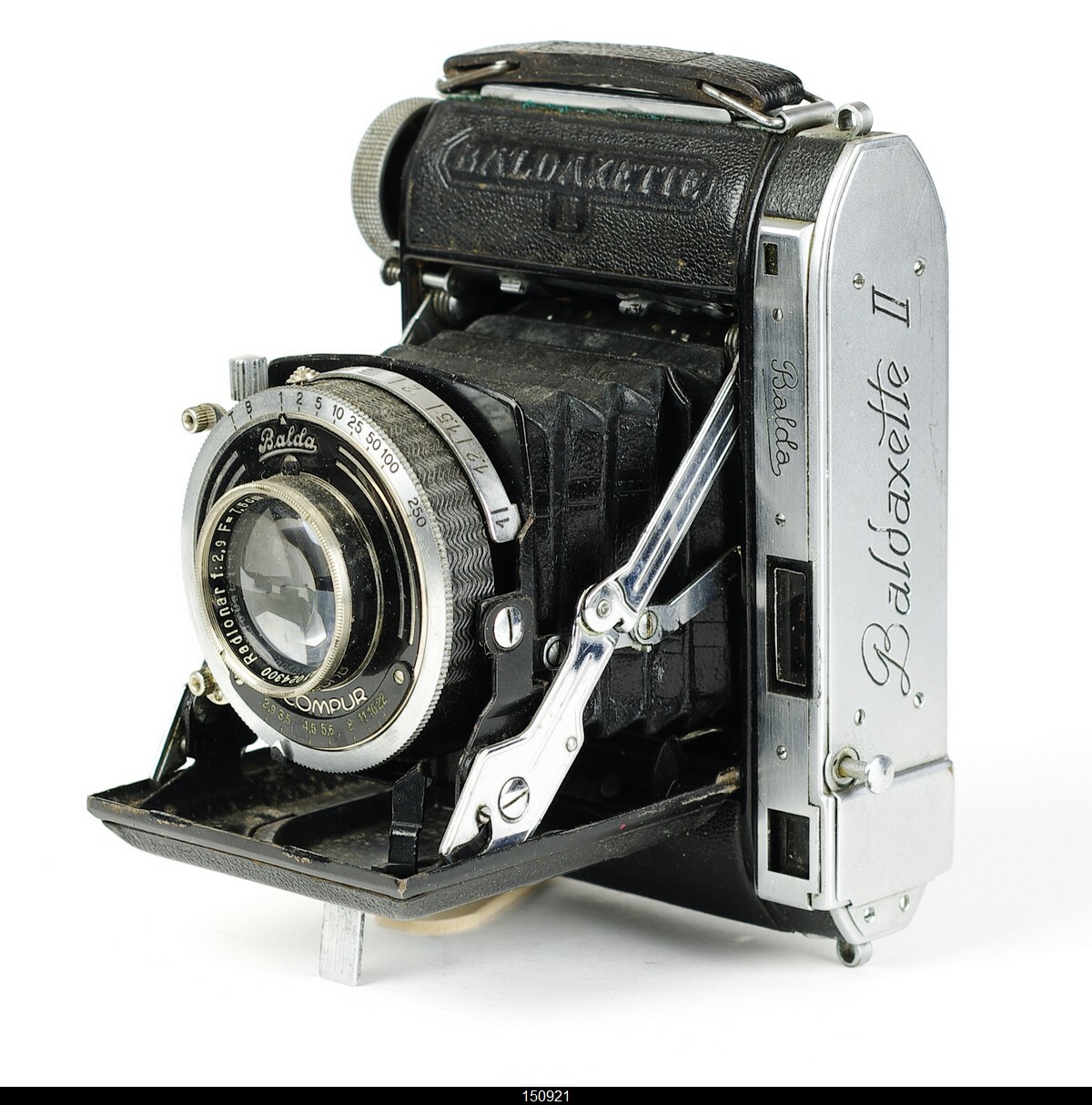
The Balda Baldaxette II is a high-quality 6×6 medium format folding rangefinder camera produced in Germany by Balda Werke of Dresden between 1937 and 1939. Designed for precision and portability, it represents the pinnacle of German engineering in pre-war 120 film cameras, combining a coupled rangefinder, quality optics, and a robust folding design aimed at serious amateur and professional photographers.
Overview
Introduced during a period of intense innovation in medium format camera design, the Baldaxette II was positioned as a premium alternative to the dominant Rolleiflex TLRs and other European folding cameras. Manufactured in limited numbers from 1937 to 1939, the Baldaxette II was part of Balda’s effort to capture a share of the growing market for compact, high-performance medium format cameras. Unlike twin-lens reflex models, the Baldaxette II used a single-lens folding design with a coupled rangefinder, allowing for more accurate focusing and a slimmer profile when collapsed.
The camera was targeted at discerning photographers who valued optical quality and mechanical precision without the bulk of larger format systems. It featured a rigid struts-based folding mechanism, a hallmark of Balda’s engineering, which provided greater stability than typical bellows-only folders. The Baldaxette II was available with a range of high-grade lenses, most commonly the Zeiss Tessar or Schneider Xenar, both renowned for their sharpness and contrast. Its 6×6 cm negative format produced twelve exposures per standard 120 roll film, delivering excellent image quality suitable for enlargement.
Within Balda’s product lineup, the Baldaxette II succeeded the original Baldaxette and represented the brand’s most advanced folding rangefinder model before World War II disrupted production. Balda was known for its meticulous construction and use of premium materials, and the Baldaxette II exemplified this reputation with its all-metal body, finely machined components, and precise rangefinder coupling. While not as widely produced as competitors from Rollei or Kodak, the Baldaxette II earned a reputation among connoisseurs for its elegant design and superior build quality.
Specifications
| Specification | Value |
| Type | Rangefinder |
| Film Format | 120 film (6×6 cm) |
| Years Produced | 1937–1939 |
| Lens Mount | Fixed lens (non-interchangeable) |
| Shutter | Compur or Prontor-SE leaf shutter, speeds 1–1/300 sec + B |
| Aperture Range | f/3.5 to f/22 (varies by lens) |
| Metering | None (uncoupled or external meter required) |
| Exposure Modes | Manual only |
| Viewfinder | Optical viewfinder with superimposed brightline frame and coupled rangefinder patch |
| Focusing | Coupled rangefinder, helical focus on lens standard |
| Lens | 75mm f/3.5 Zeiss Tessar or Schneider Xenar (most common) |
| Focus Range | Approximately 1 meter to infinity |
| Film Advance | Dual red window and backup film counter (via back door) |
| Dimensions | Approx. 110 × 90 × 55 mm (folded); 110 × 90 × 140 mm (extended) |
| Weight | Approx. 780–820 g (depending on lens/shutter) |
| Construction | Metal body with leatherette covering, rigid strut folding system |
Key Features
- Coupled Rangefinder: Precise focusing via a central brightline patch that aligns images for sharp focus, a significant advantage over scale-focusing folders.
- High-Quality Optics: Typically equipped with either a Zeiss Tessar or Schneider Xenar 75mm f/3.5 lens, both among the finest lenses of the era.
- Rigid Strut Folding Mechanism: Unlike many folding cameras that rely solely on bellows, the Baldaxette II uses metal struts for enhanced stability and reduced risk of misalignment.
- Leaf Shutter with High Speeds: Compur or Prontor-SE shutters offer speeds up to 1/300 sec, enabling use in bright conditions and with flash synchronization.
- Compact Portability: When folded, the camera is pocketable in larger coats, making it ideal for travel and street photography.
Historical Context
The Baldaxette II was released at a time when German camera manufacturers were pushing the boundaries of compact medium format design. The mid-to-late 1930s saw a surge in demand for portable yet high-performance cameras, driven by the rise of photojournalism and amateur photography. Competitors like the Zeiss Ikon Super Ikonta C, Kodak Retina I, and Wirgin Edinex offered similar 6×6 folding designs, but few matched the Baldaxette II’s combination of build quality and optical excellence.
Balda, though less internationally recognized than Zeiss or Leica, had established a reputation for precision engineering and innovative folding mechanisms. The Baldaxette II was intended to compete directly with the upper tier of folding cameras, emphasizing durability and optical performance. However, its production run was cut short by the outbreak of World War II in 1939, which shifted industrial priorities and limited availability. As a result, the Baldaxette II was produced in relatively small numbers, contributing to its rarity today.
Collectibility & Value
The Balda Baldaxette II is a sought-after collector’s item due to its limited production, high build quality, and historical significance. In excellent working condition, with a clean lens and responsive shutter, examples can fetch between €800 and €1,500 at auction or through specialist vintage camera dealers, with models featuring the Zeiss Tessar lens commanding higher prices. Rarity, originality, and functional integrity are key determinants of value.
Collectors should inspect the camera for common issues such as stiff or inaccurate rangefinder coupling, shutter speed inaccuracies (especially at higher speeds), and bellows integrity. Light leaks due to deteriorated bellows are a frequent problem in aged examples. Additionally, the red window should be checked for clouding or residue. Because the camera lacks a built-in light meter, users must rely on external meters or smartphone apps for exposure, which does not detract from value but affects usability. Original cases, manuals, and lens caps can further enhance desirability.
Similar Cameras
- Zeiss Ikon Super Ikonta C (534/16)
- Kodak Retina I (Type 117)
- Wirgin Edinex 35
- Plaubel Makina 67 (later model, but conceptually similar)
- Foca II B (French-made 6×6 rangefinder folder)
Repair & Maintenance
The Baldaxette II requires no batteries, as it is fully mechanical. However, servicing often involves cleaning and lubricating the leaf shutter (Compur or Prontor-SE), which may suffer from oil drying or sticking over time. Shutter speeds should be tested with a timer or photodiode tester to ensure accuracy. The coupled rangefinder mechanism is delicate and may require optical alignment if images appear misregistered. Bellows replacement is possible but requires skilled craftsmanship due to the rigid strut design. Regular use and gentle handling help maintain smooth operation, and storing the camera with the lens retracted and bellows protected from light and moisture is recommended.
eBay Listings


As an eBay Partner, we earn from qualifying purchases. This helps support our independent vintage technology research.
Related Models
- Balda Baldinette (1951) (1951-)
- Balda Baldax (1933-1938)
- Balda Baldaxette I (1936-1938)
- Balda Juwella (1938-1940)
- Agfa Automatic 66
- Agfa Billy Compur
- Agfa Billy I
- Agfa Billy Jgetar 8.8
- Agfa Billy Record II
- Agfa Billy Zero