ARGUS C44
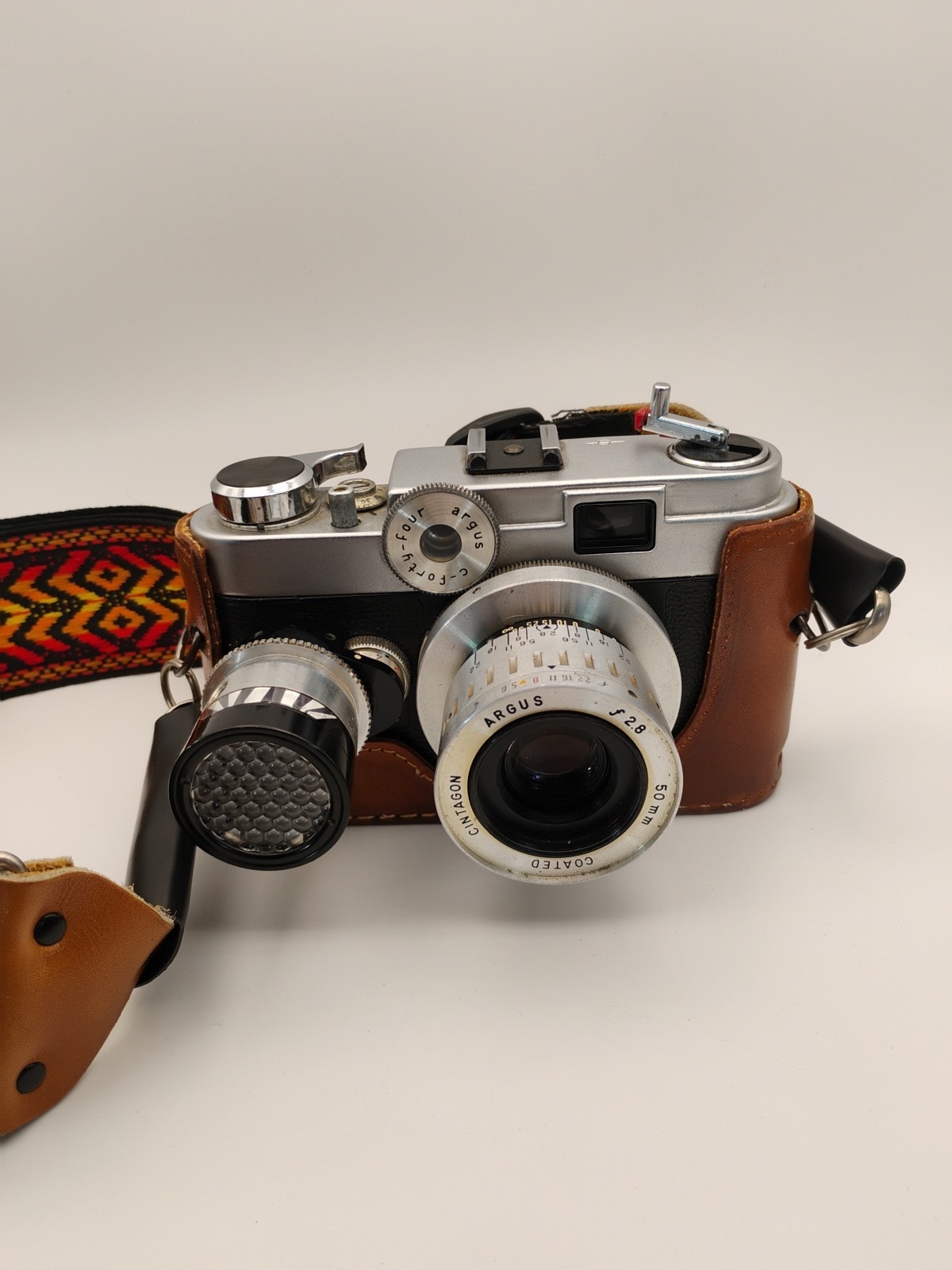
The Argus C44 is a 35mm rangefinder camera produced by Argus Cameras of Ann Arbor, Michigan, from 1956 to 1958. It represents one of the final and most technically advanced models in the company’s C-series line, notable for its interchangeable lens system and precision engineering aimed at serious amateur and semi-professional photographers.
Overview
Introduced at a pivotal moment in American camera manufacturing, the Argus C44 was designed to elevate the brand’s reputation beyond its earlier reputation for budget-friendly, fixed-lens rangefinders like the iconic Argus C3. The C44 was positioned as a high-end, system-oriented camera, offering interchangeable lenses, a coupled rangefinder, and a robust metal chassis. It was intended to compete with European imports such as the Leica III series and the Contax II, though at a more accessible price point. The C44 was marketed toward advanced amateurs and photojournalists who desired flexibility without the premium cost of German equipment.
The C44 shares design lineage with the earlier Argus C3 and C4 models but introduces significant improvements, including a bayonet lens mount compatible with a range of dedicated optics, a combined viewfinder and rangefinder window, and a more refined shutter mechanism. The camera’s layout features a top-mounted shutter speed dial, a film advance lever (a step up from the earlier C3’s knob), and a rapid-wind film back that allows for mid-roll film changes—a rare feature in American 35mm cameras of the era. Despite its advanced features, the C44 retained the boxy, utilitarian aesthetic typical of Argus designs, with a black enamel or chrome finish and prominent control knobs.
Specifications
| Specification | Value |
| Type | Rangefinder |
| Film Format | 35mm (135 cartridge) |
| Years Produced | 1956–1958 |
| Lens Mount | Argus Bayonet Mount (C44-specific) |
| Shutter | Focal-plane cloth shutter, speeds 1–1/1000 sec, B, X-sync |
| Metering | None (uncoupled selenium light meter available on some variants) |
| Exposure Modes | Manual only |
| Viewfinder | Combined optical viewfinder and coupled rangefinder |
| Dimensions | Approx. 150mm (W) × 90mm (H) × 60mm (D); Weight: ~850g (body only, no lens) |
Key Features
- Interchangeable Lens System: The C44 supports a range of lenses via a proprietary bayonet mount, including the 35mm f/3.5, 50mm f/3.6 (standard), 85mm f/3.5, and 135mm f/4, allowing for versatility in focal length.
- Focal-Plane Shutter with High Speeds: Offers shutter speeds from 1 second to 1/1000 second, rare among American cameras of the time and competitive with European counterparts.
- Rapid-Wind Film Back: Enables mid-roll film changes and quick film loading, a feature uncommon in rangefinders of this class.
- Coupled Rangefinder Focusing: Provides accurate manual focus via a bright, integrated split-image patch within the viewfinder.
- X and M Flash Sync: Dual flash synchronization (X for electronic flash, M for medium-peak bulbs) via PC terminals on the shutter housing.
Historical Context
The Argus C44 was released during a period of intense competition in the 35mm camera market. By the mid-1950s, Japanese manufacturers such as Nikon and Canon were beginning to gain traction in the West, while German brands like Leica and Zeiss Ikon dominated the high-end segment. Argus, once a leader in American camera production, sought to reassert its technical credibility with the C44. The camera was intended as a flagship model to showcase the company’s engineering capabilities and to appeal to photographers who wanted a domestically produced, system-capable rangefinder.
Despite its advanced features, the C44 arrived late in the era of American camera dominance. Production was limited, and the model was discontinued after only two years, likely due to high manufacturing costs and limited market penetration. It faced stiff competition not only from abroad but also from emerging American SLRs like the Alpa-Reflex and later the Topcon series. Additionally, the lack of through-the-lens metering and the proprietary lens mount—while high quality—limited third-party support and long-term expandability. As a result, the C44 remained a niche product, overshadowed by its more famous predecessor, the C3.
Collectibility & Value
Today, the Argus C44 is a sought-after collector’s item due to its rarity, historical significance, and status as the pinnacle of Argus rangefinder design. Fewer than 20,000 units are estimated to have been produced, and complete examples with lenses and accessories are uncommon. In excellent working condition, a C44 with a standard 50mm lens can command between $400 and $800 on the vintage camera market, with rarer lenses like the 135mm f/4 fetching additional premiums.
Collectors should inspect the shutter operation carefully, as the high-speed focal-plane mechanism is prone to uneven speeds or fabric deterioration over time. The rangefinder alignment is another critical point—misalignment is common in aged units and difficult to repair without specialized tools. The selenium light meter, if present, is likely non-functional due to age-related degradation, though this does not significantly affect usability as the camera lacks TTL metering. Original cases, instruction manuals, and lens caps add substantial value. Due to its complexity compared to the C3, the C44 is less common on the market and often overlooked by casual collectors, making it a hidden gem for enthusiasts of American photographic engineering.
Similar Cameras
- Leica IIIg (1957–1960): German-built rangefinder with interchangeable lenses, M39 mount, and comparable shutter speeds; superior build and optics but significantly more expensive.
- Nikon S3 (1958): Japanese rangefinder with bayonet mount, 1/1000 sec shutter, and excellent Nikkor lenses; direct competitor in the professional rangefinder space.
- Contax IIa (1954–1961): German rangefinder with interchangeable lenses, long heritage, and robust construction; shared the same market niche but with superior optics and higher cost.
- FED 4 (USSR, 1955–1970): Soviet Leica copy with M39 mount and 1/1000 sec shutter; much lower cost but less precise build quality.
- Koni-Omega Rapid (1958–1965): Japanese press camera with interchangeable lenses and focal-plane shutter; similar rapid-wind feature and professional orientation.
Repair & Maintenance
The Argus C44 requires no batteries for basic operation, as it is fully mechanical. However, selenium light meter variants (rare) do not require external power but are typically non-functional due to material decay. The most common maintenance issues involve the focal-plane shutter, which can develop uneven speeds, especially at 1/500 and 1/1000 sec, due to cloth fatigue or lubricant hardening. Shutter cloth replacement is complex and should be performed by a technician experienced with vintage focal-plane mechanisms.
Rangefinder calibration is another frequent concern; the linkage between the focusing helicoid and the rangefinder mechanism can become misaligned, leading to inaccurate focus. Cleaning the viewfinder and rangefinder windows is recommended, as internal haze or fungus can degrade visibility. The film advance lever and rewind mechanism should operate smoothly; worn gears or stiff springs may require disassembly. Given the camera’s rarity and specialized design, original parts are difficult to source, making skilled repair essential. Regular use and proper storage in a dry environment are the best ways to preserve functionality.
eBay Listings



As an eBay Partner, we earn from qualifying purchases. This helps support our independent vintage technology research.