Argus C3 (1939–1966)
At 759.8 grams, it rests in the hand like a cast-iron paperweight — dense, deliberate, and unmistakably American.
Overview
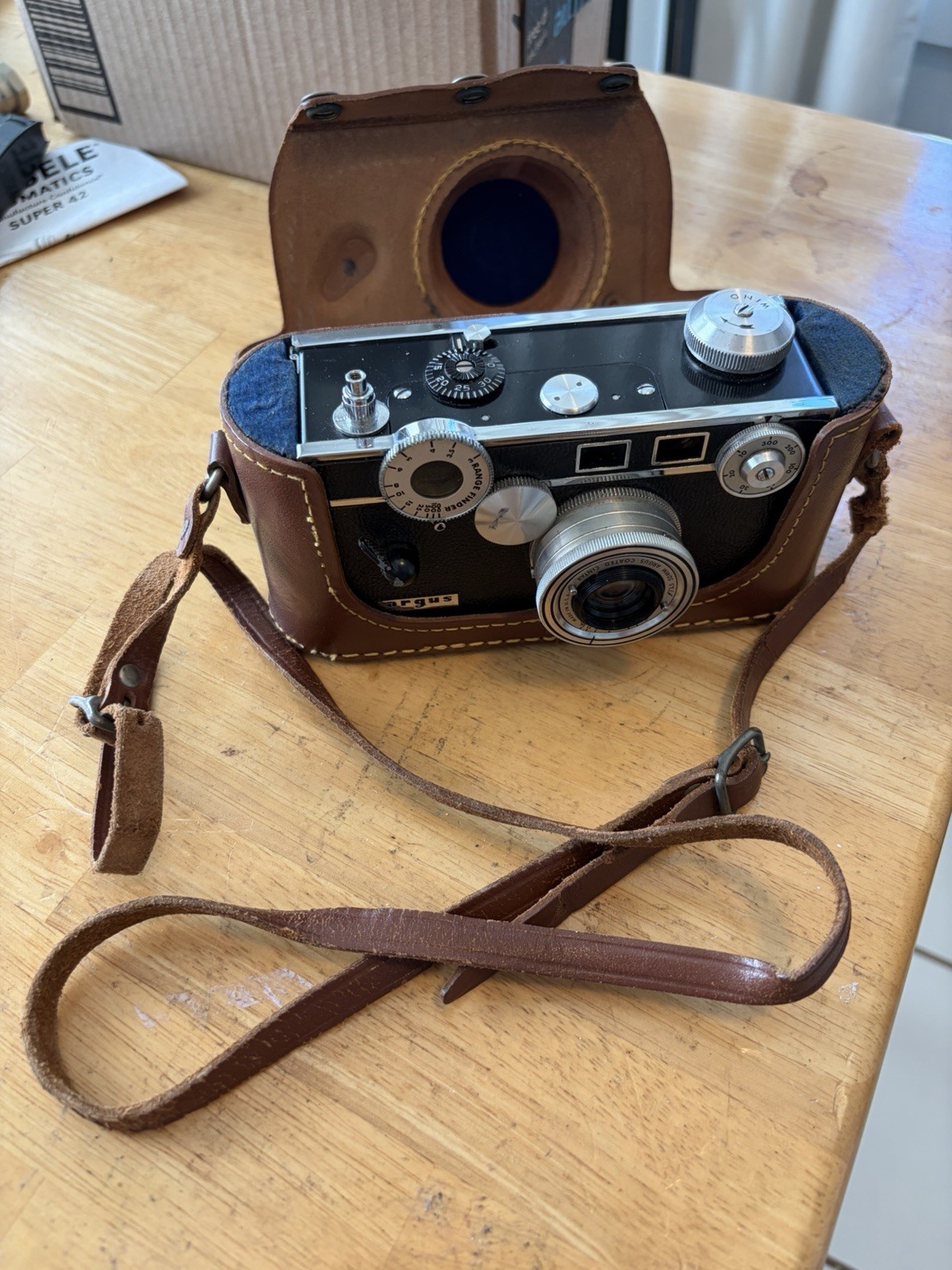
The Argus C3 isn’t subtle. From the moment it’s lifted, its heft announces itself — a hunk of bakelite and cast metal forged in the image of industrial pragmatism. Produced from 1939 to 1966, this 35mm rangefinder became an icon not for elegance, but for endurance. Nicknamed "The Brick" long before it was ever nostalgic, the C3 earned its moniker through sheer physical presence and a no-nonsense design that prioritized function over form. It wasn’t trying to impress; it was built to last, and in doing so, it became the best-selling 35mm camera of its era, with over 2.2 million units sold.
Owners report it as one of the first mass-produced American 35mm cameras, a point of national pride during a time when German optics dominated the market. Though it lacked the finesse of a Leica or the compactness of later Japanese models, the C3 carved its niche by being accessible, durable, and mechanically straightforward. It was a camera for students, amateurs, and families — the sort of machine handed down with a roll of film and a quick lesson on focusing through the coupled rangefinder. Its manual exposure and manual focus systems demanded engagement, but not expertise, making it a favorite for those learning the craft.
Despite its popularity, the C3 was no technological leap forward. It was, in fact, a minor revision of the earlier Argus C2, refining rather than reinventing. But refinement was enough. When production paused during WWII and resumed in late 1945, demand surged. By the 1950s, it was a fixture in American households, a workhorse that delivered reliable results with the Argus Coated Cintar 50mm f/3.5 lens — a lens collectors note as surprisingly sharp for its class, even if its rendering lacks the drama of higher-end glass.
Specifications
| Manufacturer | Argus |
| Product Type | 35mm rangefinder camera |
| Production Years | 1939–1966 |
| Film Type | 135 (35mm film) |
| Film Format | 35 mm × 24 mm |
| Lens | Argus Coated Cintar 50mm 1:3.5 |
| Shutter Type | leaf shutter |
| Shutter Speed Range | Bulb, 1/10–1/300 |
| Minimum Aperture | f/16 |
| Weight | 26.8 oz. (759.8 g) |
| Focus System | Manual |
| Exposure Control | Manual |
| Construction | made of bakelite plastic and cast metal |
| Focus Coupling | coupled rangefinder |
| Lens Mount | interchangeable lens |
Key Features
759.8 Grams of Bakelite and Cast Metal
The C3’s construction is its first statement. Made from a combination of bakelite plastic and cast metal, it feels more like a tool than a camera. There’s no attempt at streamlining — the body is angular, blocky, and unapologetically utilitarian. This isn’t a camera designed to slip into a jacket pocket; it’s meant to be held, gripped, and operated with deliberate intent. The weight, while substantial, provides stability, and the material choice reflects the industrial ethos of its time — durable, moldable, and cost-effective for mass production.
Coupled Rangefinder with Manual Focus
Focusing is achieved through a coupled rangefinder system, a significant advantage over scale-focus models of the era. The patch in the viewfinder allows for precise manual focusing by aligning split images, a system that, when functional, delivers accurate results. Owners report the mechanism can degrade over time, especially if the camera has sat unused, but when adjusted correctly, it remains a reliable method for achieving sharp images. The focus knob is large and textured, designed for gloved hands or cold weather use — another hint at its practical American roots.
Interchangeable Lens System
Despite its reputation as a simple camera, the C3 supports interchangeable lenses — a feature uncommon in entry-level models of the period. The standard fit is the Argus Coated Cintar 50mm f/3.5, but the mount allows for other compatible optics, expanding its versatility. However, the ecosystem of available lenses was limited compared to German or later Japanese systems, and collectors note that finding working, non-Cintar lenses today is rare. Still, the capability itself speaks to Argus’s ambition to offer more than just a fixed-lens box.
Leaf Shutter with Bulb and 1/10–1/300 Speeds
The leaf shutter offers a range from Bulb to 1/300 second — modest by modern standards, but sufficient for daylight photography and flash synchronization. The speeds are set via a dial on the top plate, with tactile clicks that reassure the user of proper selection. The Bulb setting allows for long exposures, useful for night shots or low-light work with a tripod. However, the shutter is also the camera’s Achilles’ heel; owners frequently report it becoming stuck, especially in units that have not been regularly serviced. Once seized, disassembly is reportedly difficult due to tight tolerances and aging lubricants.
Manual Exposure Control with f/16 Minimum Aperture
Exposure is entirely manual, with aperture controlled via a ring on the lens barrel. The Cintar lens stops down to f/16, offering reasonable depth of field control in varied lighting. With no built-in meter, photographers must rely on external meters or the sunny-16 rule — a limitation that, while demanding, was standard for the era. The aperture ring turns smoothly when maintained, but like the shutter, it can stiffen with age. The lack of automation is not a flaw but a feature of its time, placing full creative control in the user’s hands.
Historical Context
Introduced in 1939, the Argus C3 emerged as one of the first mass-produced American 35mm cameras, a bold move in a market dominated by European imports. It was a minor revision of the Argus C2, but its timing and durability cemented its place in photographic history. Production halted during World War II and resumed in late 1945, meeting a surge in postwar consumer demand. Over nearly three decades, it remained the best-selling 35mm camera in the U.S., a testament to its affordability and ruggedness. A variant, the Argus C3 Matchmatic, was produced from 1958 to 1966, adding a built-in exposure meter — a late nod to advancing technology before the model line faded.
Collectibility & Value
Today, the Argus C3 is widely available and affordably priced, reflecting its original mass-market intent. According to market reports, a body-only unit in low condition can fetch $10–20, while a complete camera with lens typically sells for $20–30. A fully accessorized example — including case and literature — may reach $60–80. One retail listing noted a new price of $67.15, suggesting current values remain close to original cost when adjusted for inflation. At carboot sales, entire lots of three cameras have moved for as little as £15, underscoring their abundance.
However, collectibility is tempered by reliability concerns. The most commonly reported issue is a seized shutter, with one owner noting, "Unfortunately the shutter on this one is stuck and I can't seem to get it apart to fix it." This problem is widespread enough to be considered a common failure point. While repair is possible, the complexity of disassembly and scarcity of specialized parts make restoration a challenge for all but the most determined tinkerers. As a result, many C3s exist as display pieces rather than working tools.
eBay Listings


As an eBay Partner, we earn from qualifying purchases. This helps support our independent vintage technology research.