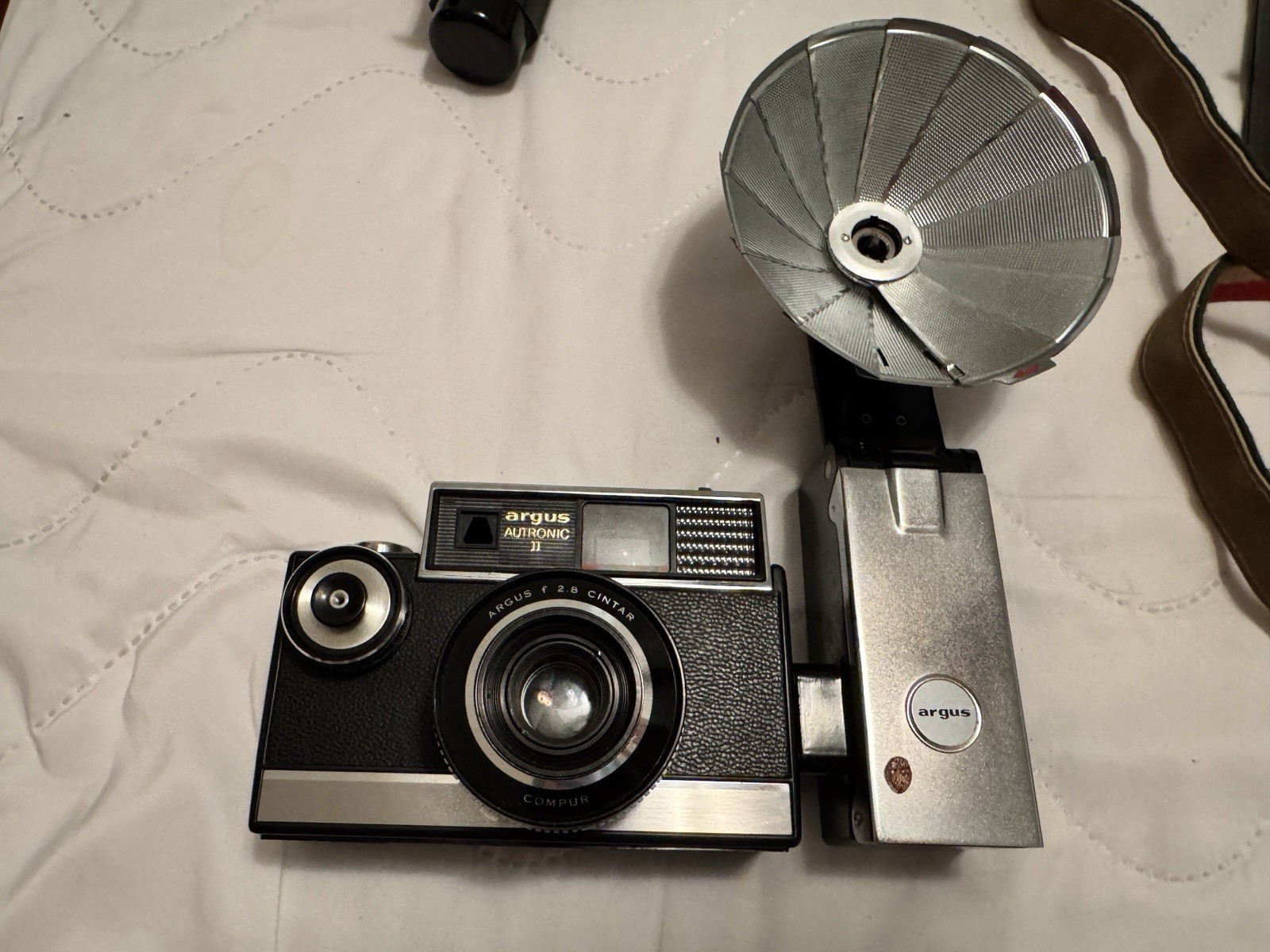
Argus Autronic I (circa 1962)
At 865 grams, it lands in your hands like a slab of mid-century ambition—solid, serious, and quietly promising automatic exposure in an era when most still wound their shutters by hand.
Overview
The Argus Autronic I isn’t a camera that whispers elegance—it announces itself with weight and a no-nonsense metal chassis, a 35mm rangefinder built during a pivotal shift in consumer photography. Marketed as a step into automation, it targeted amateurs who wanted to move beyond fumbling with manual settings but weren’t ready to pay for high-end German engineering. This is a fully automatic camera in the original sense: it sets the f-stop for you based on scene brightness, leaving shutter speed selection to the user within a fixed range. Despite its heft—865 grams—it doesn’t feel luxurious; instead, it conveys the solidity of a machine built to last, even if the experience of using it now feels dated. Manual focus is the only option, executed via a stiff but precise rangefinder patch, and the entire system hinges on the promise of simplicity. It wasn’t trying to be a Leica or a Nikon; it was trying to be the camera that made photography accessible without sacrificing too much control.
Owners report that the Autronic I occupies an odd niche: heavy enough to feel substantial, yet optically underwhelming by today’s standards. The lens, a fixed Argus Cintar 50mm, is part of what defines its character—neither rare nor particularly sharp, but representative of the cost-cutting optics common in American-made cameras of the early 1960s. It evolved from the legendary Argus C33 platform, but unlike its predecessor, it abandoned interchangeable lenses in favor of a sealed, automated design philosophy. That shift marked a turning point for Argus, moving away from modularity toward integrated systems aimed at the mass market. Whether that was progress or compromise depends on who you ask.
Specifications
| Manufacturer | Argus |
| Model | Autronic I Model 35156-M |
| Product Type | 35mm film rangefinder camera |
| Film Type | 35mm roll |
| Focus Type | Manual focus (only) |
| Lens | Argus Cintar 50mm f/2.8 |
| Shutter Speed Range | 1/30–1/500 second |
| Film Speed Range | ASA 10–400 |
| Body Material | metal |
| Weight | 865g |
Key Features
Fully Automatic Aperture Selection
The defining trait of the Autronic I is its “fully automatic” exposure system, which adjusts the lens aperture based on ambient light. Users set the film speed and select a shutter speed between 1/30 and 1/500, then point the camera—the internal meter (reportedly selenium-cell, though not confirmed in documentation) handles the rest. This was a significant selling point in 1962, positioning the Autronic I ahead of many manual contemporaries. However, the automation comes with limitations: no manual override, no aperture preview, and no battery backup (if indeed it uses no battery at all—this remains unverified). In practice, owners note that while convenient, the system can be inconsistent in low light or high-contrast scenes, where modern eyes might expect exposure compensation.
Fixed Argus Cintar 50mm f/2.8 Lens
The lens is a Cintar 50mm f/2.8, a coated triplet design manufactured in-house by Argus. While some sources list an f/3.5 variant, the most consistent documentation—including listings with serial verification—points to f/2.8 as the standard for the Autronic I. It’s a modest performer: sharp in the center at mid-apertures but soft toward the edges, with noticeable flare in backlight. It lacks the contrast and resolution of contemporary German or Japanese lenses, but it holds a certain charm—images have a soft, almost dreamlike quality that some modern shooters seek out intentionally. There’s no filter thread specified in confirmed documentation for the Autronic I (though the Autronic II had one), so attaching filters requires an adapter or lens hood workaround.
865g All-Metal Body
Weighing in at 865 grams, the Autronic I is substantial—more so than many rangefinders of its class. The metal body contributes to its durability, and collectors note that surviving examples often show less wear than plastic-bodied competitors from the same era. However, the weight also makes it less pocketable and more fatiguing for extended handheld use. The build reflects Argus’s transition from the modular C3 series to a more integrated, consumer-focused design. Buttons and dials are functional but not refined; the film advance lever is stiff, and the shutter release requires a firm press. It’s a camera that demands attention, not one that disappears into the background.
Historical Context
Introduced circa 1962, the Argus Autronic I was part of a short-lived four-year production run that included three other Autronic models. It represented Argus’s attempt to modernize its lineup in response to growing competition from Japanese manufacturers offering compact, automated cameras. Unlike the modular C33, which allowed lens changes and had a cult following among enthusiasts, the Autronic series locked users into a fixed-lens system with built-in automation. This shift alienated some traditionalists but appealed to a new generation of snapshot photographers. The Autronic I sat alongside models like the Autronic 35 and Autronic C3 in the product family, though its exact positioning—whether premium or entry-level—is not documented. By the mid-1960s, Argus’s influence was waning, and the Autronic line marked one of its final serious efforts in the 35mm rangefinder market.
Collectibility & Value
Today, the Argus Autronic I trades at modest prices, with recent examples listed between $18.00 and $59.90. Most appear on Etsy and eBay in “untested” condition, reflecting uncertainty about the longevity of the selenium meter and reliability of the shutter mechanism. While not rare, it’s also not common—complete, working units with clean viewfinders and smooth focus are harder to find. Collectors tend to view it as a transitional curiosity: interesting for its blend of automation and manual control, but not a performer on par with contemporary Japanese or European models. The consensus, as noted by one reviewer, is that it’s “beautiful to look at, but clunky to operate with soft lenses by modern standards.” Maintenance information is scarce, and replacement parts are not readily available, making functional restoration a challenge.
eBay Listings



As an eBay Partner, we earn from qualifying purchases. This helps support our independent vintage technology research.