Ansco No. 3A Folding Buster Brown
A postcard-format rollfilm folder from Binghamton, patented in 1912 - and one of the harder Buster Browns to pin down.
Overview
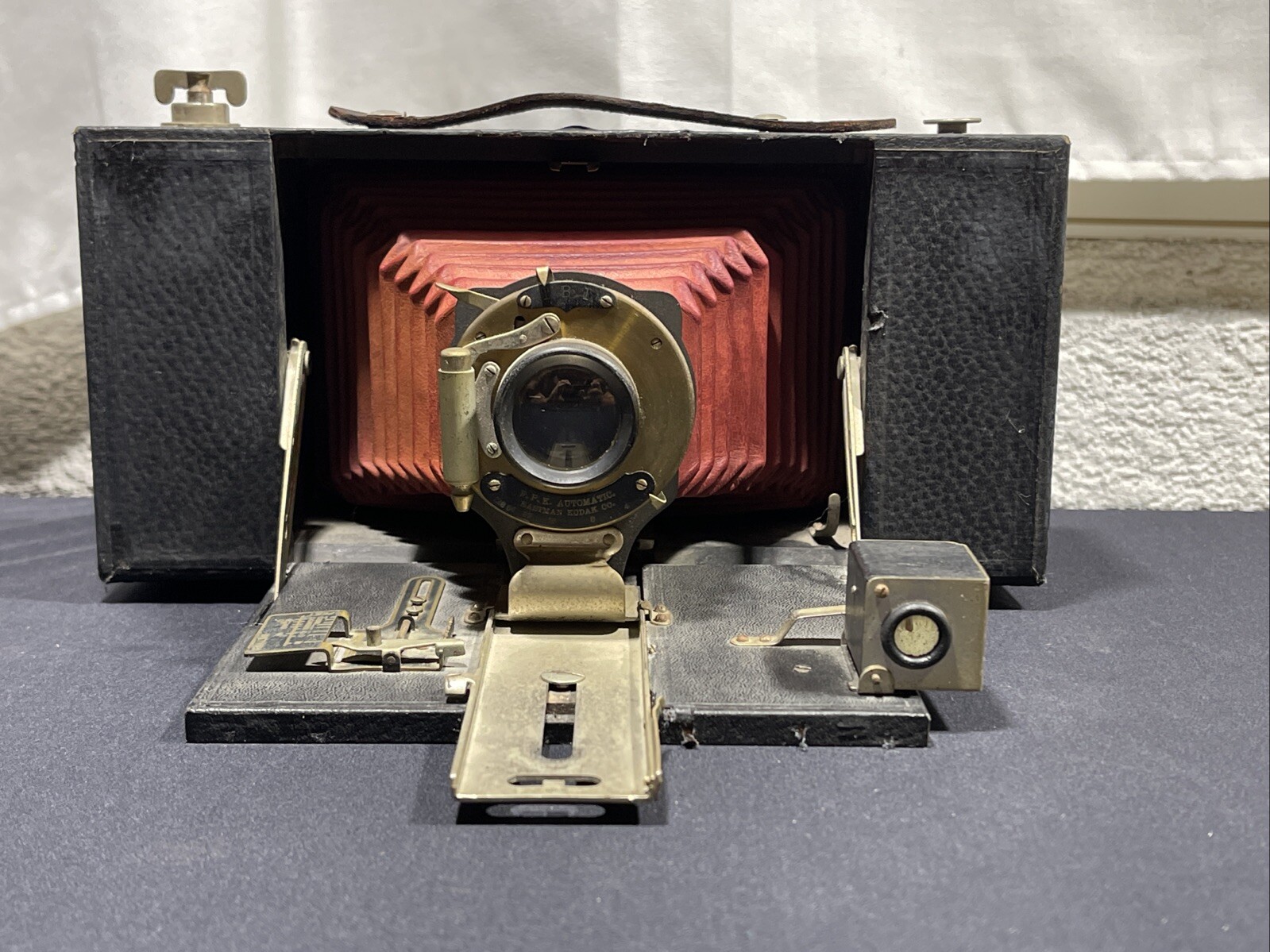
The Ansco No. 3A Folding Buster Brown is a large folding rollfilm camera built by Ansco, the American manufacturer based in Binghamton, New York. Listings and collector references most often call it a "large Postcard rollfilm camera." The film is 122, the long-running postcard-size rollfilm stock that gave you a contact print roughly the size of a postcard with no enlargement. The camera carries a Wollensak lens, and surviving examples are typically described as having black bellows. The patent date attached to the model in period listings is 1912, and "Circa 1912" is how most sellers date it.
One thing to flag up front. The No. 3A is not the same camera as the No. 2, No. 2A, No. 2C, or No. 3 Buster Browns, and the sources do not state an explicit family relationship between them. A period manual covering the Buster Brown line lists No. 2, No. 2A, No. 2C, and No. 3. The 3A is not among the models that manual covers. Be careful with any listing that blurs these together.
Key Features
122 Rollfilm and the Postcard Format
The defining trait of the No. 3A is its film. It is a 122 film camera, which puts it in the "large Postcard rollfilm" class. For a folder of this era, that meant negatives big enough that a contact print was already a finished, mailable object. No darkroom enlargement required.
Wollensak Lens
Surviving examples are described as carrying a Wollensak lens. That is all the sources establish. No focal length, no maximum aperture, and no further lens identification appear in the available documentation. Anyone checking a specific example should read the lens engraving directly rather than rely on a general claim about the model.
Black Bellows and the 1912 Color Change
Examples are described with black bellows, and one price-guide source notes that Ansco used red bellows until 1912, then black. If that holds, bellows color is a rough dating cue on a Buster Brown folder, with red pointing earlier and black pointing to 1912 and after. It is a single-source claim, so treat it as a rule of thumb.
Historical Context
Ansco's corporate history reaches back further than the name. The company was formed through a merger with E. & H.T. Anthony and the Scovill & Adams company in 1902. Its predecessor, the E. & H.T. Anthony Co., was the largest distributor of photographic supplies in the United States in the 19th century, a business that started in 1841 or 1842. One company history says the Ansco Company's story dates back to Daguerre. The No. 3A itself is tied to a 1912 patent date, which is also the circa date most sellers use.
Collectibility & Value
No. 3A listings turn up with the leather case included, and at least one has been offered as a one-owner "Original Owner" example. Condition varies. One surviving unit was described by its seller as "Exc- 89%. Generally clean, some wear on bellows & overall ageing," while another was simply listed as having a non-working shutter. No sold prices or dollar figures appear in the available research, so there is no reliable market value to quote. Given the age, expect bellows wear and shutter trouble to be the two things to inspect before buying. Confirm the lens engraving too, since the sources do not pin down the Wollensak fitment.
eBay Listings


As an eBay Partner, we earn from qualifying purchases. This helps support our independent vintage technology research.