Ansco Clipper (1930s–1950s)
At just 16 exposures per roll of 616 film, it demanded patience—but delivered square 2¼" negatives with surprising clarity.
Overview
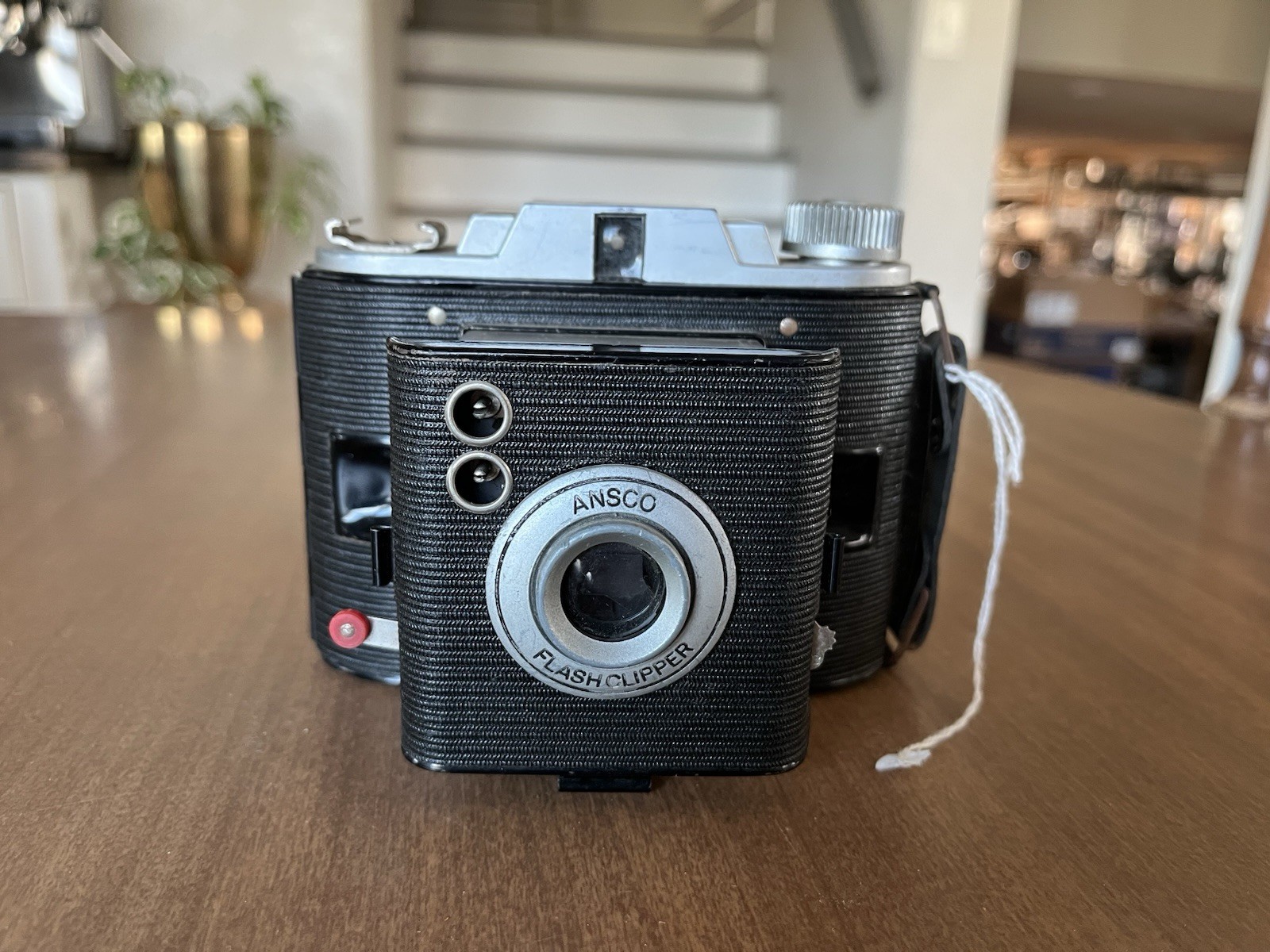
The Ansco Clipper isn’t a camera for the technically restless. It’s a machine built for simplicity, aimed squarely at the amateur who wanted to point, shoot, and forget. Manufactured by Agfa-Ansco and later simply Ansco of Binghamton, New York, the Clipper line entered production in the mid-1930s and stayed in circulation through the 1950s, a testament to its no-frills durability. Marketed under various names—Ansco Flash Clipper, Ansco Clipper 16, PD-16 Clipper, and Agfa Ansco Clipper—it was essentially a rebadged evolution of the Agfa PD16 Clipper, stripped of German branding but retaining the same core design. This was mass-market photography at its most accessible: fixed focus, fixed exposure, and entirely non-adjustable.
Owners report it as a true point-and-shoot, with no aperture control, no focus ring, and no speed dial. The entire experience hinges on trusting the engineering. According to the original manual, the camera was “scientifically designed that exceptionally fine results are easily” obtained—a bold claim for such a basic tool, yet one backed by the consistent square 2¼" negatives it produces. The Clipper Special, introduced around 1938–1940, stood as the top-tier model in the lineup, though collectors note it functions “the same as any standard Clipper camera.” Whether labeled Flash Clipper or PD-16, these were minor variants on a proven formula: get the shot, don’t overthink it.
Specifications
| Manufacturer | Ansco (formerly Agfa-Ansco) |
| Product type | Simple non-adjustable camera |
| Film format | Standard no. 616 roll film |
| Image size | 2 1/4" square |
| Lens | Fixed focus Unifo Double Lens |
| Shutter | 2-position shutter I. & B. (Instantaneous and Bulb) |
| Model number | JN 168 |
| Accessory case | Ansco Clipper Eveready Case, JN 133 |
Key Features
Fixed Focus Unifo Double Lens
The lens is a fixed focus meniscus type, branded as the Unifo Double Lens—a simple optical design that relies on depth of field and small aperture to keep subjects in acceptable focus. There’s no focusing mechanism, no adjustment, no fine-tuning. It’s a lens built for daylight snapshots, not precision. Yet, in the hands of users, it consistently produces sharp-enough 2¼" square negatives when used in good light, a credit to the “scientific design” touted in the manual.
2-Position Shutter I. & B.
Shutter control is reduced to two settings: I (Instantaneous) and B (Bulb). The instantaneous setting fires the shutter at a single, fixed speed—exact duration undocumented. The bulb setting allows unlimited exposure time as long as the sliding release is held, useful for night shots or low-light scenes with a tripod. Activation is manual, via a sliding lever, requiring a deliberate motion that doubles as a self-timer of sorts—no rush, no snap.
Ansco Clipper Special as Top Model
and while collectors confirm it “works the same as any standard Clipper camera,” its status as the top model suggests minor refinements—perhaps better finish, included case, or packaging—though no technical upgrades are documented.
Historical Context
The Clipper line debuted in the mid-1930s, a period when roll film cameras were becoming household items. Originally based on the Agfa PD16 Clipper, the Ansco version emerged as a rebranded, American-market alternative after Agfa-Ansco shifted branding. By the late 1940s—around 1947, according to owner accounts—the camera was still in production, reflecting its enduring appeal as a low-cost, reliable snapshot tool. Its design philosophy prioritized accessibility over innovation, making it a staple of mid-century amateur photography.
Collectibility & Value
The Ansco Clipper trades quietly in the vintage camera market, rarely commanding high prices. A 2003 price guide listed a “B” condition example at $22, and recent sale listings show complete units—camera, box, and booklet—going for $24.97. One owner reported purchasing a working Clipper for $20, underscoring its status as an affordable entry into 616 film photography. While not rare, complete sets with original accessories are valued by collectors of mid-century American cameras. No data exists on common failures or maintenance issues, though the simplicity of the design suggests reliability if stored properly.
eBay Listings


As an eBay Partner, we earn from qualifying purchases. This helps support our independent vintage technology research.