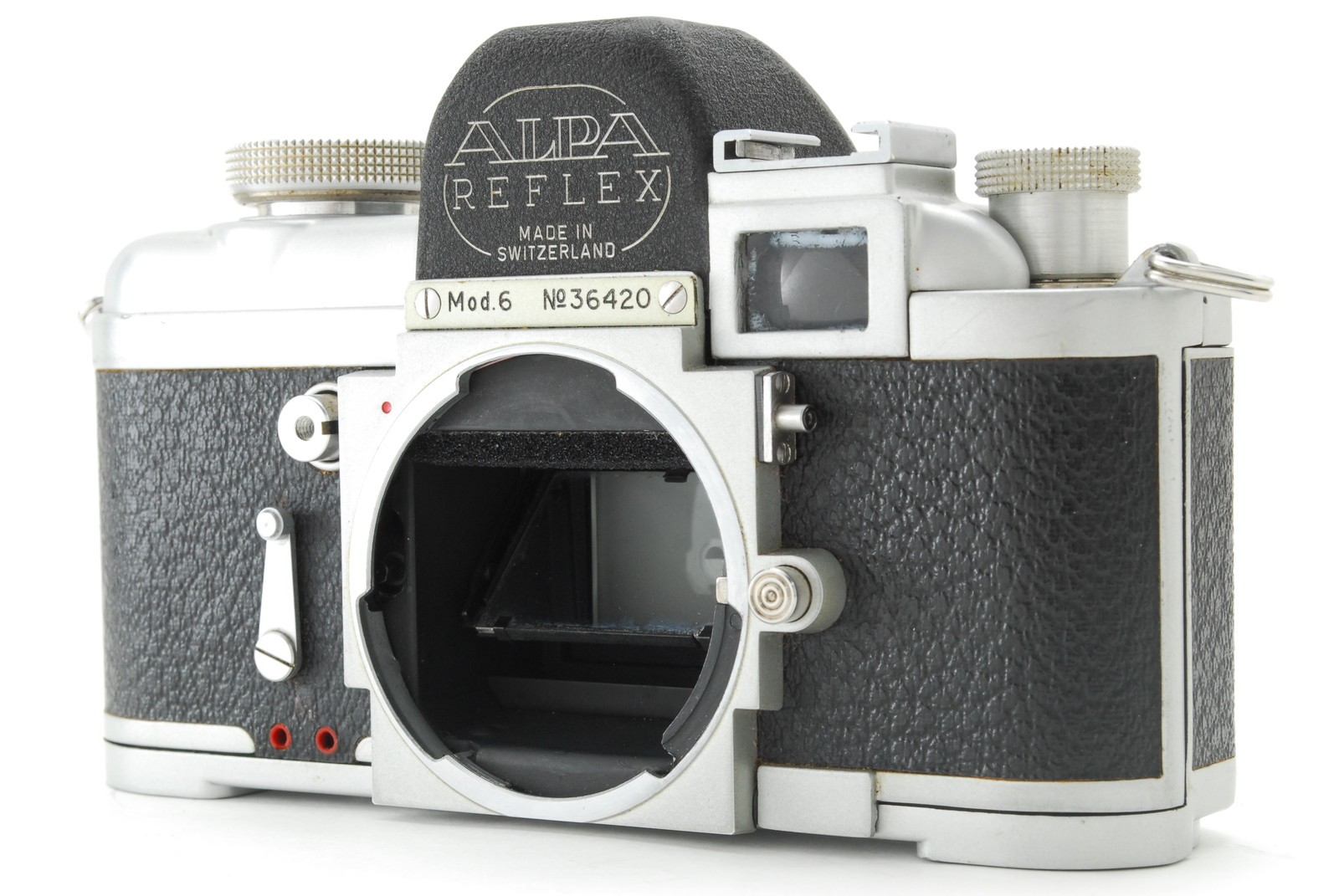
Alpa Reflex modèle 6 (1956–1959)
It doesn’t beg for attention—just quietly outperforms everything around it, like a Swiss watch with a shutter release.
Overview
The Alpa Reflex modèle 6—also known as the Alnea/Reflex model 6—wasn’t built to impress the masses. This 35mm SLR, manufactured by Pignons S.A. from 1956 to 1959, was engineered for a rare breed: photographers who valued mechanical perfection above all else. It found its audience among professionals willing to pay handsomely for absolute precision, and it delivered with a build quality that still feels obsessive today. As part of the second generation of Alpa 35mm cameras, the model 6 arrived after the debut of the 4, 5, 7, and 8 in 1952, but it’s the one where the series truly hit its stride—refining earlier concepts into something closer to mechanical art.
There’s no plastic here, no cost-cutting shortcuts. Every piece was machined from solid brass and chrome-plated, then assembled with the care you’d expect from a Geneva watchmaker. The camera operates entirely mechanically, with a focal plane shutter that runs from 1 second to 1/1000th and B, synchronized for flash at 1/60th. It lacks a winding lever—the kind that would later appear on the 6b—so you’re advancing the film by hand, which slows you down in the best way. This isn’t a camera for snapping quick shots; it’s for composing them, carefully, deliberately. And when you do press the shutter, it feels like turning a bank vault dial: every click has weight, every movement is precise.
Specifications
| Manufacturer | Pignons S.A. |
| Type | 35mm SLR camera |
| Years Produced | 1956–1959 |
| Body Material | magnesium alloy |
| Viewfinder | reflex finder at 45º; a second optical viewer is located under the flash shoe |
| Shutter Type | focal plane shutter (curtain type) |
| Shutter Speeds | 1 second to 1/1000th of a second and B |
| Flash Synchronization | at 1/60th |
| Winding Mechanism | There isn’t yet a winding lever; this won’t arrive until the model 6b. |
| Self-Timer | present |
| Self-Timer Delay | up to 15 seconds |
| Lens Mount | bayonet mount |
| Lens Compatibility | Lenses must be fitted with a relay push-button mounted on a ring, in the style of the Exakta mount, to release the shutter while stopping down to a pre-set aperture. |
| Serial Number Range | serial number 38772 is one of the last of the 6s, which finished at s/n 39,000. |
| Pentaprism Viewfinder | yes |
| Soft Rubber Coated Eyepiece | yes |
| Finder Prism View | gives a conventional straight-through view |
| Instant-Return Mirror | yes |
| Lens Stopdown Mechanism | relies on lenses including a PAD coupling arm |
| Back Focus | the thinnest of any 35 mm camera |
Key Features
Built like a timepiece, not a tool
Owners report the Alpa 6 feels more like a precision instrument than a camera. Machined from solid brass and chrome-plated, it carries the weight and solidity of something meant to last generations. The controls aren’t just functional—they’re satisfying. “Every dial clicks with the authority of a bank vault,” one collector noted, and that’s not exaggeration. The shutter release is smooth and deliberate, the film advance requires effort, and the self-timer winds with a quiet resistance that suggests internal gears calibrated to Swiss standards. This is a camera designed and assembled with the genius and precision of Swiss watchmakers, and it shows in every interaction.
Optical brilliance with a twist
The viewfinder is a standout: a pentaprism system that delivers a bright, life-size image with a natural 45° viewing angle. It includes a split-image focus aide integrated into the ground glass, combining SLR accuracy with rangefinder-like precision. But it’s not just the main finder that matters—there’s a second optical viewer tucked under the flash shoe, allowing for rapid framing without engaging the reflex mirror. It’s a small detail, but one that reveals Alpa’s obsession with usability. The prism gives a conventional straight-through view, and the soft rubber eyepiece seals out stray light without crushing your brow. And thanks to the instant-return mirror, you never lose sight of your subject after the shot.
Lens system built for adaptability
Alpa didn’t make their own lenses, but they sourced from the best: Angenieux, Kern, Kinoptik, Schneider, and others. What made the system special was its adaptability. The bayonet mount was designed so that adapters could be made for almost any other 35mm SLR—Exakta, M42, Nikon, Leicaflex, T-mount, Contax. The back focus was the thinnest of any 35mm camera, which made this possible without optical compromise. Lenses needed a relay push-button on a ring—like the Exakta system—to trigger the shutter while stopping down to a preset aperture, and they had to include a PAD coupling arm for proper stopdown operation. It’s a finicky setup by modern standards, but it worked, and it gave users unmatched flexibility.
Shutter that feels like silk
The focal plane shutter is where the Alpa 6 earns its reputation. Running from 1 second to 1/1000th and B, it’s regulated by a Swiss watch movement, making it one of the most vibration-free shutters ever fitted to a 35mm camera. The feel is “as smooth and precise as anything ever fitted to a 35mm camera,” according to longtime users. Flash sync at 1/60th isn’t fast by today’s standards, but it was reliable for both flashbulbs and electronic units, and the internal synchronization meant no guesswork with cables. The self-timer, with up to 15 seconds of delay, is fully mechanical and integrates seamlessly—no batteries, no failures.
Focusing and film handling: deliberate, not rushed
There’s no rangefinder coupled to the lens—focusing is done entirely through the SLR viewfinder. But the split-image prism makes it fast and accurate, especially when paired with high-contrast subjects. The camera lacks a winding lever, so film advance is manual and requires removing the back to load—a process that demands patience. But that’s part of the point. This isn’t a camera for street photography or action. It’s for studio work, architecture, technical imaging—where every frame matters and every setting is chosen with intent. The rapid gear rewind mechanism makes unloading smooth, and the entire system is built for repeatability and consistency.
Historical Context
The Alpa Reflex was born into a world already familiar with the German Kine Exakta, the pioneer of 35mm SLRs. While the Contax S, Praktica, and Edixa were still a few years off, Alpa wasn’t chasing trends—they were refining them. The second generation of Alpa cameras, including the model 6, debuted in 1952, but the 6 arrived shortly after the 4, 5, and 7, representing a maturation of the design language. It wasn’t trying to be the first with a pentaprism or the fastest shutter—it was trying to be the best-built, most reliable, and most precise. And in that narrow mission, it succeeded. Marketed to professionals who demanded mechanical perfection, the Alpa 6 never aimed for mass appeal. It was expensive, complex, and uncompromising—and that’s exactly why the right people loved it.
eBay Listings


As an eBay Partner, we earn from qualifying purchases. This helps support our independent vintage technology research.
Related Models
- Alpa Alnea 7 (1952)
- Alpa Alpa Prisma Reflex
- Alpa 10d (1959-1969)
- Alpa 11 (1967-1989)
- Alpa 7 (1949-1955)
- Agfa Agfaflex
- Agfa Ambiflex
- Agfa Easy
- Agfa Futura Af zoom
- Agfa Isoflash-Rapid C