ALPA 11
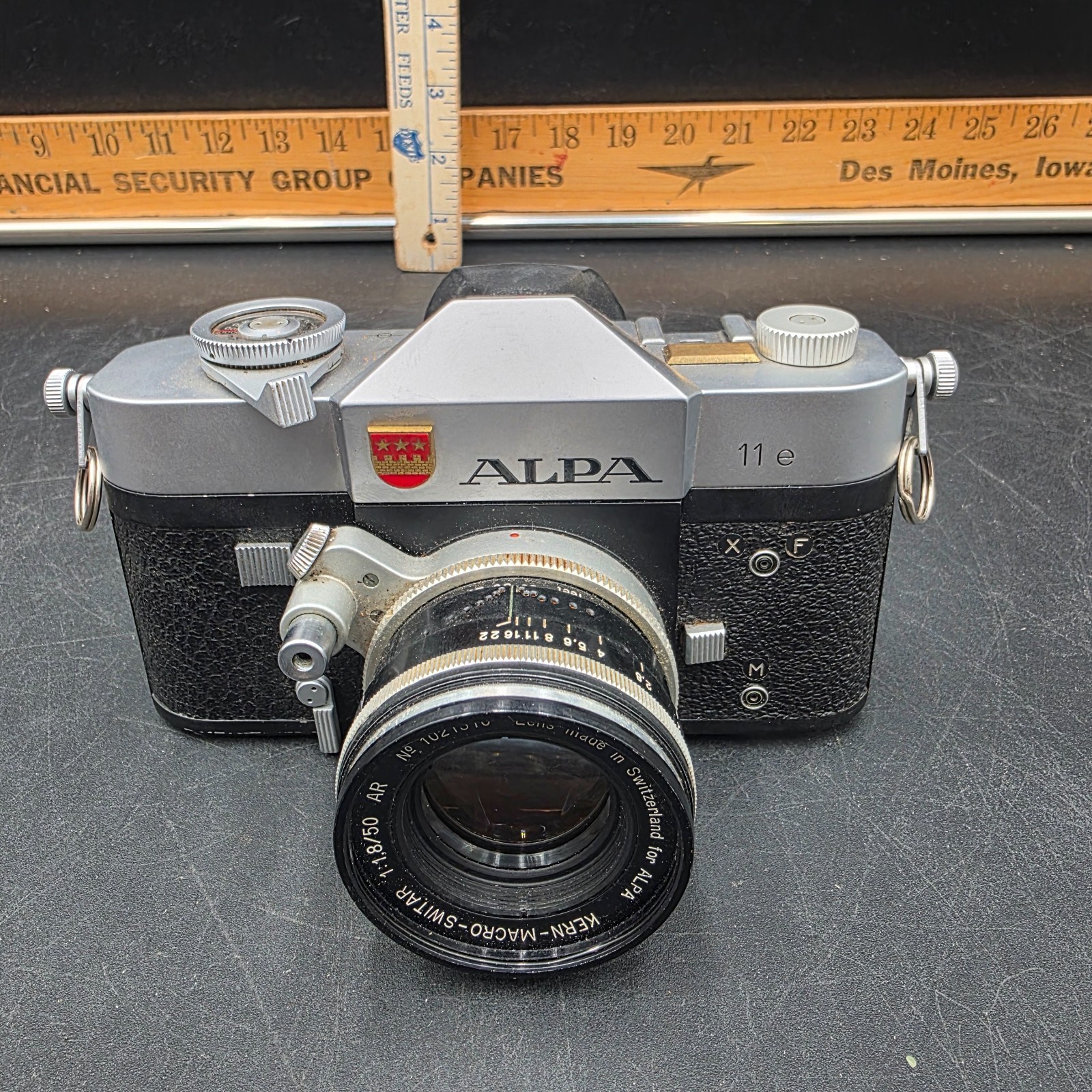
The Alpa 11 is the flagship 35mm single-lens reflex (SLR) camera produced by the Swiss precision engineering firm Alpa, representing the culmination of decades of optical and mechanical refinement. Designed for professional photographers and technical imaging specialists, the Alpa 11 combines modular construction, exceptional build quality, and advanced metering capabilities in a compact, system-oriented platform.
Overview
Introduced in 1967 and produced until 1989, the Alpa 11 succeeded the Alpa 10S and 10D models as the pinnacle of Alpa’s 35mm SLR line. Unlike mass-market SLRs from Japanese manufacturers, the Alpa 11 was engineered for precision, modularity, and long-term reliability, targeting high-end professional markets including architectural, industrial, and studio photography. Built entirely in Switzerland, the camera features a die-cast aluminum chassis, brass components, and meticulous hand assembly, reflecting Alpa’s reputation for engineering excellence.
The Alpa 11 was designed as a modular system camera, allowing interchangeable viewfinders, focusing screens, film backs, and motor drives. This flexibility enabled users to customize the camera for specific applications, from technical large-format-style work to high-speed photojournalism. Its compact size—unusual for a professional SLR of its era—belied its robust construction and advanced feature set. The Alpa 11 was not marketed for consumer appeal but rather as a precision instrument, comparable in philosophy to the Hasselblad 500 series or the Rolleiflex SL66, albeit in 35mm format.
One of the defining characteristics of the Alpa 11 is its integration of spot metering via a through-the-lens (TTL) silicon photodiode cell, a rarity among 35mm SLRs at the time. This feature, combined with its high-quality prisms and focusing screens, made the Alpa 11 particularly suited for controlled lighting environments where precise exposure control was critical. The camera was also notable for its quiet, reliable Copal Square shutter, which offered flash synchronization at all speeds—a significant advantage for studio work.
Specifications
| Specification | Value |
| Type | 35mm Single-Lens Reflex (SLR) |
| Film Format | 35mm (24x36mm) |
| Years Produced | 1967–1989 |
| Lens Mount | Alpa Bayonet Mount (proprietary) |
| Shutter | Vertical-travel, metal-blade Copal Square focal-plane shutter; 1 sec to 1/1000 sec, plus B |
| Flash Sync | X-sync at all shutter speeds, 1/60 sec minimum sync speed |
| Metering | TTL center-weighted spot metering (1° angle) via silicon photodiode |
| Exposure Modes | Manual only |
| Viewfinder | Interchangeable pentaprism or waist-level finder; fixed ground glass screen with microprism and split-image rangefinder |
| Focusing Screen | Interchangeable (multiple types available) |
| Film Advance | Manual lever (90° throw), frame counter |
| Self-Timer | Optional accessory (external) |
| Battery | Two 1.35V PX625 mercury batteries (for meter only) |
| Dimensions | 140 mm (W) × 90 mm (H) × 50 mm (D) |
| Weight | Approx. 780 g (body only, without battery) |
Key Features
- TTL Spot Metering: One of the first 35mm SLRs to offer true 1° spot metering via a dedicated silicon photodiode, enabling precise exposure readings in high-contrast scenes.
- Modular Design: Fully interchangeable viewfinders, focusing screens, and film backs allowed for system customization akin to medium format technical cameras.
- Copal Square Shutter: High-quality, reliable vertical-travel metal shutter with all-speed flash sync, reducing flash shadowing and enabling creative lighting setups.
- Precision Swiss Engineering: Hand-assembled in Switzerland with brass and aluminum components, ensuring long-term durability and mechanical accuracy.
- Proprietary Lens System: Optimized for Alpa’s own high-performance lenses, including the Rodenstock and Kern series, known for their sharpness and color correction.
Historical Context
The Alpa 11 was launched during a transformative period in 35mm photography, as Japanese manufacturers like Nikon, Canon, and Minolta were rapidly expanding their professional SLR offerings with electronic automation and mass production. In contrast, Alpa positioned the 11 as a boutique alternative—mechanical, modular, and built to last. It was not intended to compete on features like auto-exposure or motorized film advance, but rather on precision, ergonomics, and optical performance.
The camera found a niche among photographers who valued exacting standards over convenience, particularly in architectural and technical fields where repeatable accuracy and lens quality were paramount. Competitors included the Leica R3 (introduced in 1976), the Nikon F2, and the Topcon RE Super, though the Alpa 11 distinguished itself through its compact size, superior build, and spot metering capability. Despite its high price and limited distribution, the Alpa 11 earned a loyal following among discerning professionals, particularly in Europe and North America.
Collectibility & Value
Today, the Alpa 11 is a sought-after collector’s item, prized for its rarity, craftsmanship, and historical significance. Fewer than 10,000 units were produced over its 22-year production run, and complete systems with original lenses and accessories command premium prices at auction. In good working condition, a body-only Alpa 11 typically sells for $1,200–$2,000, while full kits with rare lenses like the Rodenstock-Heligon 50mm f/2 or the Kern Switar 100mm f/2.8 can exceed $5,000.
Collectors should inspect for shutter accuracy, mirror movement smoothness, and meter functionality—original PX625 batteries are obsolete, so retrofitting with modern alternatives (e.g., Wein Cell or adapters) is often necessary. Common issues include degraded light seals, stiff film advance levers, and worn leatherette. Due to the proprietary nature of the system, repair parts are scarce, and expertise is limited to a few specialized technicians in Switzerland and the U.S.
Similar Cameras
- Hasselblad ELX – Medium format SLR with modular design and high precision, though larger and heavier.
- Leica R3-R5 – Mechanically robust 35mm SLRs with German engineering, but less modular than the Alpa 11.
- Topcon RE Super – Japanese-made professional SLR with excellent optics and build, featuring TTL metering.
- Nikon F2 – Legendary Nikon SLR with interchangeable viewfinders and rugged construction, widely used by photojournalists.
- Rolleiflex SL35 – Compact German SLR with high-quality Zeiss optics, though less customizable than the Alpa system.
Repair & Maintenance
The Alpa 11 uses two PX625 1.35V mercury batteries for its spot meter, which are no longer manufactured. Modern replacements include zinc-air batteries (e.g., Wein Cell MRB625) or voltage adapters using 1.5V silver oxide batteries, though calibration may be required. The Copal Square shutter is generally reliable but should be serviced every 5–10 years to maintain timing accuracy. Common maintenance issues include sticky shutter curtains, worn film pressure plates, and degraded light seals. Due to the camera’s complexity and proprietary components, repairs should be performed by technicians experienced with Alpa systems—recommended services include Alpa AG (Switzerland) and specialized vintage camera repair shops in the U.S. and Germany. Regular cleaning, lubrication, and calibration are essential for long-term functionality.
eBay Listings


As an eBay Partner, we earn from qualifying purchases. This helps support our independent vintage technology research.
Related Models
- Alpa 6 (1948-1953)
- Alpa Alnea 7 (1952)
- Alpa Alpa Prisma Reflex
- Alpa 10d (1959-1969)
- Alpa 7 (1949-1955)
- Agfa Agfaflex
- Agfa Ambiflex
- Agfa Easy
- Agfa Futura Af zoom
- Agfa Isoflash-Rapid C