Agfa Super Isolette (1954–1960)
German-made 6×6 medium format folding camera with coupled rangefinder and 75mm f/3.5 Solinar lens.
Overview
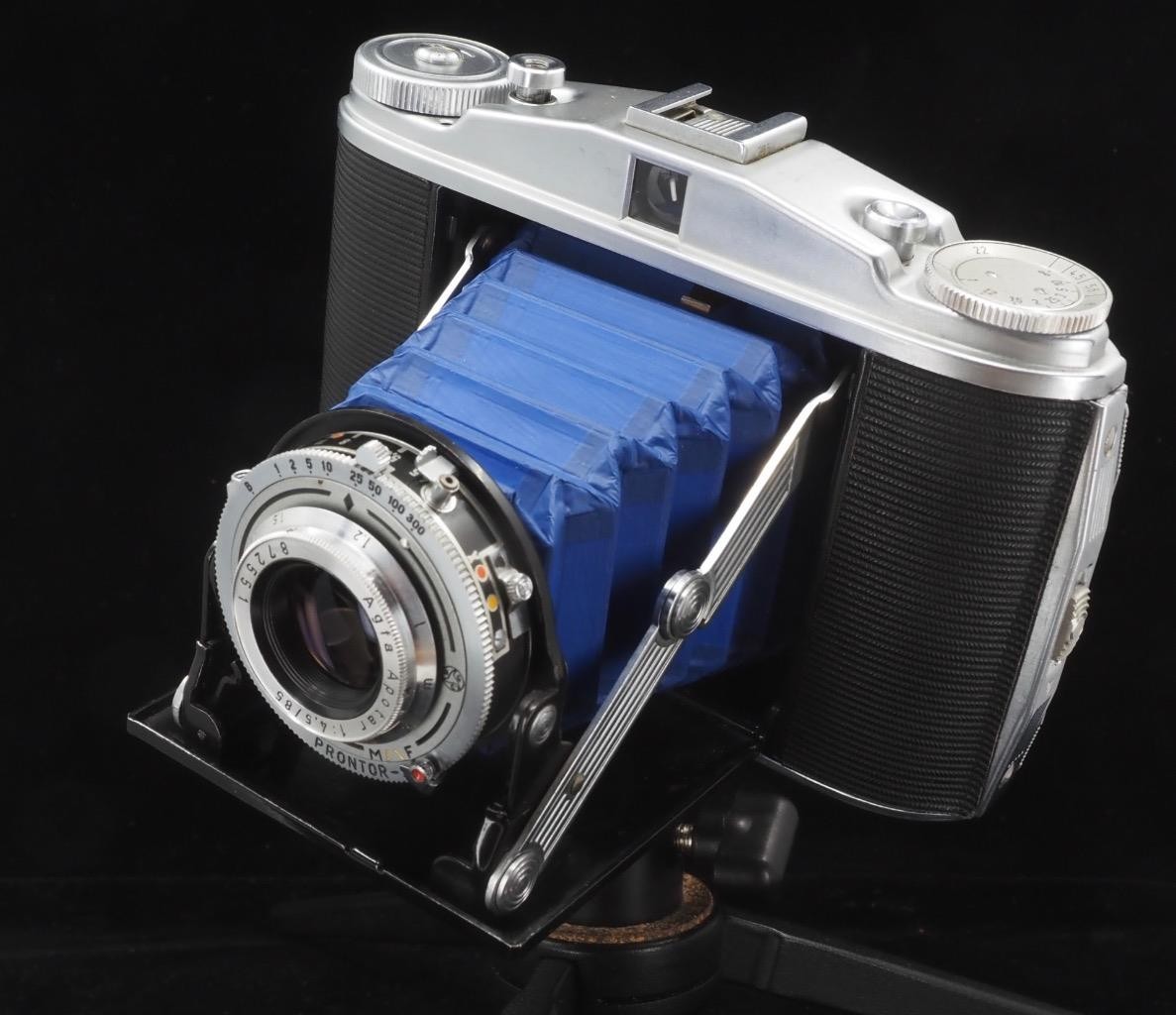
The Agfa Super Isolette, also sold as the Agfa Super Speedex and Ansco Super Speedex, is a 6×6 cm medium format folding camera produced in Berlin, Germany from 1954 to 1960. It was Agfa’s top-of-the-line folding camera, positioned as the finest of its type and surpassed only by the later Agfa Automatic 66. The camera features a coupled rangefinder, unit focusing via helicoid, and an all-metal body with leatherette covering. It uses 120 roll film to produce twelve 6×6 cm exposures. The Super Isolette was the flagship of the Isolette series, evolving from earlier models like the Isolette III, and is mechanically and materially superior to standard Isolette and Speedex variants.
Specifications
| Film Format | 120 roll film, 6×6 cm (12 frames) |
| Lens | 75mm f/3.5 Agfa Solinar, 4-element, 3-group anastigmat (Tessar-type), single coated |
| Aperture Range | f/3.5 to f/22, stop-down to ~f/45 |
| Shutter | Synchro-Compur MX (early) or MXV (later, ~s/n 7xxx+), 1–500, B, X/M sync |
| Focus | Coupled rangefinder, unit focus, 3.3 ft (1 m) minimum |
| Weight | 837g (29.5 oz) loaded |
| Filter Size | 29.5mm screw-in or 32mm push-on |
| Viewfinder | Reverse-Galilean with central rangefinder patch, no framelines or parallax correction |
| Flash Sync | PC terminal, X and M sync at all speeds |
| Self-Timer | Present on later models (V setting), ~8-second delay |
Design
The Super Isolette features a semiautomatic film loading system with a geared mechanism that senses film and advances to the first frame without a red window. The film advance knob is on the right side of the top housing, and a knurled disc on the left side serves as a film-type and lighting condition reminder (R/N and D/T). It includes double-exposure prevention via an interlock visible in an indicator window near the shutter release. The lens uses a push-rod coupled to the rangefinder for precise focusing, and the entire lens assembly moves via helicoid. The cloth bellows are covered in leather and are more difficult to replace than on standard Isolette models. The body has metal film bearings and a pressure plate on the back cover. The 10-bladed aperture produces smooth bokeh, and the lens can be disassembled and relubricated.
Context
Agfa produced the Super Isolette to promote sales of Agfa film, positioning it as their premier folding camera. It competed with high-end models like the Zeiss Super Ikontas, Certo6, and Zeiss Ikon Super Ikonta 530/532. Despite its quality, sales were limited by the growing popularity of 35mm cameras. The design inspired the KMZ Iskra in the Soviet Union. As the culmination of the post-war Isolette line—based on the pre-war Isolette—it represented the peak of Agfa’s folding camera engineering.
Market
Originally priced at approximately $150, the Super Isolette had a market value of $400–$450 USD around 2015. It is relatively uncommon today and often requires servicing. Common issues include stuck focus rings due to hardened grease, shutter malfunctions, and light leaks from deteriorated bellows. The Synchro-Compur shutter is generally robust and can typically be restored with cleaning. The Solinar lens may develop a "cloudy rear doublet," but when in good condition, delivers sharp images across the frame, even wide open. The film advance is exceptionally smooth when maintained.
eBay Listings


As an eBay Partner, we earn from qualifying purchases. This helps support our independent vintage technology research.