Agfa Standard (1926–mid-1930s)
A metal-bodied folding camera introduced by Agfa in 1926, available in multiple formats for plates and roll film.
Overview
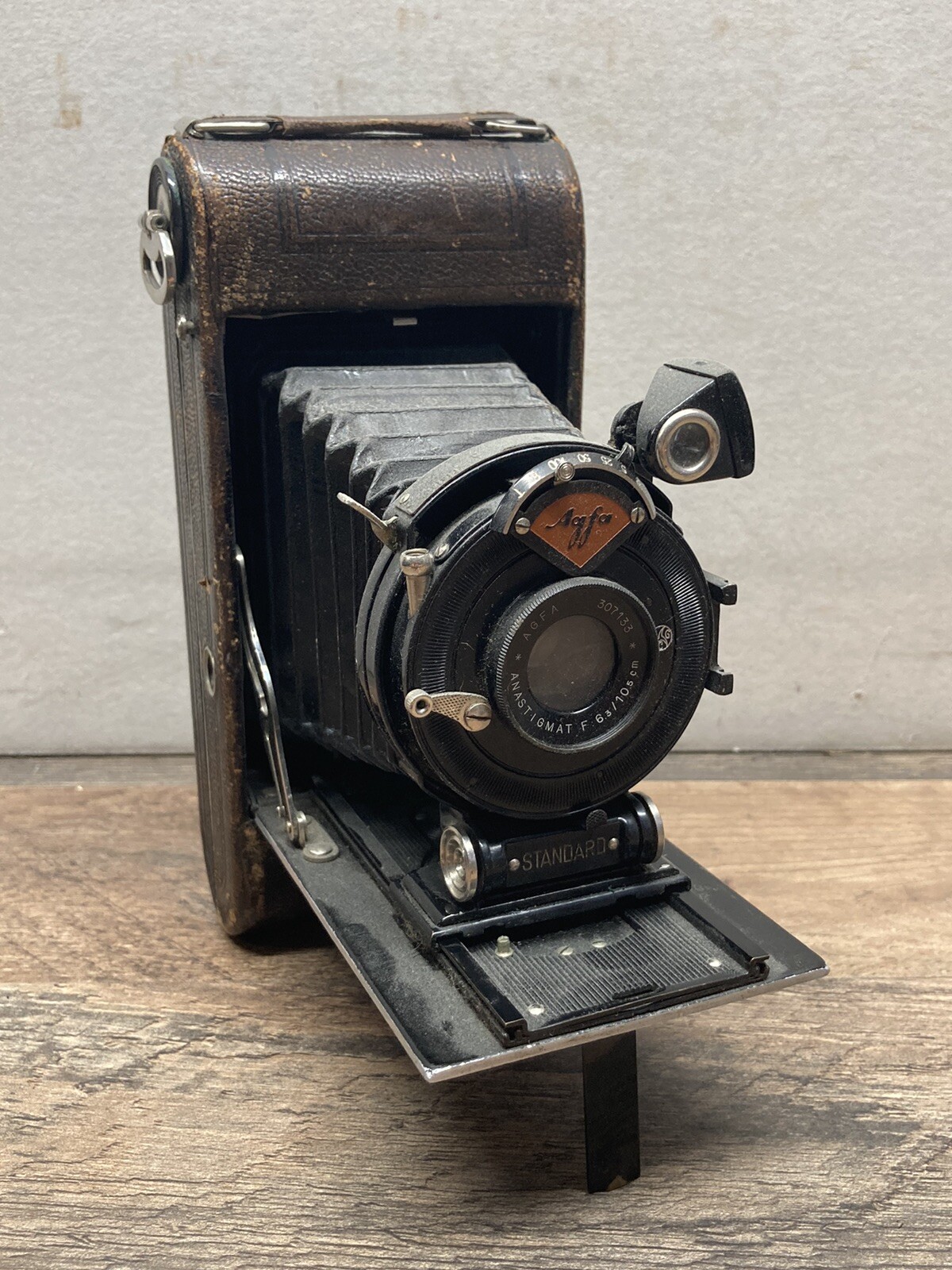
The Agfa Standard was the first new camera model released by Agfa after acquiring the Munich-based Rietzschel camera works in 1925 as part of the IG Farben merger. Production began around 1926, with the design originating from a patent filed under Rietzschel (BP 270623/1926). The Standard line included models for both plate and roll film, with formats spanning 6.5×9 cm and 9×12 cm plates, as well as 120 and 116 roll film. Models such as the 204, 208, 254, 255, and 258 were offered, each tailored to specific film types and frame sizes. The camera featured a helical focusing mechanism that moved the lens and shutter as a unit, with focus down to about 2 meters on many models. It was constructed with a metal body covered in leather, leather bellows, and included both a wire frame finder and a rotating brilliant viewfinder. Film advance was indicated by a uniquely square red window, not coupled to the shutter.
Specifications
| Format | 6.5×9 cm or 9×12 cm plates; 120 or 116 roll film (models 254, 255, 258, 204, 208) |
| Film Type | Roll film 120 (model 254), 116 (models 255, 258); plates (models 204, 208) |
| Lens | Trilinear Agfa Anastigmat f/4.5 or f/6.3, 10.5 cm or 13 cm focal length |
| Shutter | Gauthier Automat (1/2 – 1/100, B, T) or Compur (1 – 1/250, B, T, with self-timer) |
| Aperture Range | f/4.5 to f/32 or f/36, with continental f-stop markings (9, 12.5, 18, 25) |
| Focusing | Helical unit focus down to 2 meters (approx. 6.5 feet), or 6 feet (1.8 meters) on some models |
| Viewfinder | Rotating brilliant finder and wire frame finder; split-image rangefinder on 1930 rangefinder model |
| Construction | Aluminium body, leather covering, leather bellows |
| Original Price | £4.17.6 (circa 1928) |
Design
The Agfa Standard features unit focusing via a helical mechanism that moves the entire lens and shutter assembly forward. The lens is mounted on a cast metal block without rise or shift. Spool holders hinge out of the body for easy loading, and the camera includes standard tripod fittings for both orientations. The red window is uniquely square. On the 1930 rangefinder model, the split-image rangefinder uses a single front window with the eyepiece offset, requiring the user to view both directly and through the optics for alignment. The shutter housing doubles as the focusing unit, and the lens construction is described as simple, with only two glass elements. The Gauthier Automat shutter is made of thin foil-like material, and there is no double-exposure prevention mechanism.
Context
The Agfa Standard was the first camera developed under the Agfa name after the company absorbed Rietzschel’s camera operations in 1925. While earlier Rietzschel models like the Isolar and Ninon were continued, the Standard was Agfa’s first original design. It marked the company’s entry into the folding camera market with a range that spanned plate and roll-film formats, reflecting the transitional period in amateur photography. The 9×12 cm plate model 208 was discontinued earlier than the smaller roll-film variants.
Market
Common issues include stiff helical focusing due to dried lubricant, film flatness problems, light leaks from loose winding, and potential film marking from a protruding lens mount. Users are advised to advance film only with the camera open and lens erected to avoid damage. The camera lacks double-exposure prevention, requiring manual discipline.
eBay Listings


As an eBay Partner, we earn from qualifying purchases. This helps support our independent vintage technology research.
Service Manuals & Schematics
- Manual — archive.org