AGFA OPTIMA II
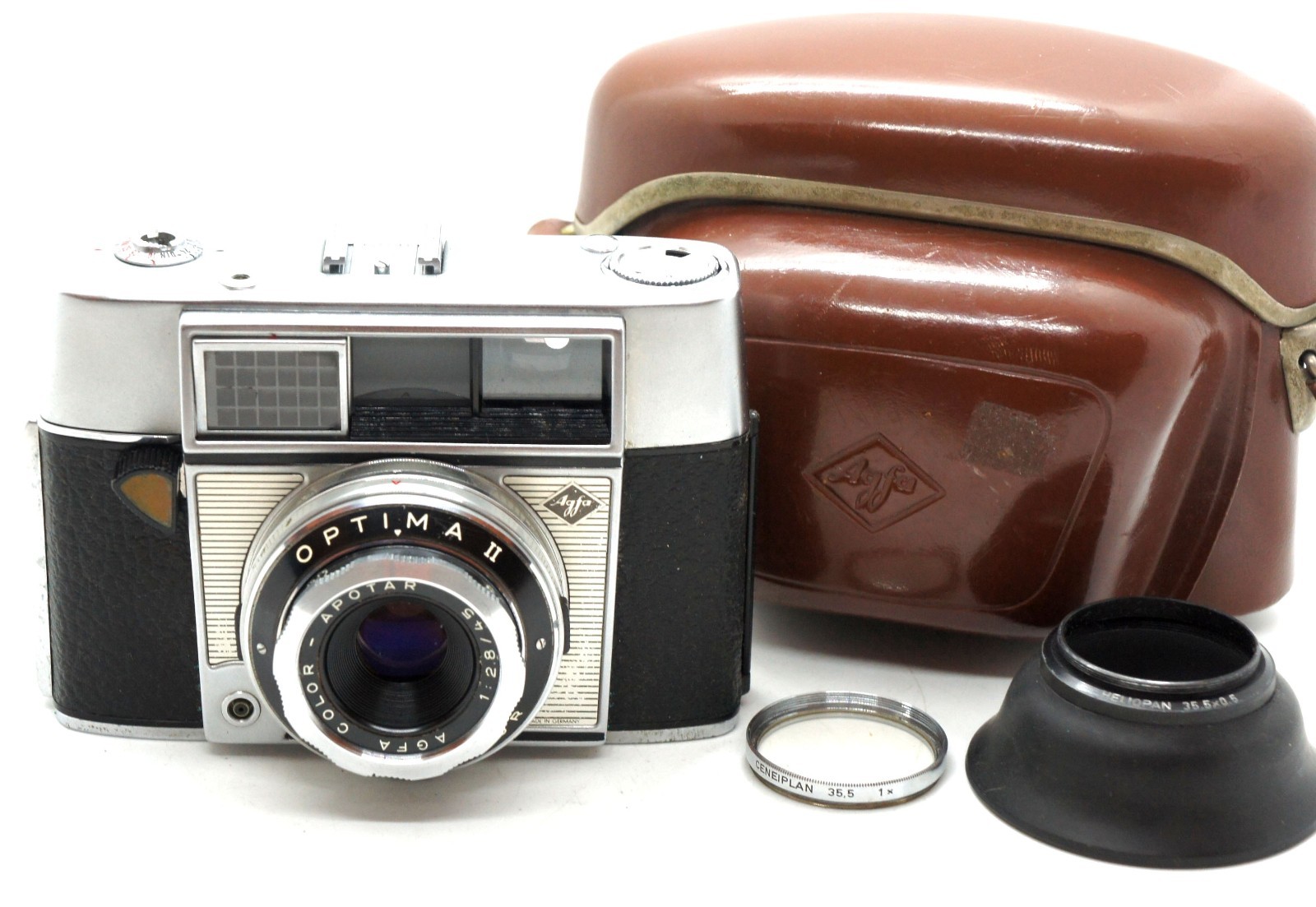
The Agfa Optima II is a compact, viewfinder-style 35mm camera introduced in 1962 as an updated version of the original Optima. It represents a significant step in Agfa’s transition toward automated exposure control in consumer-level cameras, combining precision engineering with user-friendly operation.
Overview
Released during a period of rapid innovation in consumer photography, the Agfa Optima II was designed to appeal to amateur photographers seeking ease of use without sacrificing image quality. It succeeded the original Optima (1958–1962) and built upon its foundation by refining the automatic exposure system and improving mechanical reliability. Unlike fully manual cameras of the era, the Optima II featured a selenium-cell metering system that automatically set the shutter speed based on scene brightness, requiring the user only to focus and set the film speed. This semi-automatic approach placed it at the forefront of "point-and-shoot" technology in the early 1960s.
The camera was marketed as a premium compact 35mm model, emphasizing its elegant design, German engineering, and integration of advanced exposure automation. It was part of Agfa’s broader strategy to compete with Japanese manufacturers like Canon and Minolta in the growing amateur market. The Optima II was produced at Agfa’s Leverkusen, West Germany factory and was distributed internationally, often with regional variations in branding and trim. Its sleek die-cast aluminum body, leatherette covering, and minimalist controls reflected contemporary mid-century industrial design principles.
Positioned between basic box cameras and professional rangefinders, the Optima II fit into Agfa’s lineup as a high-end compact offering—above models like the Agfa Clack but below the more sophisticated Agfa Rapid series. It was succeeded in 1968 by the Optima Compact and later by the Optima Sensor line, which introduced CdS metering. Despite its lack of manual exposure override, the Optima II gained a reputation for consistent exposure accuracy in typical daylight conditions, making it a favorite among casual photographers and travelers.
Specifications
| Specification | Value |
| Type | Viewfinder Camera |
| Film Format | 35mm (135 cartridge) |
| Years Produced | 1962–1968 |
| Lens Mount | Fixed lens (non-interchangeable) |
| Shutter | Compur-Matic leaf shutter, speeds from 1/30 to 1/500 sec + B; auto mode (1/30 to 1/500) controlled by selenium meter |
| Lens | Agfa Solinar 45mm f/2.8 (4 elements in 3 groups) |
| Aperture Range | f/2.8 to f/16 (manually set) |
| Focus | Zone focus with distance scale (3 ft to ∞), preset via viewfinder parallax mark |
| Metering | Selenium-cell exposure meter (no battery required), center-weighted |
| Exposure Modes | Aperture-priority automatic (shutter speed selected by meter), manual shutter speed selection (1/30–1/500), Bulb |
| Viewfinder | Combined optical viewfinder and exposure indicator; includes parallax correction marks |
| Film Speed Range | ASA 10–400 (manually set via film speed dial) |
| Flash Sync | Yes, PC terminal and hot shoe (X-sync only), 1/30 sec sync speed |
| Dimensions | 120 mm (W) × 70 mm (H) × 50 mm (D); approx. 520 g (with lens cap) |
| Power Source | None (selenium meter requires no battery) |
Key Features
- Aperture-priority automatic exposure: The selenium meter automatically selects the correct shutter speed (1/30–1/500 sec) once the user sets the aperture and film speed.
- Fixed Agfa Solinar 45mm f/2.8 lens: A high-quality, coated lens known for sharpness and good contrast, optimized for the 35mm format.
- Battery-free operation: The selenium cell meter generates its own power, eliminating the need for batteries—a major advantage at the time.
- Integrated flash synchronization: Equipped with both a PC sync socket and a built-in hot shoe for external flash units.
- Ergonomic zone-focusing system: Simple distance-based focusing with clear markings, suitable for snapshots and street photography.
Historical Context
The Agfa Optima II was introduced at a pivotal moment in photographic history, as manufacturers sought to simplify camera operation for the expanding amateur market. In the early 1960s, 35mm photography was becoming increasingly popular due to advances in film sensitivity and miniaturization of camera components. Agfa, a major German chemical and imaging company, leveraged its expertise in film and optics to create cameras that complemented its photographic products.
The Optima II competed directly with models like the Kodak Retina IIIS, Zeiss Ikon Contaflex Super B, and emerging Japanese offerings such as the Minolta Hi-Matic. While not the first camera with automatic exposure, it was among the most refined in its class, offering reliable automation in a compact form. Its selenium meter, while prone to degradation over decades, was cutting-edge for consumer cameras in 1962. The lack of a battery requirement made it more convenient than later CdS-metered cameras that relied on increasingly hard-to-find mercury cells.
Market reception was positive, particularly in Europe and North America, where it was praised for its build quality and exposure consistency. However, by the late 1960s, Japanese manufacturers began to dominate the compact 35mm market with lighter, more compact designs and faster lenses. Agfa responded with further refinements, but the Optima II marked the peak of Agfa’s mechanical compact camera engineering before the shift toward plastics and electronics.
Collectibility & Value
Today, the Agfa Optima II is a sought-after model among collectors of vintage German cameras, particularly those interested in the evolution of automatic exposure systems. Well-preserved examples in working condition typically sell for $150–$300 USD, with higher prices for cameras that include original cases, manuals, or rare accessories. Fully functional selenium meters are increasingly rare, as the cells often degrade over time, leading to underexposure or complete failure.
When purchasing an Optima II, collectors should inspect the lens for haze, fungus, or separation, though the Solinar 45mm f/2.8 is generally robust. The shutter should be tested across all speeds, especially the automatic mode, to ensure the meter responds correctly to light changes. The focus linkage and aperture blades should move smoothly. Common issues include stiff film advance levers, light seals deterioration, and worn leatherette. Because the camera lacks a battery, testing the meter requires bright ambient light and a known-light meter for comparison.
Despite its age, the Optima II remains functional for film photography if properly maintained. Its all-mechanical design means no dependency on modern electronics, and the 45mm f/2.8 lens produces excellent results on modern ISO 100–400 films. It is particularly valued for street photography and travel use due to its compact size and quiet leaf shutter.
Similar Cameras
- Kodak Retina IIIC (1954–1960) – German-built, 35mm viewfinder with interchangeable lenses and coupled rangefinder.
- Minolta Hi-Matic (1962–1966) – Japanese-made, aperture-priority 35mm camera with selenium meter and 45mm f/2 lens.
- Canon Demi Rapid (1963–1968) – Compact 35mm half-frame camera with automatic exposure and CdS metering.
- Zeiss Ikon Contessa LK (1957–1964) – Budget-oriented 35mm viewfinder with automatic exposure and 45mm f/2.8 Tessar.
- Polaroid 1000 (1962) – Simpler selenium-metered 35mm camera, but without automatic shutter speed selection.
Repair & Maintenance
The Agfa Optima II requires no batteries, relying solely on its selenium-cell exposure meter, which can degrade over time due to moisture, prolonged exposure to light, or physical damage. Restoration of a non-functional meter is generally not feasible; however, the camera can still be used manually with a handheld light meter. Shutter servicing is recommended every 10–15 years for regular users, as the Compur-Matic leaf shutter contains fine springs and timing mechanisms that may drift with age.
Common maintenance tasks include replacing light seals (around the film door), cleaning the viewfinder prism, and lubricating the film advance and rewind mechanisms. The zone focus system is simple but may require adjustment if the distance linkage becomes loose. Due to the camera’s mechanical complexity and age, repairs should be performed by technicians experienced in vintage German cameras. Replacement parts are scarce, so preservation of original components is critical. Using the camera periodically helps prevent lubricant hardening and keeps mechanisms functional.
eBay Listings



As an eBay Partner, we earn from qualifying purchases. This helps support our independent vintage technology research.