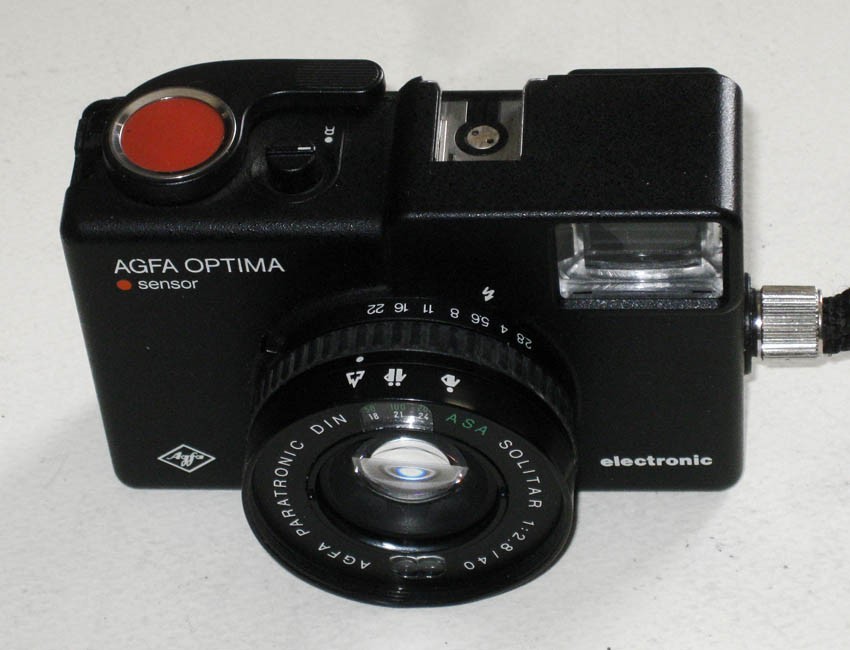
AGFA OPTIMA
The Agfa Optima is a landmark 35mm compact camera introduced in 1959, representing one of the first mass-market fully automatic 35mm cameras. Utilizing an innovative "traffic light" exposure system, it simplified photography for amateur users by automating exposure selection based on scene brightness.
Overview
Introduced in 1959, the Agfa Optima was a pivotal model in the evolution of consumer photography, bridging the gap between fully manual cameras and accessible point-and-shoot operation. Marketed primarily to amateur photographers and casual users, the Optima was designed to eliminate the complexities of manual exposure settings while maintaining high optical quality and mechanical reliability. It was part of Agfa’s broader strategy to expand its presence in the post-war consumer camera market, capitalizing on the growing popularity of 35mm film and the demand for user-friendly devices.
The Optima series was notable for its integration of a selenium-cell exposure meter linked directly to the aperture and shutter speed mechanisms, enabling fully automatic exposure without the need for batteries. This system, known as the "traffic light" indicator, used a moving needle or pointer aligned with red, yellow, and green zones in the viewfinder to indicate exposure—green for correct exposure, yellow for near-correct, and red for under- or overexposure risk. This intuitive feedback system was revolutionary for its time and contributed significantly to the camera’s popularity across Europe and North America.
The Optima line evolved over its production run from 1959 to 1968, with multiple variants including the Optima I, Optima II, and Optima Compact. The Optima Sensor is not a recognized model in the original series. Despite subtle differences in design and metering refinements, all shared the core principle of automation for ease of use. The camera typically featured a fixed 45mm f/2.8 Solinar lens (a high-quality lens co-developed with Schneider-Kreuznach), a leaf shutter with speeds from 1/30 to 1/500 second, and automatic coupling between shutter speed and aperture based on light conditions. Its die-cast metal body, leather covering, and minimalist controls reflected a balance of durability and elegance, making it a favorite among middle-class consumers seeking reliable performance without technical complexity.
Specifications
| Specification | Value |
| Type | Compact rangefinder-style viewfinder camera |
| Film Format | 35mm (135 cartridge) |
| Years Produced | 1959–1968 |
| Lens Mount | Fixed lens (non-interchangeable) |
| Lens | 45mm f/2.8 Solinar (4 elements in 3 groups) — lens co-developed with Schneider-Kreuznach |
| Shutter | Leaf shutter with speeds 1/30 to 1/500 sec in full stops; shutter speed selection is automatic and not user-selectable. No B setting on any standard Optima model. |
| Aperture Range | f/2.8 to f/16 (automatically selected) |
| Metering | Selenium-cell exposure meter with color-coded zone indicator (no battery required); needle points to red, yellow, or green zones in viewfinder |
| Exposure Modes | Fully automatic exposure; no manual aperture override on any model in the original Optima series |
| Viewfinder | Optical, coincident-image rangefinder coupled to focusing, with integrated exposure indicator |
| Focusing | Manual focus via front lens ring, coupled rangefinder |
| Flash Sync | PC sync terminal and hot shoe (X-sync only), flash sync at all shutter speeds |
| Film Speed Range | ASA 10–400 (manually set via dial on top plate) |
| Dimensions | Approx. 140 × 80 × 50 mm |
| Weight | Approx. 550 g (without battery; no battery required) |
Key Features
- Traffic Light Exposure System: A pioneering visual feedback mechanism using red, yellow, and green indicators in the viewfinder to guide exposure accuracy—no batteries required due to selenium cell power.
- Fully Automatic Exposure: The camera automatically selects both shutter speed and aperture based on scene brightness, eliminating the need for manual calculation.
- High-Quality Fixed Lens: The 45mm f/2.8 Solinar lens delivers sharp, contrast-rich images with smooth bokeh, comparable to lenses found on higher-end rangefinders.
- Rangefinder Focusing: Integrated coincident-image rangefinder ensures precise manual focus, a rarity in automatic consumer cameras of the era.
- Durable Construction: Die-cast metal chassis with leatherette covering and precision mechanical shutter ensures longevity and resistance to everyday wear.
Historical Context
The Agfa Optima was introduced during a period of growing accessibility in 35mm photography. In the late 1950s, 35mm photography was rapidly shifting from a specialist domain to a mainstream consumer activity. Companies like Kodak, Canon, and Zeiss-Ikon were introducing simpler cameras, but few offered true automation. Agfa, leveraging its expertise in film and optics, positioned the Optima as a premium yet accessible option for the modern amateur. Its debut in 1959 coincided with the rise of color film and family snapshot culture, making automatic exposure a compelling selling point.
The Optima faced competition from cameras like the Kodak Retina IIIc (manual), the Zeiss Ikon Contaflex Super (TLR), and later the Olympus 35 series. However, its unique traffic light system gave it a distinct edge in usability. Market reception was overwhelmingly positive, particularly in Germany, the UK, and the United States, where it was praised for its blend of automation and optical quality. Agfa’s aggressive marketing emphasized the camera’s "no guesswork" philosophy, appealing to users intimidated by technical settings. The Optima helped establish Agfa as a serious player in the 35mm camera market, paving the way for later models like the Optima Electronic and the Agfamatic series.
Collectibility & Value
Today, the Agfa Optima is a sought-after collectible among vintage camera enthusiasts, particularly early models with original finish and functioning selenium meters. Values typically range from $75 to $200 USD depending on condition, model variant, and functionality. The Optima I and original Compact models are especially prized for their historical significance and mechanical purity. However, collectors should exercise caution: selenium cells degrade over time, often resulting in inaccurate or non-functional metering. While the camera can still be used manually with external metering, a dead meter diminishes its value and usability.
When purchasing an Agfa Optima, inspect the selenium cell for signs of bubbling, discoloration, or separation—common indicators of failure. Additionally, check that the shutter fires cleanly at all speeds and that the aperture blades move freely. The rangefinder alignment should be verified, as misalignment is not uncommon in older units. Lubrication of the film advance mechanism may be necessary in long-stored examples. Despite these potential issues, well-maintained Optima cameras remain reliable performers and are excellent choices for users interested in vintage automatic photography without reliance on modern electronics.
Similar Cameras
- Kodak Retina IIIC (1954–1960): German-built 35mm rangefinder with interchangeable lenses and manual exposure, offering higher-end features but requiring greater user involvement.
- Canon Canonet QL17 (1961–1970): Later but comparable in market positioning, featuring automatic exposure and a fast lens, though powered by batteries.
- Zeiss Ikon Contessa 35 (1957–1964): A German-made compact with automatic exposure via selenium meter, similar in philosophy but without a rangefinder.
- Yashica Electro 35 (1966–1970s): Fully automatic 35mm rangefinder with CdS metering, representing the next generation of electronic automation.
- Pentax Electro Spotmatic (1971): Though an SLR, it shared the goal of automated exposure for amateurs, using TTL metering and electronic control.
Repair & Maintenance
The Agfa Optima requires no batteries for operation, as its selenium-cell meter generates power directly from light. This eliminates battery corrosion issues common in later electronic cameras but introduces the risk of selenium degradation—a permanent condition that cannot be repaired but can be worked around using an external light meter. Common mechanical issues include stiff shutter blades, sticky aperture mechanisms, and dried lubricants in the film transport system. Regular use and occasional CLA (clean, lubricate, adjust) servicing by a technician experienced in vintage German cameras are recommended. Shutter speeds should be tested with a timing device, as aging components can cause inaccuracies. The rangefinder mechanism may require calibration if images appear consistently out of focus despite proper focusing. Due to the availability of parts and Agfa’s robust build quality, the Optima is considered moderately easy to repair and maintain compared to other cameras of its era.
eBay Listings


As an eBay Partner, we earn from qualifying purchases. This helps support our independent vintage technology research.
Service Manuals & Schematics
- Owner's Manual — archive.org
- Owner's Manual — archive.org
- Owner's Manual — archive.org
- Owner's Manual — archive.org
- Owner's Manual — archive.org