AGFA ISOLETTE
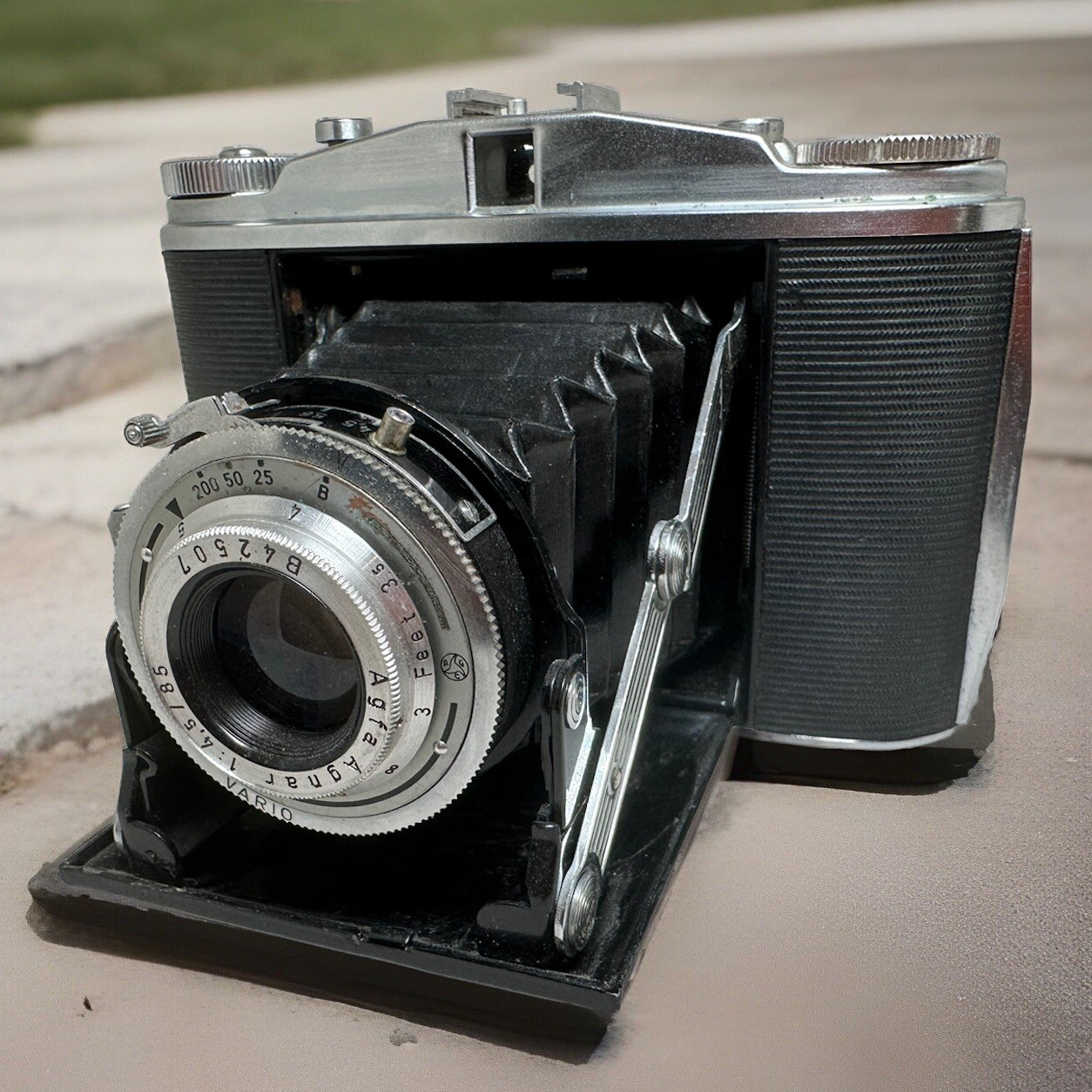
The Agfa Isolette is a series of compact folding medium format cameras produced by Agfa between 1937 and 1958. Designed for 120 roll film, it delivers 12 exposures of 6×6 cm images and is notable for its high-quality Solinar or Agfa Solinar lenses, coupled-viewfinder focusing, and robust mechanical construction.
Overview
Introduced in 1937, the Agfa Isolette was developed during a period of rapid innovation in roll-film folding cameras, aimed at providing amateur and semi-professional photographers with a portable yet capable medium format system. It was positioned as a premium compact folder, bridging the gap between basic box cameras and larger, more complex press or studio models. The Isolette series evolved over two decades, with multiple iterations—designated Isolette I through Isolette III and later variants—each refining optics, shutter mechanisms, and focusing systems. The camera’s hallmark was its compact folded profile, achieved through a collapsing bellows and folding strut mechanism, making it highly portable for travel and street photography.
Manufactured in Leverkusen, Germany, the Isolette was part of Agfa’s push to expand its presence in the high-end consumer camera market during the late 1930s and post-war era. It featured a built-in coupled rangefinder (on later models), automatic parallax correction in the viewfinder, and a high-quality lens selection—typically a 75mm f/3.8 or f/4.5 Agfa Solinar, a lens designed by Agfa but often optically equivalent to Zeiss Tessar types. The camera’s all-metal body, leather covering, and precision German engineering gave it a reputation for durability and optical fidelity. While not as widely exported as some contemporaries like the Kodak Retina, the Isolette earned a loyal following in Europe for its compactness and image quality.
Specifications
| Specification | Value |
| Type | Folding view/rangefinder camera |
| Film Format | 120 roll film |
| Image Format | 6×6 cm (12 exposures) |
| Years Produced | 1937–1958 |
| Lens | 75mm f/3.8 or f/4.5 Agfa Solinar (Tessar-type), fixed |
| Aperture Range | f/3.8 to f/22 (varies by model) |
| Shutter | Compur or Agfa Synchro shutter |
| Shutter Speeds | B, 1–1/300 second (Isolette I–II); B, 1–1/400 second (Isolette III with Synchro) |
| Flash Sync | Yes, via PC sync socket (later models) |
| Focusing | Coupled rangefinder (Isolette II and III), helical focus mount |
| Viewfinder | Combined optical viewfinder with automatic parallax correction |
| Metering | None (unmetered) |
| Exposure Modes | Manual only |
| Film Advance | Red window (early models), later with automatic frame counter |
| Dimensions | Approx. 110 × 75 × 55 mm (folded); 110 × 75 × 100 mm (extended) |
| Weight | Approx. 580–620 g (depending on shutter and lens) |
Key Features
- 75mm f/3.8 or f/4.5 Agfa Solinar lens: A high-quality, four-element Tessar-type lens delivering sharp, contrast-rich images with minimal aberration.
- Coupled rangefinder focusing (Isolette II and III): Eliminates guesswork in manual focus, with a bright, clear patch in the viewfinder for accurate distance setting.
- Compact folding design: Collapses into a pocketable size with a rigid strut brace that locks the lens standard in place when open.
- Automatic parallax correction: The viewfinder frame adjusts vertically as focus distance changes, improving composition accuracy at close range.
- High-speed shutter options: Later models equipped with Agfa Synchro shutters offer speeds up to 1/400 second, rare for folding cameras of the era.
Historical Context
The Agfa Isolette was launched in 1937, during a golden age of German optical engineering. It emerged in response to growing demand for portable medium format cameras that offered better image quality than 35mm but without the bulk of larger formats. Competing primarily with the Kodak Retina I (introduced 1934) and the Wirgin Edinex series, the Isolette distinguished itself with its rigid folding mechanism and superior lens quality. Early models (Isolette I) featured a simple scale-focusing system and a Compur shutter, while the Isolette II (c. 1948) introduced the coupled rangefinder—a significant upgrade that brought it in line with professional standards.
Post-World War II, Agfa re-established its camera production under British oversight, and the Isolette III (c. 1953) represented the peak of the series. It featured a faster f/3.8 Solinar lens, Synchro shutter with 1/400 sec, and improved flash synchronization. Despite these advancements, the rise of 35mm SLRs and rangefinders in the 1950s—such as the Contax and Leica systems—diminished the market for high-end folders. Agfa discontinued the Isolette in 1958, shifting focus to 35mm compact cameras and consumer film products.
Collectibility & Value
The Agfa Isolette is a sought-after collector’s item, particularly the Isolette II and III models with coupled rangefinders and f/3.8 lenses. In excellent working condition, these cameras typically sell for $250–$500 USD, with rare variants or mint-condition examples commanding higher prices. The value is driven by the camera’s optical quality, historical significance, and compact design. Collectors prize the Isolette for its German craftsmanship and its role in Agfa’s pre-digital legacy.
When purchasing an Isolette, buyers should inspect the bellows for pinholes or brittleness, test the shutter speeds across all settings (especially 1/300 and 1/400), and verify that the rangefinder is properly aligned. Common issues include stiff focusing helicals, light leaks from deteriorated seals, and shutter curtain drag. The lens should be free of haze, fungus, or separation. While repair parts are scarce, skilled technicians familiar with vintage Compur and Synchro shutters can service the mechanisms. Because the camera uses no batteries, it remains fully functional if mechanically sound.
Similar Cameras
- Kodak Retina I (Type 117) – 120 folding camera with 75mm lens, similar form factor and era.
- Wirgin Edinex 44 – German-made 6×6 folder with coupled rangefinder and high-quality optics.
- Zeiss Ikon Super Ikonta C – Premium folding camera with 80mm Tessar, known for build quality and image fidelity.
- Rolleiflex 4×4 – TLR alternative in 6×6 format, though bulkier than the Isolette.
- Fodor Vollenda 6×6 – Dutch-made folder with similar specifications and compact design.
Repair & Maintenance
The Agfa Isolette requires no batteries and operates entirely mechanically. Common maintenance concerns include cleaning and lubricating the focusing helical, ensuring the folding strut locks securely, and verifying shutter accuracy. The Compur and Agfa Synchro shutters are serviceable but require expertise due to their complexity. Bellows replacement is possible but challenging due to the compact design. Regular use and storage in a dry environment prevent mold and corrosion. For optimal performance, a full CLA (clean, lubricate, adjust) by a specialist in vintage German cameras is recommended every 10–15 years.
eBay Listings


As an eBay Partner, we earn from qualifying purchases. This helps support our independent vintage technology research.
Service Manuals & Schematics
- Manual — archive.org
- Owner's Manual — archive.org
- Owner's Manual (1956) — archive.org