Agfa Isola (1955–1959)
The one that started it all: a flat little box that slips into your coat like a deck of cards, yet opens up to deliver honest 6x6 medium format square
Overview
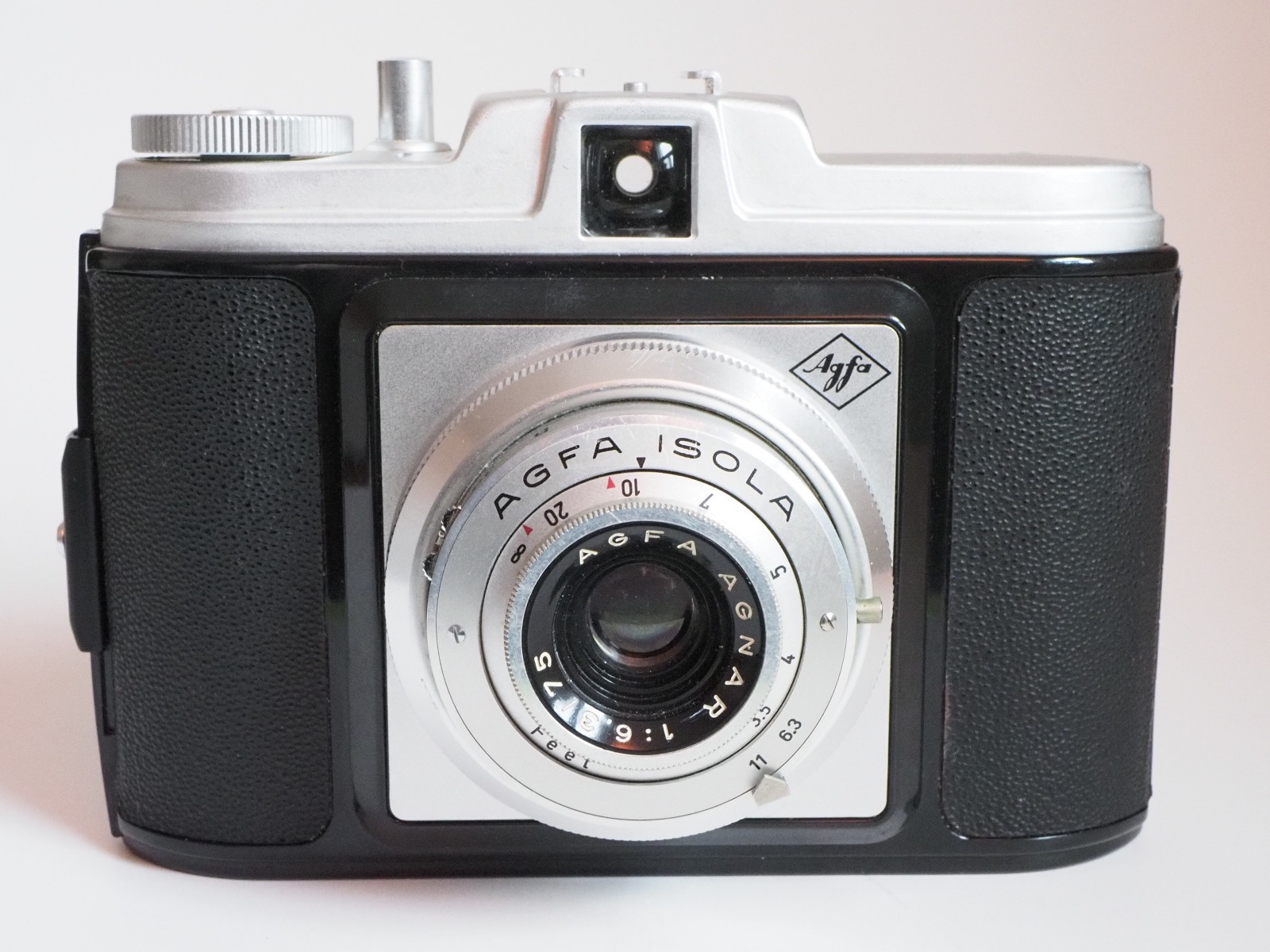
You know that moment when you unfold a camera and it feels like pulling a rabbit from a hat? The Agfa Isola doesn’t just unfold—it transforms. One second it’s a slim rectangle you could mistake for a cigarette case, the next you’ve extended the collapsible lens tube and locked it into place, ready to shoot 6x6 negatives on 120 roll film. This was Agfa’s answer in the mid-1950s to the growing demand for portable medium format: not a toy, not a professional rig, but a cleverly designed, lightweight snapshot camera for the discerning amateur. It’s the original of the Isola line, predating the Isola I and Isola II, and it set the tone for simplicity, portability, and mechanical reliability.
It’s not flashy—no rangefinder, no light meter, no fancy shutter speeds. Just a meniscus lens, zone focusing, and a basic shutter with Bulb and two fixed speeds: 1/30 and 1/100 second. Aperture options are f/11 for sunny days and f/16 when the clouds roll in. The lens, unnamed on the camera but consistent with Agfa’s modest optical designs of the era, is a simple single-element meniscus, not the triplet found on later models. That means you’re trading edge-to-edge sharpness for charm and character—soft corners, gentle contrast, and a look that leans more poetic than clinical. But for the price and portability, it delivers a surprising amount of image quality, especially when stopped down and used with care.
What really sets the Isola apart is its form. When collapsed, it’s barely an inch thick—thinner than most smartphones today—and it fits in a jacket pocket without bulging. The folding design wasn’t new, but Agfa executed it with clean German engineering: a smooth slide for the lens, a reassuring click when locked, and a built-in double exposure guard that prevents firing until the film is advanced. It’s a small thing, but it means you won’t accidentally waste a frame by pressing the shutter twice. Of course, that also means you can’t do intentional double exposures unless you rig a workaround, but for most users, that’s a fair trade for reliability.
Specifications
| Manufacturer | Agfa Camerawerk, Munich |
| Production Years | 1955–1959 |
| Original Price | Not documented |
| Film Format | 120 roll film |
| Picture Format | 6x6 cm (10 exposures per roll) |
| Lens | Meniscus, 72.5mm f/11 |
| Aperture Settings | f/11 (sun), f/16 (cloud) |
| Shutter Speeds | B, 1/30, 1/100 second |
| Focusing | Zone focus: 1.5m–2.5m, 2.5m–5m, 5m–∞ |
| Viewfinder | Direct optical viewfinder, non-parallax corrected |
| Shutter Type | Leaf shutter, mechanically actuated |
| Flash Sync | PC socket, no hot shoe |
| Tripod Mount | Yes, 1/4"-20 thread |
| Cable Release | Yes, threaded shutter button |
| Built-in Filter | No |
| Weight | Approx. 320g (without film) |
| Dimensions (collapsed) | 110 x 70 x 25 mm |
| Dimensions (extended) | 110 x 70 x 85 mm |
| Country of Origin | Germany |
| Serial Number Location | Top plate, near viewfinder |
Key Features
Collapsible Body, Maximum Portability
The Isola’s genius is in its folding design. The lens retracts into the body, and when closed, it’s one of the thinnest medium format cameras ever made. This wasn’t just about looks—it was a deliberate move to make 120 film practical for everyday carry. Unlike bulky folders or rigid-bodied TLRs, the Isola could go anywhere. Slide it into a coat, toss it in a bag, and you’ve got a serious film format at your side without the weight. The mechanism is simple but effective: pull the front standard forward, twist slightly to lock, and you’re ready to shoot. It’s not as refined as a Zeiss folder, but it works reliably and adds to the charm of using it.
Simple Meniscus Lens, Distinctive Rendering
The 72.5mm meniscus lens is where the Isola shows its limitations—and its soul. It’s a single-element design, meaning it doesn’t resolve like a modern lens or even a triplet. But in the right conditions—good light, stopped down to f/16—it produces images with a soft, dreamy quality that many modern shooters chase with filters. Highlights bloom slightly, contrast is gentle, and there’s a three-dimensional warmth to the rendering that digital often misses. It’s not a lens for technical perfection, but for mood, atmosphere, and the kind of imperfection that feels human. Think of it like a vintage microphone: it doesn’t capture everything, but what it does capture has character.
Double Exposure Prevention That Actually Works
One of the Isola’s standout features is its mechanical double exposure guard. After you press the shutter, the mechanism locks until you advance the film via the red window on the back. This prevents accidental double exposures—a common issue with simple cameras—but it also means you can’t do intentional ones without workarounds. Some photographers find this frustrating, but for a camera aimed at casual use, it’s a smart safeguard. It also forces you to be deliberate: each shot counts, and you have to remember to wind on. The red window itself is small and requires care to align the frame numbers correctly, but once you get the rhythm, it becomes second nature.
Historical Context
The mid-1950s were a golden era for amateur photography. Kodak had popularized the snapshot, 35mm was gaining ground, but medium format still ruled for quality. Agfa, better known for its films than its cameras, saw an opportunity: create a medium format camera that didn’t feel like a commitment. The Isola was their answer—a camera that bridged the gap between the box Brownie and the professional folder. It wasn’t competing with the Rolleiflex or Contax; it was for the traveler, the student, the weekend shooter who wanted better negatives without the bulk.
At the time, German camera makers were refining mechanical precision while Japanese brands were beginning to challenge with innovation and value. The Isola sat in the middle: German-built, modestly specced, but well-made. It shared DNA with other folding cameras like the Kodak Brownie Starlet or the Wirgin Edinex, but with the advantage of 6x6 format. It was succeeded by the Isola I in 1957, which upgraded to a triplet lens and slightly different shutter speeds, but the original Isola remains the purest expression of the concept: minimal, functional, and quietly elegant.
Collectibility & Value
The original Agfa Isola is less common than its successors, partly because it had a shorter production run and partly because many were simply used until they wore out. Today, it’s a niche collectible—sought after by fans of minimalist design and medium format oddities. Prices reflect its obscurity: a working example in good condition typically sells for €30–€60, with mint or boxed units occasionally reaching €100. It’s not a high-value collector’s item like a Leica, but it’s also not a throwaway. For that price, you’re getting a piece of photographic history that still functions as intended.
Common issues include stiff or frozen lens tubes, especially if the camera has been stored collapsed for decades. The shutter can stick at slow speeds, and the red window’s plastic may have yellowed or cracked. The leatherette sometimes peels, but that’s cosmetic. Functionally, the biggest thing to check is whether the film advance properly resets the shutter—some units develop wear in the gear train. Also, inspect the viewfinder glass for haze or fungus, though the optical path is short and generally forgiving.
For shooters, the Isola is a joy if you embrace its limits. Use ISO 100 or 400 film, shoot in daylight, and stop down to f/16. Handhold at 1/30 only if you’re steady; otherwise, use a tripod for anything in low light. The zone focus system demands estimation, but that’s part of the fun. It won’t replace your digital camera, but it will teach you to slow down, compose deliberately, and appreciate the physical act of taking a photo.
eBay Listings



As an eBay Partner, we earn from qualifying purchases. This helps support our independent vintage technology research.