Agfa Billy Record (1933–1942)
At 540 grams, it rests in the hands like a compact vault of pre-war German engineering—solid, no-nonsense, and built to last.
Overview
The Agfa Billy Record isn’t flashy, but it doesn’t need to be. This vertical folding medium format camera, produced from 1933 to 1942, was designed for photographers who valued reliability over spectacle. Built by Agfa Camera Works in Munich, Germany, the Billy Record series offered a self-erecting bellows mechanism that snapped into position with a satisfying mechanical precision—no fiddling with collapsing struts or misaligned rails. It used 120 roll film to produce eight 6 x 9 cm negatives, a format that still delivers rich detail and tonal depth when developed with care.
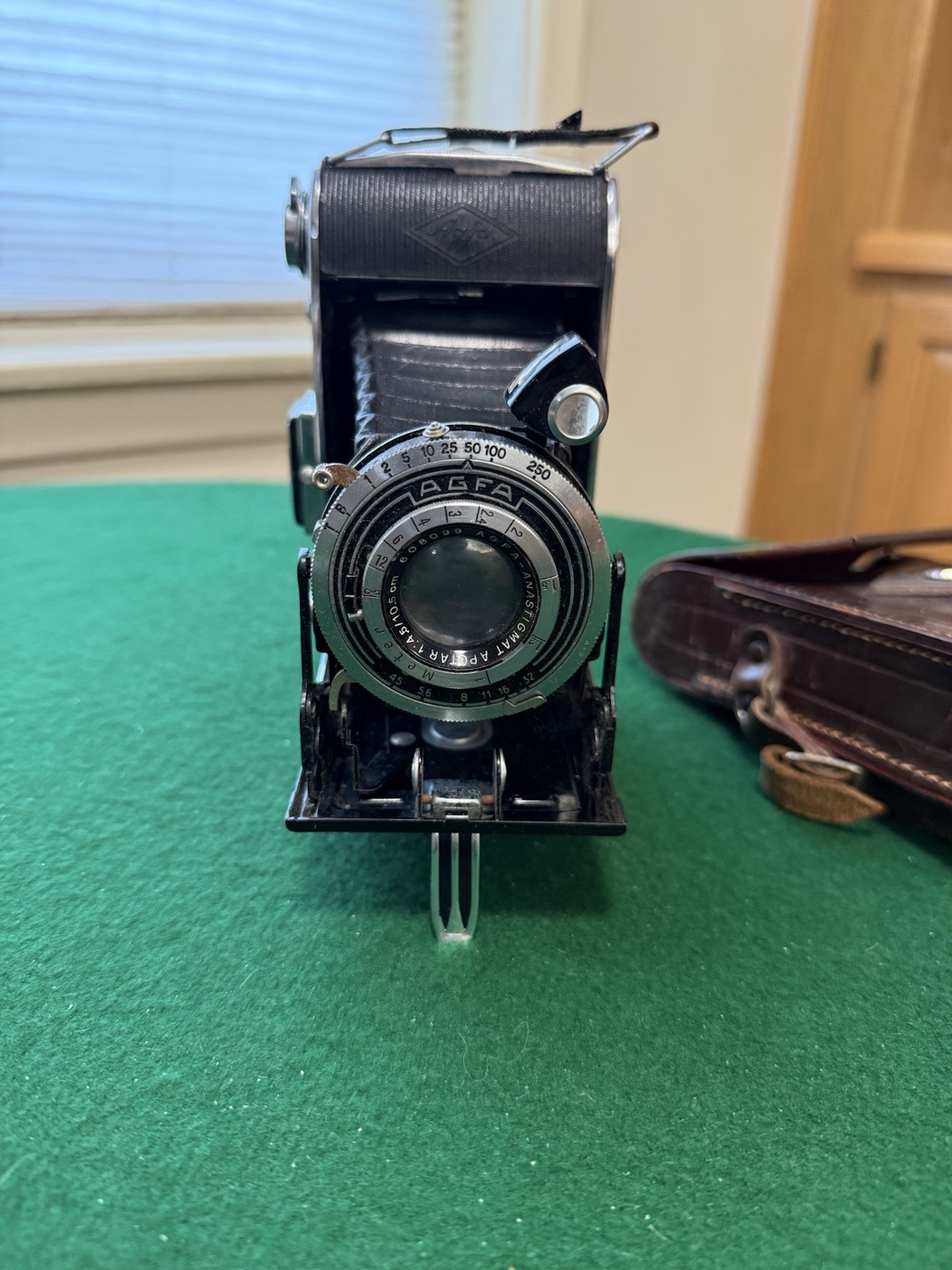
Three main models define the series: the Billy Record 8.8, 7.7, and 4.5—each named for the maximum aperture of its lens. These weren’t minor variants; they represented a deliberate tiering of performance and price. The 8.8 and 7.7 shared the same basic metal body shell, differing primarily in lens speed and shutter type. The 4.5 model, meanwhile, stepped up with faster optics and a broader shutter speed range, though it borrowed its body style from the more advanced Agfa Billy Compur. Despite their differences, all models carried the same DNA: robust construction, thoughtful ergonomics, and a no-compromise approach to film handling.
Owners report the film advance system—featuring a knob and a covered red window—as notably secure, outperforming some contemporary Kodak designs that were prone to light leaks. The shutter release is a remote lever connected via a metal rod to the body, a design that avoids direct pressure on the lens standard during exposure. Flash sync is provided via a PC socket, though it’s intended for flash bulbs, not modern electronic units. Later versions, circa 1952, added a small optical viewfinder, but most examples in circulation today retain the original metal-frame glassless finder.
Specifications
| Manufacturer | Agfa (Agfa camera works, Munich, Germany) |
| Product type | Vertical folding, self-erecting medium format camera for 120 film |
| Film | 120 roll film |
| Image size | 6 x 9 cm |
| Number of exposures | 8 |
| Lens (Billy Record 8.8) | Agfa Anastigmat Jgestar 100mm f/8.8 |
| Aperture range (8.8) | f/8.8 to f/16 |
| Shutter (8.8) | Agfa Automat |
| Shutter speeds (8.8) | T, B, 1/25, 1/50, 1/100 sec. |
| Focus type (8.8) | Two-position (6-16 ft & 16 ft-infinity) |
| Dimensions (closed, 8.8) | 80 x 155 x 32 mm |
| Dimensions (open, 8.8) | 80 x 155 x 126 mm |
| Weight (8.8) | 540g |
| Lens (Billy Record 7.7) | Agfa Anastigmat Jgestar 100mm f/7.7 (three elements) |
| Aperture range (7.7) | f/7.7 to f/32 |
| Shutter (7.7) | Prontor |
| Shutter speeds (7.7) | 1/25 to 1/100 sec. |
| Dimensions (closed, 7.7) | 165 x 88 x 37 mm |
| Dimensions (open, 7.7) | 165 x 108 x 131 mm |
| Weight (7.7) | 560 g |
| Original price (7.7) | 30 Reichsmark (Germany), 185 Francs (France) |
| Lens (Billy Record 4.5) | Apotar 105mm f/4.5 or Solinar 105mm f/4.5 |
| Shutter (4.5) | Prontor II |
| Shutter speeds (4.5) | 1 sec to 1/150 sec. |
| Film advance | Knob with red window (covered) |
| Viewfinder | Metal-frame glassless finder; later models (c.1952) featured a small optical finder |
| Shutter release | Remote lever connected via metal rod to body |
| Flash sync | PC socket for flash bulbs (not for modern electronic flash) |
| Tripod socket | Configuration varies by model/sub-variant |
Key Features
Folding Bed with Self-Erecting Bellows
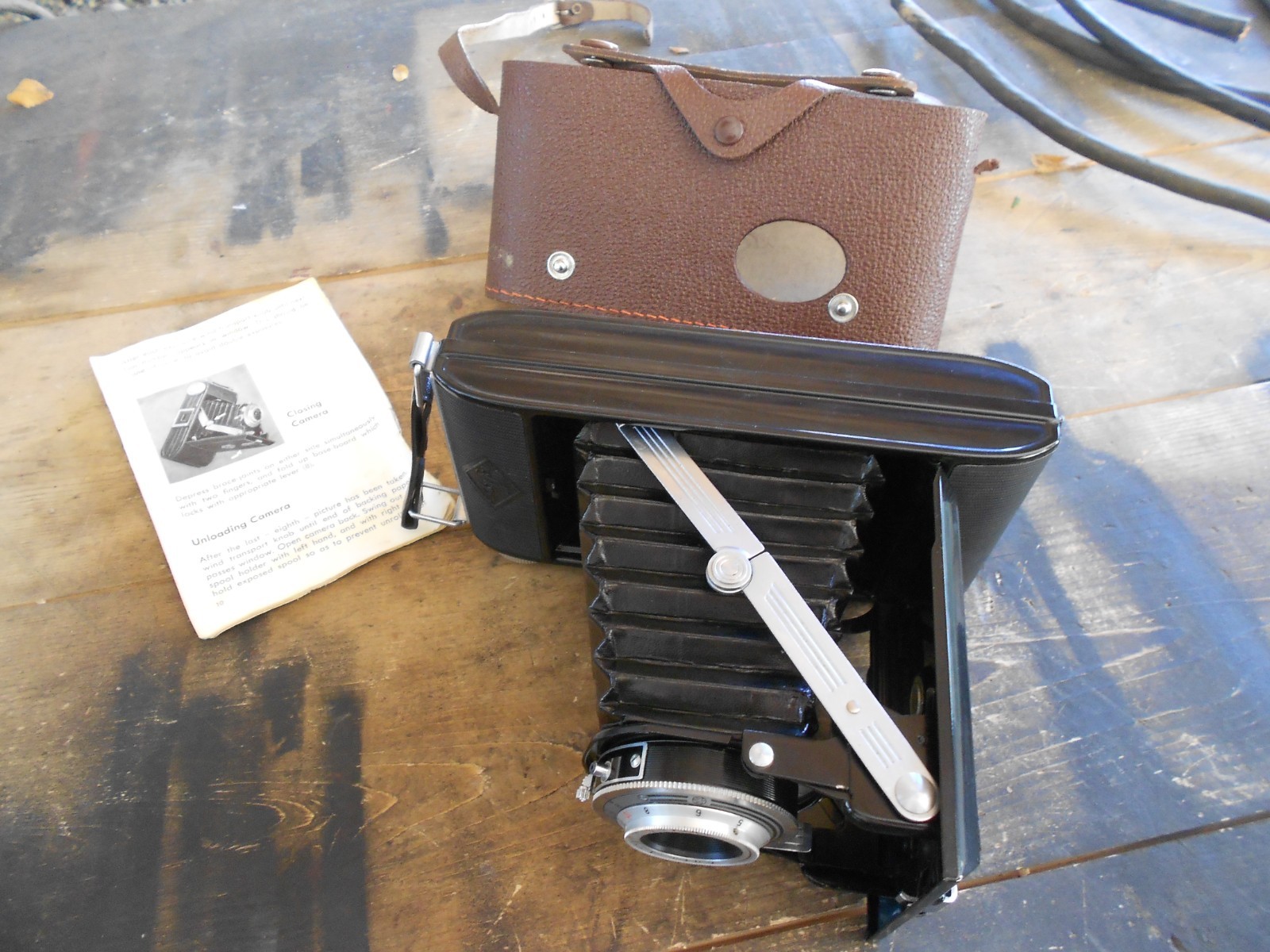
The self-erecting bellows system is one of the Billy Record’s standout features. Unlike many folding cameras that require manual extension and locking, the Billy Record’s bed springs into position when released, guided by a folding strut mechanism. This design speeds up setup and reduces wear on the bellows over time. The metal construction of the body ensures rigidity, minimizing flex that could lead to focus shift or image distortion.
Shared Metal Body Shell (8.8, 7.7, 6.3 Models)
The 8.8, 7.7, and 6.3 models all use the same basic metal body shell, a decision that streamlined production and simplified repairs. This commonality means parts interchangeability is relatively high across these variants, a boon for collectors and restorers. The body feels dense and well-damped, with a heft that conveys quality without being cumbersome.
Secure Film Loading with Covered Red Window
The film advance uses a knob and a metal-covered red window, a design noted for being more secure than some Kodak contemporaries. The cover prevents light leaks during transport, and the window itself is precisely aligned to ensure accurate frame spacing. Users report fewer alignment issues compared to rollfilm cameras that rely on pressure plates or spring-loaded indicators.
Colored Bellows and Chrome Decor (Optional)
Some models feature colored bellows—often red or maroon—and cosmetic touches like chrome trim around the lens or viewfinder. These details, while not affecting performance, reflect Agfa’s attention to market appeal. The Billy Record wasn’t just a tool; it was a consumer product meant to feel desirable in the hand.
Remote Shutter Release via Metal Rod
The shutter is triggered by a remote lever connected to the body via a rigid metal rod. This setup isolates the actuation force from the lens standard, reducing the risk of camera shake. It’s a simple but effective solution, especially when using slower shutter speeds or tripod work.
PC Socket for Flash Bulbs
A PC socket is provided for flash bulb synchronization, a necessity in the pre-electronic-flash era. However, it’s not compatible with modern electronic flashes, which require lower trigger voltages. Owners using flash must either employ vintage bulbs with appropriate adapters or use modern sync cables with voltage protection.
Historical Context
The Agfa Billy Record series was produced from 1933 to 1942, with manufacturing interrupted by World War II. The broader Agfa Billy line began in 1927, but the Billy Record represented a significant evolution—vertical format, self-erecting mechanism, and improved film handling. Models were designated by their lens aperture: 8.8, 7.7, 6.3, and 4.5, each indicating a step up in light-gathering ability. The 4.5 model, with its faster lens and Prontor II shutter, used the body style of the Agfa Billy Compur, suggesting a shared engineering platform across higher-end models.
The series was succeeded by the Agfa Billy Record II, continuing the lineage into the postwar period. In some markets, the camera was sold under the name Ventura 69, a rebranding strategy common in the era. The Billy Record 8.8 was also known as the Speedex Record in the USA and Great Britain, reflecting Agfa’s international distribution network.
Collectibility & Value
The Agfa Billy Record is not considered rare. It was widely produced and many examples survive today, though condition varies significantly. The most common problem is tattered bellows—expected after 80 years—but replacement parts can often be sourced from New Old Stock or donor cameras. Restoration is feasible for those with basic tool skills, and the mechanical simplicity of the design makes troubleshooting straightforward.
Current market value for the series averages between $30 and $70, depending on condition. Specific sales have been documented between $17 and $75 from 2002 to 2021, with higher prices typically reflecting fully functional shutters, intact bellows, and clean lenses. A Billy Record 4.5 sold for $65 on eBay, while Etsy listings have shown prices as high as $116, though these may reflect collector premiums or bundled accessories.
eBay Listings


As an eBay Partner, we earn from qualifying purchases. This helps support our independent vintage technology research.
Service Manuals & Schematics
- Manual (2020) — archive.org
- Manual — archive.org
- Manual (1933) — archive.org