Agfa Isolette III (1954)
6x6 medium format folding camera with uncoupled rangefinder, introduced in 1954
Overview
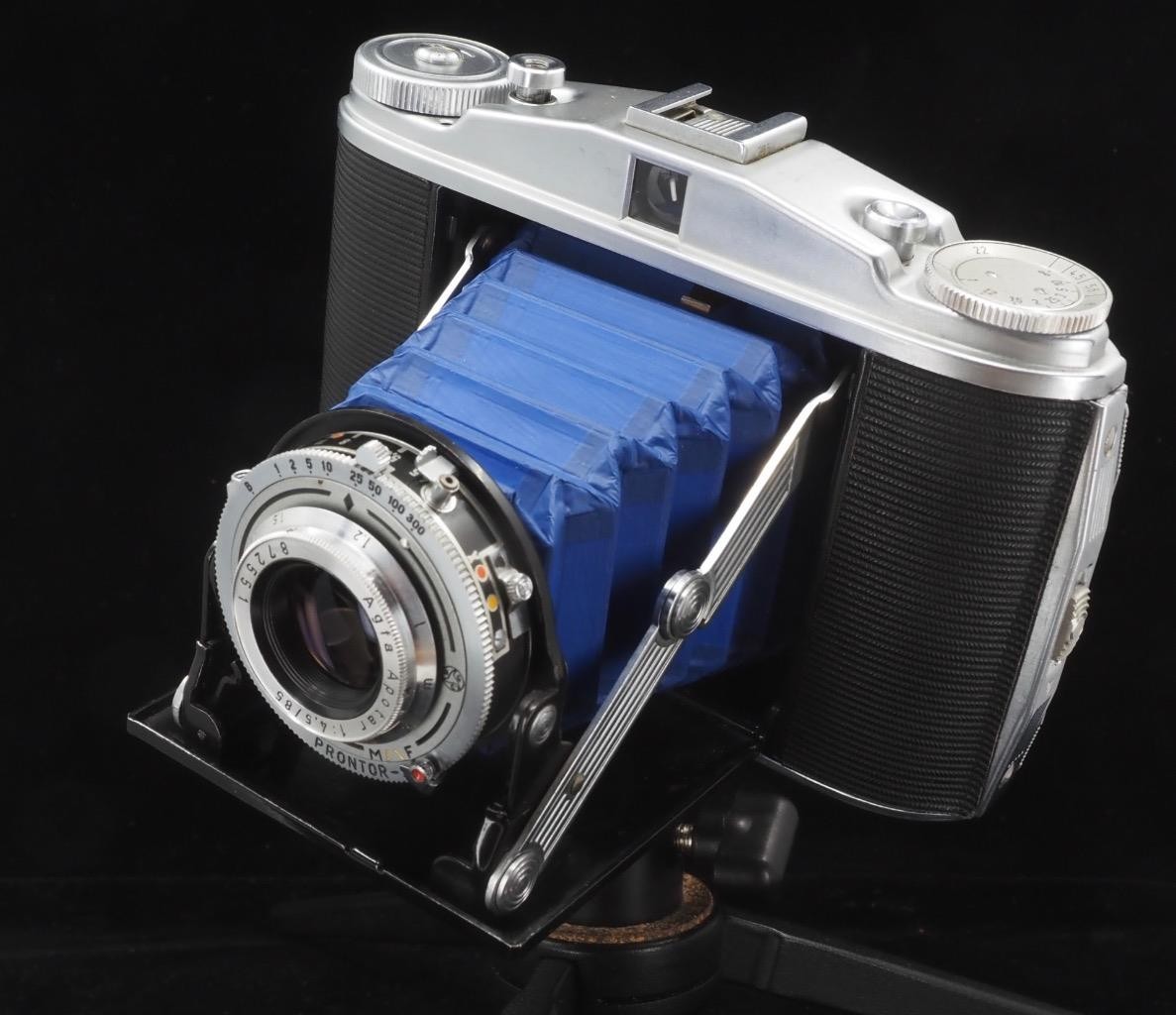
The Agfa Isolette III is a 6x6 medium format folding camera made by Agfa, introduced in 1954. It builds on the Isolette II by adding an uncoupled rangefinder, improving focusing accuracy for its class. The camera uses 120 roll film and features a coated 85mm f/4.5 Apotar triplet lens as standard, with Agnar and Solinar lenses also available. It was positioned as a beginner-friendly camera within the Isolette range, which includes six models, with the III often regarded as one of the most capable due to its rangefinder and solid build.
Specifications
| Image Format | 6x6 |
| Film Format | 120 roll film |
| Lens | Coated 85mm f/4.5 Apotar triplet (Agnar and Solinar also available) |
| Aperture Range | ƒ/4.5 to ƒ/32 |
| Shutter | Prontor SV |
| Shutter Speeds | 1, 1/2, 1/5, 1/10, 1/25, 1/50, 1/100, 1/300 s plus B |
| Focus Range | 1 metre (3.5 feet) to infinity |
| Focusing System | Uncoupled rangefinder |
| Film Advance | Manual, using red window on back |
| Flash Sync | PC socket with X/M sync selector |
| Viewfinder | Reverse Galilean telescope type, 5 mm eyepiece diameter |
| Rangefinder/Viewfinder Windows | 8 mm square |
| Self-Timer Delay | Approximately eleven seconds |
| "Happy Snapper" Aperture | Red dot at approximately ƒ/10–ƒ/11 |
| "Happy Snapper" Focus Settings | 10 feet (3 metres) and 30 feet (10 metres) |
Design
The Isolette III features textured black leatherette covering with rounded shoulders and a mostly symmetrical top plate. The body is constructed from aluminium, the lens door from steel, and the top plate from pressed brass with satin plating. The uncoupled rangefinder uses a coated half-mirror and a central bright spot slightly yellow/green in color, adjusted via a small dial on the top plate. The viewfinder image appears distinctly pink. The shutter release connects to the Prontor SV shutter via a hinged linkage, and the shutter includes a cocking lever but no T setting—only B. The film advance knob has a reverse-threaded screw (clockwise to loosen), and a small window next to the knob indicates film advance. A small sliding door on the back reveals frame numbers on the film backing. From 1956 onwards, later versions added a film reminder dial on the top left with DIN and color film type markings, and the depth-of-field scale was moved to surround the lens. Double exposure prevention is provided by a lock on the shutter release, with a red indicator visible until the film is advanced.
Context
The Isolette III is essentially an Isolette II upgraded with an uncoupled rangefinder. Within the Isolette series—comprising the original, I, II, III, IV, and V—the III is often considered more fully featured than the IV and V. The lens hierarchy ranks Agnar as the lowest, Apotar as mid-range, and Solinar as the highest-performing option. The range was designed as an accessible line for beginners, balancing simplicity with capable optics and build.
Market
Common purchase prices have included around £20 or $25 with case, and approximately 200 SEK in 2015. A typical overhaul cost has been around $130. The camera is very common due to high production numbers, with many units remaining in good condition. Common issues include a focus ring blocked by hardened lubricant, pinholes in the bellows, sticky or slow shutter, stiff rangefinder wheel, and light leaks. The rangefinder’s half-mirror coating is delicate and can be damaged by improper cleaning. The cocking lever may fail to stay back if the shutter is set to T/B during cocking. The self-timer, while functional, is generally advised against due to risk of mechanism failure.
eBay Listings


As an eBay Partner, we earn from qualifying purchases. This helps support our independent vintage technology research.