Adox Sport (c.1938–1955)
A no-nonsense German folder that quietly outlasted wars and trends, packing sharp optics into a tank-like chassis that still clicks shut like it was built yesterday.
Overview
Open the leather case, flip the latch, and the Adox Sport snaps open with a metallic certainty that feels almost reassuring—like a tool that knows its job and does it without fuss. This isn’t a camera trying to impress; it’s a working photographer’s companion from an era when gear had to survive cobblestone streets, train compartments, and the occasional dunk in a rain-soaked coat pocket. Born in the late 1930s and refined through the 1940s and early ’50s, the Sport series emerged from Adox’s Wiesbaden factory as a direct answer to the booming demand for rugged, medium-format folders that didn’t bankrupt the amateur. It wasn’t flashy, but it was honest—built from stamped steel, leather bellows, and a lens standard that refused to wobble, even after decades of folding and unfolding.
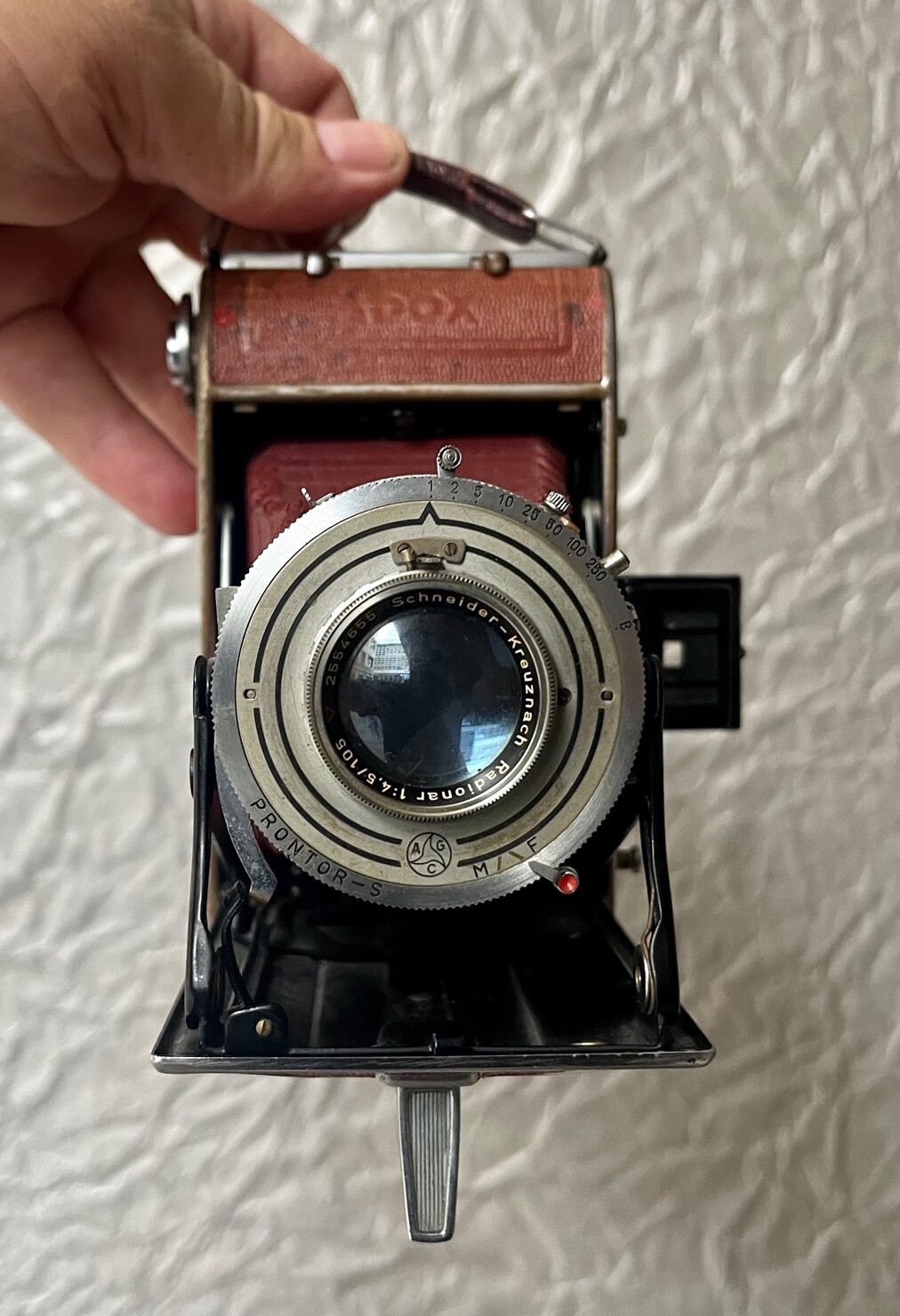
The Sport evolved through several iterations—initially known simply as the “Sport” before being retroactively dubbed the “Sport 0” when newer versions arrived. It shot 120 film in either 6×9 cm or 6×4.5 cm format, thanks to a sliding internal mask that let you switch aspect ratios without tools. That flexibility was rare at the time, especially in a camera priced for the middle class. Early models wore Schneider-Kreuznach Radionar 105mm f/4.5 lenses paired with Compur Vario shutters, while later versions—like the Sport Ia and IIa—switched to Steinheil Cassar glass and Prontor shutters, reflecting postwar supply shifts and Adox’s pivot toward cost-effective, high-performance optics. The Cassar, a triplet-based design inspired by the Zeiss Tessar but trimmed to three elements, delivered sharp, contrasty images with just enough character to avoid clinical sterility. It wasn’t a dreamy soft-focus lens, but in good condition, it could hold its own against contemporaries like the Kodak Retina or early Rolleiflex lenses.
What sets the Sport apart isn’t innovation—it’s durability. While other folders from the era sagged at the hinges or developed light leaks after a few years, the Sport’s vertically folding design and robust metal construction meant it could be tossed in a bag and forgotten for decades, only to wake up and still function. The viewfinder, though basic (a simple wire frame on early models, later upgraded to a hood-integrated unit), was serviceable, and the shutter release—positioned on the front standard by 1952—made handholding more natural. It wasn’t a rangefinder, so focusing was entirely scale-based, relying on guesswork and hyperfocal distance tricks. But for street shooters and travel photographers of the 1950s, that was normal. The real magic was in the lens-to-film distance: short enough for portability, long enough to render flattering portraits with gentle background separation.
Specifications
| Manufacturer | Adox, Wiesbaden, Germany |
| Production Years | c.1938–1955 |
| Original Price | Approx. 90 D-Mark (1950) |
| Film Format | 120 roll film |
| Image Format | 6×9 cm or 6×4.5 cm (with mask) |
| Lens | Schneider-Kreuznach Radionar 1:4.5/105 or Steinheil Cassar f/4.5–f/6.3/105 mm |
| Shutter | Compur Vario (1/25–1/200 sec, B) or Prontor-S/Pronto/Prontor-SV (1″–1/250 sec, B) |
| Aperture Range | f/4.5 to f/22 (varies by lens) |
| Focusing | Scale focus only, via lever on lens standard |
| Viewfinder | Frame-type (side-mounted), later models with built-in hood finder |
| Flash Sync | Yes, via PC terminal (on later models) |
| Mount | Fixed lens, no interchangeability |
| Weight | Approx. 750–800 g (varies by model) |
| Dimensions (open) | Approx. 140 × 90 × 120 mm |
| Dimensions (closed) | Approx. 140 × 90 × 50 mm |
| Construction | Metal body with leather bellows |
| Format Selector | Internal sliding mask for 6×4.5 cm |
| Accessories | Leather case, lens hood (on later models), accessory shoe |
Key Features
A Lens That Punches Above Its Weight
The Steinheil Cassar 105mm f/4.5 wasn’t a luxury optic, but it was a smart one. As a three-element design, it avoided the complexity and cost of a full Tessar while still delivering impressive sharpness across the frame when stopped down to f/8 or f/11. In an era when many budget folders used soft meniscus lenses, the Cassar stood out for its contrast and lack of veiling glare. Later models with the Prontor-SV shutter often paired the Cassar with a slightly faster f/4.5 aperture, giving photographers a bit more low-light flexibility. While wide open it showed mild softness in the corners—typical for the design—it tightened up quickly, making it ideal for reportage and portrait work where depth of field was already deep. The lens coating, when original and unblemished, held up well against flare, though many surviving examples today show scratches or haze from improper cleaning.
Shutter Evolution: From Vario to Prontor
The Sport’s shutter history tells the story of postwar German industry. Early models carried the Compur Vario, a leaf shutter with speeds up to 1/200 sec—a solid performer but increasingly expensive to produce. As Adox streamlined production, they shifted to Prontor shutters, first the Pronto (up to 1/250 sec), then the Prontor-S and finally the Prontor-SV with flash sync. These were simpler, cheaper, and more reliable in mass production. The Prontor-SV, in particular, became a workhorse across European camera brands, and its inclusion on the Sport IIIa signaled Adox’s intent to compete with Agfa and Kodak in the mid-tier market. However, Prontor shutters from this era are prone to slow speeds running fast or sticking, especially if the camera has been stored damp. A CLA (clean, lubricate, adjust) is almost always recommended before trusting exposure timing.
Multi-Format Flexibility Without the Fuss
While most folders locked you into one format, the Sport let you toggle between 6×9 and 6×4.5 by sliding a metal mask inside the film back. This wasn’t a gimmick—it doubled your shots per roll (8 vs. 16) and gave you compositional flexibility without needing a second camera. The mask, however, is often missing today, either lost or discarded by previous owners who didn’t realize its purpose. Finding a complete example with the mask is a minor victory. The film advance used a standard knob and red window system, with frame lines etched into the back—simple, effective, and immune to mechanical failure. Just don’t forget to close the red window cover after loading.
Historical Context
The Adox Sport wasn’t born in a vacuum. It arrived during a pivotal shift in amateur photography: the move from large, unwieldy box cameras to compact, portable folders that could fit in a coat pocket. In the late 1930s, Adox—already known for its photographic paper and chemicals—entered the camera market to drive film sales, much like Agfa or Kodak. The Sport was their answer to the popularity of the Kodak Brownie and the more refined Ikonta folders. After World War II, with German industry rebuilding, Adox retooled and reintroduced the Sport in 1949, this time with updated shutters and lenses to meet renewed consumer demand. It wasn’t trying to beat the high-end Zeiss Ikontas or the emerging 35mm revolution—it was aiming squarely at the practical photographer who wanted quality without extravagance.
Competitors like Wirgin’s Edinex, Balda’s Periflex, and even Zeiss’s own Ikonta 520 series offered similar formats, but the Sport distinguished itself with build quality and value. It wasn’t a luxury item, but it didn’t feel cheap. In an era when many cameras were made with pressed cardboard or flimsy alloys, the Sport’s all-metal construction gave it a longevity that surprised even its original owners. By the mid-1950s, as 35mm cameras gained popularity and Adox shifted focus back to film production, the Sport line faded out. But its reputation endured—especially among photographers in Eastern Europe, where it was sometimes rebadged as the Hapo 50 or Bower-X due to postwar distribution deals.
Collectibility & Value
Today, the Adox Sport trades in a quiet corner of the vintage camera market—respected but rarely hyped. Prices reflect that: a working Sport 0 or IIa in good cosmetic condition typically sells for $40–$70, with mint examples reaching $100 if they include the original case, mask, and a clean, haze-free lens. The real value lies in usability. Unlike many folders from the era, the Sport’s robust construction means it often survives in functional condition, even if uncleaned. That makes it a favorite among film photographers looking for an affordable entry into 6×9 shooting.
But there are caveats. The leather bellows, while durable, are prone to pinholes after 70 years—always check by shining a flashlight inside the camera in a dark room. Light leaks around the film back are also common if the felt seals have degraded. The focusing lever can stiffen or freeze, especially if the camera was stored closed for decades. And while the Prontor shutters are generally reliable, their slow speeds (1–1/25 sec) often need servicing. A full CLA from a specialist runs $60–$100, which can double the effective cost of a $50 camera—but it’s almost always worth it. Avoid any example with a cloudy or separated lens; replacements are rare, and the Cassar isn’t a standard mount.
For collectors, the Sport IIa with Cassar lens and Prontor-S shutter is the sweet spot—common enough to find, but with the refined features of the later models. The earlier Sport 0 with Radionar and Compur Vario is rarer and more desirable, but often commands only a modest premium. If you’re after a camera that shoots beautifully and won’t break the bank, the Sport delivers. If you want a showpiece, look elsewhere. This was always a tool, not a trophy.
eBay Listings



As an eBay Partner, we earn from qualifying purchases. This helps support our independent vintage technology research.