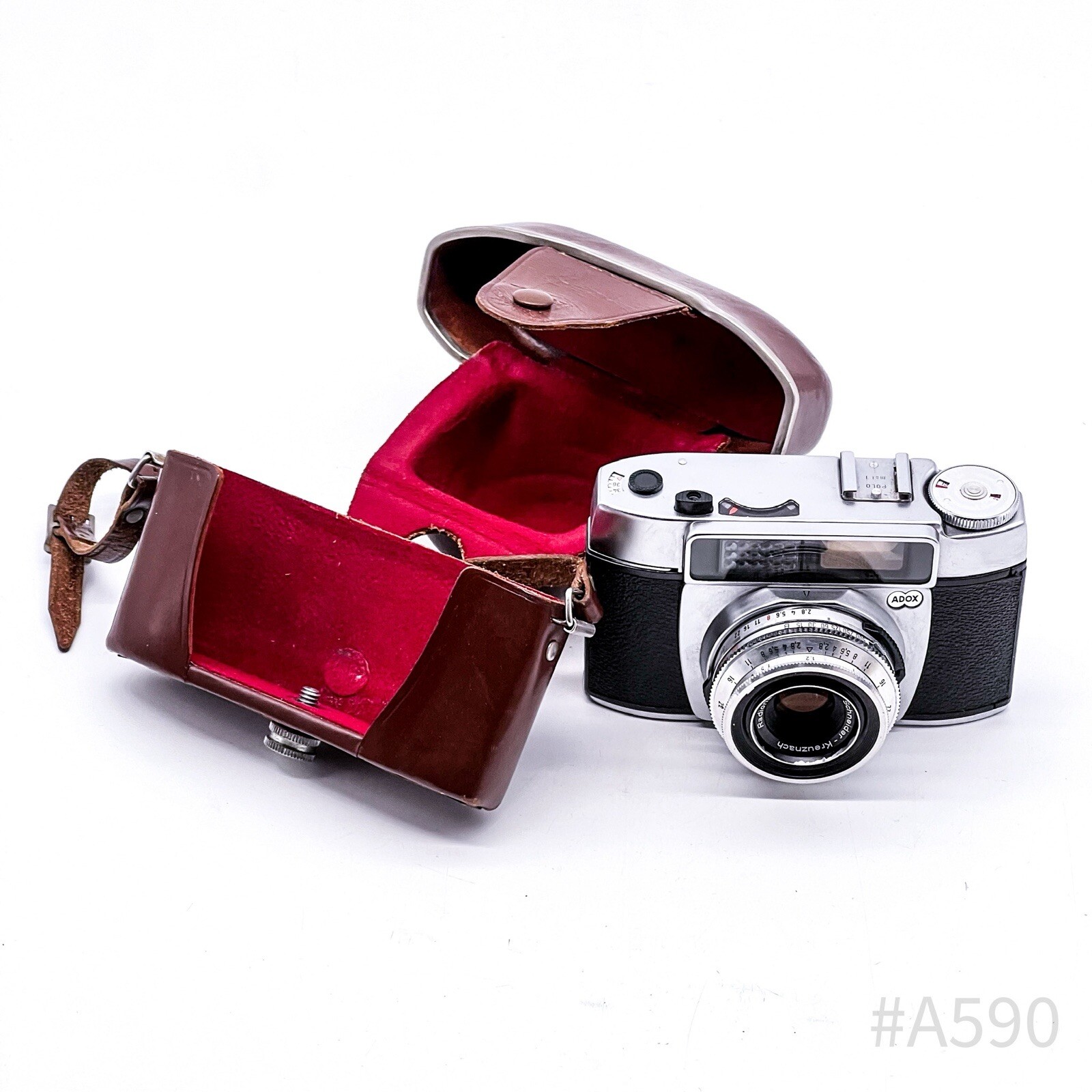
Adox POLO 2 (1960–1965)
A compact 35mm viewfinder camera that quietly outshines its budget roots with solid build and a surprisingly sharp lens.
Overview
Slide the POLO 2 into your hand and you’ll feel it immediately—this isn’t some flimsy postwar toy camera trying to pass as serious gear. It’s dense, well-balanced, and built like a miniature vault, its all-metal body hinting at the precision engineering inside. Made in Wiesbaden during the final flourish of German 35mm compact design, the POLO 2 straddles the line between no-frills utility and thoughtful craftsmanship. It doesn’t shout for attention, but in the right light, its clean lines and restrained chrome trim carry a quiet elegance that feels more Swiss than mid-century German. You won’t find a light meter here, let alone automation—this is pure manual shooting, the kind that forces you to slow down, meter with your eyes, and engage with the moment. And yet, despite its simplicity, the POLO 2 delivers images that often punch above its weight, thanks to a lens that, for its era and price point, resolves detail with a clarity that can still impress today.
Positioned just above the base-model POLO and POLO 1, the POLO 2 wasn’t the flagship of Adox’s lineup—that honor went to the selenium-metered Polomat and fully automated Polomatic series—but it was the sweet spot for photographers who wanted better optics and shutter performance without stepping into the premium tier. Where the original POLO made do with a basic 45mm f/3.5 Adoxar and a limited shutter, the POLO 2 stepped up with either a faster Adoxar or, in some variants, a Schneider-Kreuznach Radionar 45mm f/2.8, a lens with pedigree. The shutter, typically a Prontor or Vario unit, offered speeds up to 1/250th—respectable for a compact camera of the early 1960s—and crucially, included a B setting for long exposures, a feature absent on some of its siblings. The viewfinder, while not quite as advanced as the later Polomatic’s illuminated exposure indicators, is bright and includes parallax correction marks, a small but meaningful touch for careful composition.
Specifications
| Manufacturer | Adox (Dr. C. Schleussner Fotowerke GmbH) |
| Production Years | 1960–1965 |
| Original Price | Not available |
| Film Format | 35mm (135) |
| Image Size | 24mm × 36mm |
| Lens | 45mm f/2.8 Adoxar or Schneider-Kreuznach Radionar L |
| Aperture Range | f/2.8 to f/16 |
| Shutter Type | Prontor or Vario leaf shutter |
| Shutter Speeds | 1, 1/30, 1/60, 1/125, 1/250 seconds, B |
| Focus | Scale focusing (3.5 ft to infinity) |
| Viewfinder | Direct optical viewfinder with parallax correction |
| Metering | None (fully manual) |
| Flash Sync | Yes, via PC terminal |
| Shutter Release | Threaded standard release |
| Film Advance | Knurled knob |
| Frame Counter | Manual reset (advances on rewind) |
| Body Material | Metal (chrome-plated brass or steel) |
| Weight | Approx. 380g (without lens cap) |
| Dimensions | 105mm × 60mm × 35mm |
| Accessories | Optional leather case, lens cap, cable release |
Key Features
A Lens That Punches Above Its Class
The POLO 2’s real surprise lies under the hood: its 45mm f/2.8 lens. Whether branded Adoxar or Schneider-Kreuznach Radionar L, this glass was no afterthought. The Schneider version, in particular, is a known performer—sharp in the center by f/5.6, with smooth falloff into the corners that gives images a gentle, organic character. Even wide open, it renders with enough contrast and micro-detail to make you forget you’re shooting with a 60-year-old compact. The Adoxar variant, while less celebrated, still holds its own, delivering crisp results when stopped down. Both are four-element designs typical of the era, but their coatings (when original and unblemished) manage flare better than expected, and the f/2.8 aperture gives a modest amount of background separation—enough to make portraits stand out without the bokeh of a true portrait lens. Focus is by scale, so precise zone focusing is required, but the depth-of-field markings are clearly etched and usable with a handheld meter or sunny-16 rule.
Simple, Reliable Shutter Mechanics
The Prontor or Vario leaf shutter may not be as refined as a Seikosha or Compur, but it’s dependable when serviced. The inclusion of 1/250th was a step up from earlier models limited to 1/125th, opening up handheld shooting in brighter conditions. The B setting is a welcome addition for night work or long exposures with filters, though the lack of a lockable cable release on some variants means long exposures require a steady hand or improvised solution. Shutter cocking is tied to film advance, so double-exposure prevention is mechanical and foolproof—no accidental repeats unless you manually rewind mid-roll. The shutter release is threaded, accepting standard cable releases, and the PC sync port supports both flashbulbs and early electronic flashes, making the POLO 2 surprisingly versatile in low light.
Compact Design with Tactile Refinement
Measuring just over four inches long and slipping easily into a jacket pocket, the POLO 2 was designed for mobility without sacrificing build quality. The film advance knob is knurled for grip, the rewind knob pops up with a satisfying click, and the chrome trim around the lens and viewfinder adds a touch of polish without feeling gaudy. The body’s rigidity means it ages well—few creaks, no flexing—though the leatherette can lift over time, especially on models stored in humid conditions. The viewfinder is small by modern standards but bright enough for daylight use, and the parallax correction lines help keep compositions accurate at close range. It’s not a rangefinder, so focusing is estimated, but for street photography or travel snaps, the scale focus system works well enough when paired with zone focusing techniques.
Historical Context
The POLO 2 emerged in 1960, a time when German camera makers were locked in a quiet arms race to refine the compact 35mm camera. The market was crowded: Zeiss Ikon, Wirgin, and Braun all offered similar viewfinder models, while Japanese imports like Canon and Minolta were beginning to gain traction with more advanced features. Adox, having taken over Wirgin’s Wiesbaden factory during WWII, was leveraging that infrastructure to produce a range of cameras that balanced cost and quality. The POLO series was their answer to the growing demand for affordable, portable 35mm systems—cameras for students, travelers, and amateur photographers who didn’t need (or couldn’t afford) a Leica. The POLO 2 sat in the middle of that lineup: above the basic POLO and POLO 1, but below the metered Polomat and automated Polomatic models. It was a transitional design—fully manual, yet built with the same attention to mechanical integrity that defined German engineering of the era. By the mid-1960s, however, the writing was on the wall: integrated light meters, through-the-lens viewing, and eventually SLRs would render viewfinder cameras like the POLO 2 obsolete. But for a brief window, it represented a high point in accessible, well-made compact photography.
Collectibility & Value
Today, the POLO 2 trades under the radar—undervalued, perhaps, because it lacks a rangefinder or meter. But collectors who know their Adox lines appreciate it as a well-built, optically competent camera that delivers real photographic results. In excellent condition, with a clean lens and functioning shutter, it typically sells for $80–$150. Models with the Schneider-Kreuznach Radionar lens command a slight premium—sometimes $20–$30 more—due to the lens’s reputation. The biggest risk when buying a POLO 2 is shutter failure: old leaf shutters can stick, especially at the faster speeds, and the Prontor units are prone to oil drying or gumming if the camera was stored poorly. Always test all speeds, including B, and listen for smooth, consistent clicks. The lens should be free of haze, fungus, and separation—common issues in older German optics, especially if stored in damp environments. The viewfinder glass can also develop micro-cracks or peeling coatings, though this rarely affects usability. Maintenance is straightforward: a CLA (clean, lubricate, adjust) from a technician familiar with vintage leaf shutters usually runs $75–$120, making it a reasonable investment if you’re buying a non-working example. For shooters, the POLO 2 is a rewarding choice: it’s reliable when serviced, takes standard 35mm film, and produces negatives with a character that feels distinctly analog—crisp but not clinical, with a warmth that digital often struggles to replicate.
eBay Listings


As an eBay Partner, we earn from qualifying purchases. This helps support our independent vintage technology research.