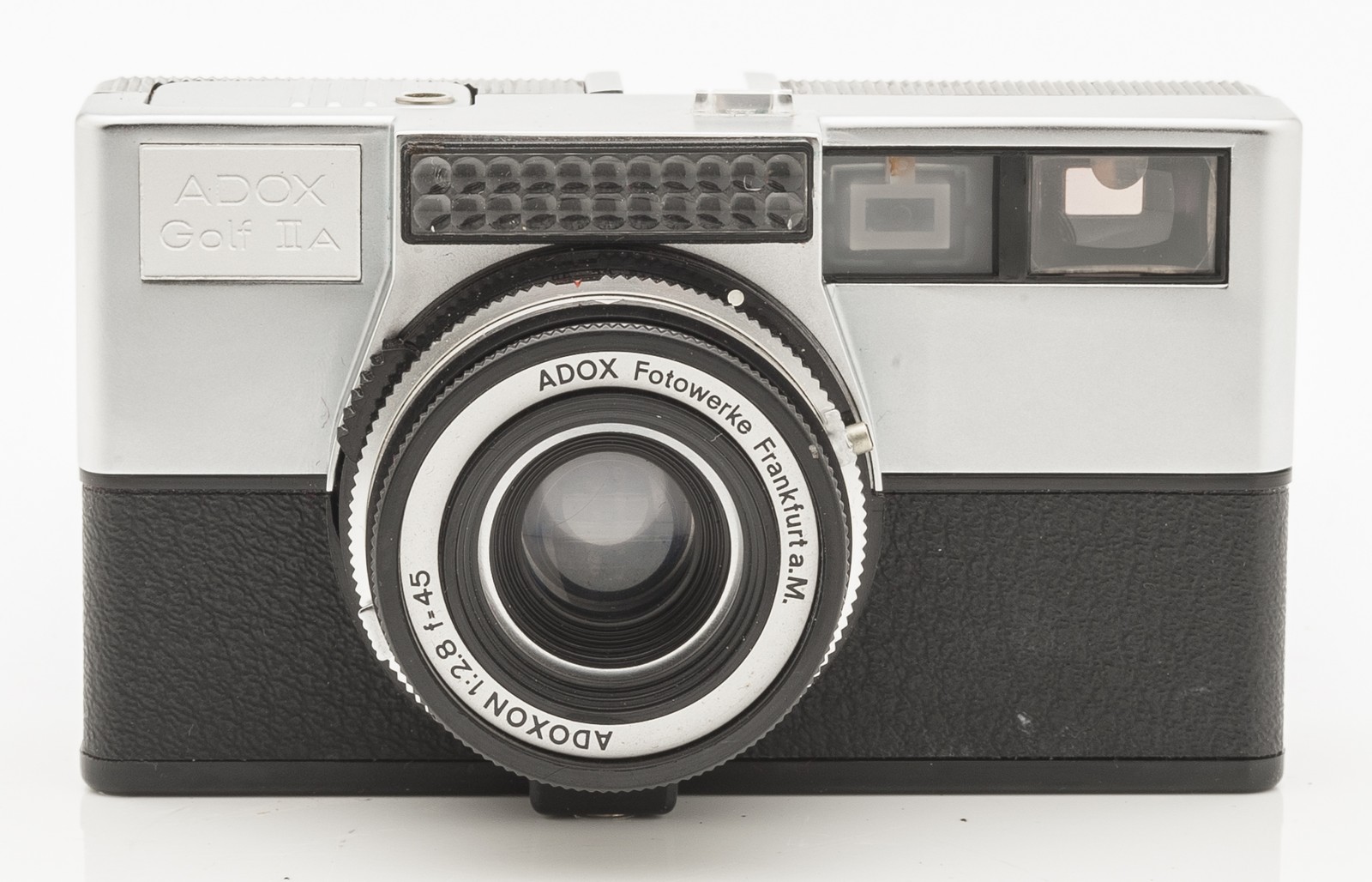
ADOX GOLF IIA
The Adox Golf IIA is a compact 35mm scale-focus camera produced by Adox between 1963 and 1966. It represents a transitional design in the evolution of affordable German compact cameras, combining simple mechanical operation with the convenience of a built-in selenium light meter and a high-quality Adoxon lens.
Overview
Introduced during a period of rapid innovation in consumer photography, the Adox Golf IIA was positioned as an advanced compact camera for amateur photographers seeking reliable performance in a portable form factor. Manufactured by Fotochemie GmbH & Co. KG in Leverkusen, Germany—better known for its Adox brand of photographic materials—the Golf IIA was part of a short-lived but technically competent line of cameras that leveraged the company’s reputation for quality optics and film. The Golf IIA succeeded the original Golf I, incorporating a key upgrade: a built-in selenium cell exposure meter, which eliminated the need for external metering and improved ease of use.
The camera features a fixed-focus lens system based on a scale-focus design, meaning focus is set manually via distance markings rather than through a rangefinder or viewfinder-based focusing aid. Despite its compact size and simple construction, the Golf IIA was engineered with metal components and a robust chassis, typical of mid-1960s German camera manufacturing standards. It was marketed toward snapshot photographers who desired better image quality than plastic-bodied competitors offered, yet still wanted a lightweight, pocketable camera. The inclusion of a coupled selenium meter placed it above entry-level models like the Kodak Instamatic or basic Agfa Click cameras, positioning it competitively against other European compacts such as the Wirgin Edinex series or the early Zeiss Ikon models.
Within the Adox camera lineup, the Golf IIA occupied a mid-tier position, below the more sophisticated Adox Cadet rangefinder but above simpler box cameras. Its production run was brief, ending around 1966 as Adox gradually withdrew from the camera manufacturing market to refocus on its core business of photographic chemicals and later, black-and-white film production. Nevertheless, the Golf IIA remains a notable example of Adox’s attempt to establish itself in the postwar camera industry.
Specifications
| Specification | Value |
| Type | Compact scale-focus camera |
| Film Format | 35mm (135 cartridge) |
| Years Produced | 1963–1966 |
| Lens Mount | Fixed Adoxon 45mm f/2.8 lens (non-interchangeable) |
| Shutter | Compur-Rapid shutter, B, 1–1/300 sec |
| Aperture Range | f/2.8 to f/16 (manual selection) |
| Metering | Built-in selenium cell meter (no battery required), center-weighted |
| Exposure Modes | Manual exposure only; meter used as guide |
| Viewfinder | Separate optical viewfinder with parallax correction marks |
| Focus System | Scale focus (hyperfocal distances marked: 4 ft, 7 ft, 12 ft, ∞) |
| Flash Sync | Yes, PC terminal and X-sync at all speeds |
| Film Advance | Manual lever advance with automatic frame counter |
| Frame Size | 24 x 36 mm |
| Frame Count | 36 exposures (standard 135 cartridge) |
| Dimensions | Approx. 110 mm (W) × 65 mm (H) × 45 mm (D) |
| Weight | Approx. 380 g (with lens cap, no film) |
| Focusing | manual scale focusing |
Key Features
- Built-in Selenium Light Meter: No batteries required; meter needle visible in viewfinder area for exposure guidance.
- High-Quality Adoxon 45mm f/2.8 Lens: Four-element Tessar-type design offering sharp imaging and good contrast.
- Compur-Rapid Shutter: Precision German-made leaf shutter with speeds up to 1/300 sec, known for reliability and accuracy.
- Compact Metal Body: Durable all-metal construction with leatherette covering, designed for portability and longevity.
- Flash Synchronization: Full X-sync support via PC terminal, suitable for use with electronic flash units.
Historical Context
The Adox Golf IIA was released at a time when 35mm compact cameras were gaining popularity among amateur photographers in Europe and North America. The early 1960s saw a shift away from large folding cameras and bulky rangefinders toward smaller, easier-to-use models that could fit in a coat pocket. Adox, primarily known for its photographic papers and chemicals, sought to capitalize on this trend by offering well-built, optically competent cameras under its own name. The Golf IIA was developed in collaboration with German optical and mechanical suppliers, including Schneider-Kreuznach, which likely produced the Adoxon-branded lens under contract.
Competitors in this segment included the Kodak Retina I (Type 117), the Wirgin Edinex 45, and the early Voigtländer Vitoret series. Unlike many of its rivals, the Golf IIA did not feature coupled focusing or automatic film loading, but it compensated with superior build quality and a high-grade shutter. Market reception was modest; while praised in contemporary reviews for its optical performance and solid construction, the Golf IIA suffered from limited international distribution and Adox’s lack of established presence in the camera hardware market. As Japanese manufacturers like Canon, Minolta, and Nikon began to dominate with increasingly sophisticated compact designs by the late 1960s, Adox exited the camera business entirely, making the Golf IIA a rare footnote in photographic history.
Collectibility & Value
Today, the Adox Golf IIA is a niche collectible, sought after by enthusiasts of vintage German cameras and Adox brand memorabilia. Due to its limited production run and the company’s short tenure in camera manufacturing, original examples in working condition are relatively rare. The current market value ranges from €150 to €300 ($170–$340 USD) depending on condition, completeness (including case, strap, and manual), and functionality of the shutter and meter.
When purchasing a Golf IIA, collectors should verify the operation of the Compur-Rapid shutter across all speeds, as these can become sticky or inaccurate with age. The selenium meter, while durable, may exhibit reduced sensitivity or complete failure due to material degradation—a common issue with selenium cells from this era. However, since the meter does not require batteries and is not electronically coupled, the camera remains fully functional even if the meter is inoperative. Other common issues include light seal deterioration (leading to film fogging), stiff film advance levers, and lens fungus or haze, particularly if the camera was stored in humid conditions.
Similar Cameras
- Wirgin Edinex 45 – German-made scale-focus 35mm camera with similar size and quality.
- Voigtländer Vitoret 110 – Stylish compact with fixed lens and built-in meter.
- Kodak Retina I (Type 117) – Iconic German-built Kodak with high-quality lens and leaf shutter.
- Agfa Optima 60 – Electronically metered compact from the same era, though slightly later.
- Zeiss Ikon Kolibri – Ultra-compact German camera with similar target market and design philosophy.
Repair & Maintenance
The Adox Golf IIA requires no batteries for operation, as the selenium meter generates its own current. However, the meter’s accuracy may diminish over time due to oxidation or delamination of the selenium cells. While not repairable, the meter can be bypassed, and exposure calculated using an external meter or smartphone app. The Compur-Rapid shutter is serviceable by experienced technicians but requires careful disassembly and cleaning. Common maintenance needs include replacing deteriorated light seals, cleaning the viewfinder and lens elements, and lubricating the film transport mechanism. Due to the scarcity of spare parts, repair difficulty is rated moderate to high, making original working condition a significant factor in collector value.
eBay Listings



As an eBay Partner, we earn from qualifying purchases. This helps support our independent vintage technology research.