Adox Golf (1952–1959)
A pocketable 6x6 folding camera that delivers dreamy medium format charm—if you don’t mind guessing focus and fighting stiff levers.
Overview
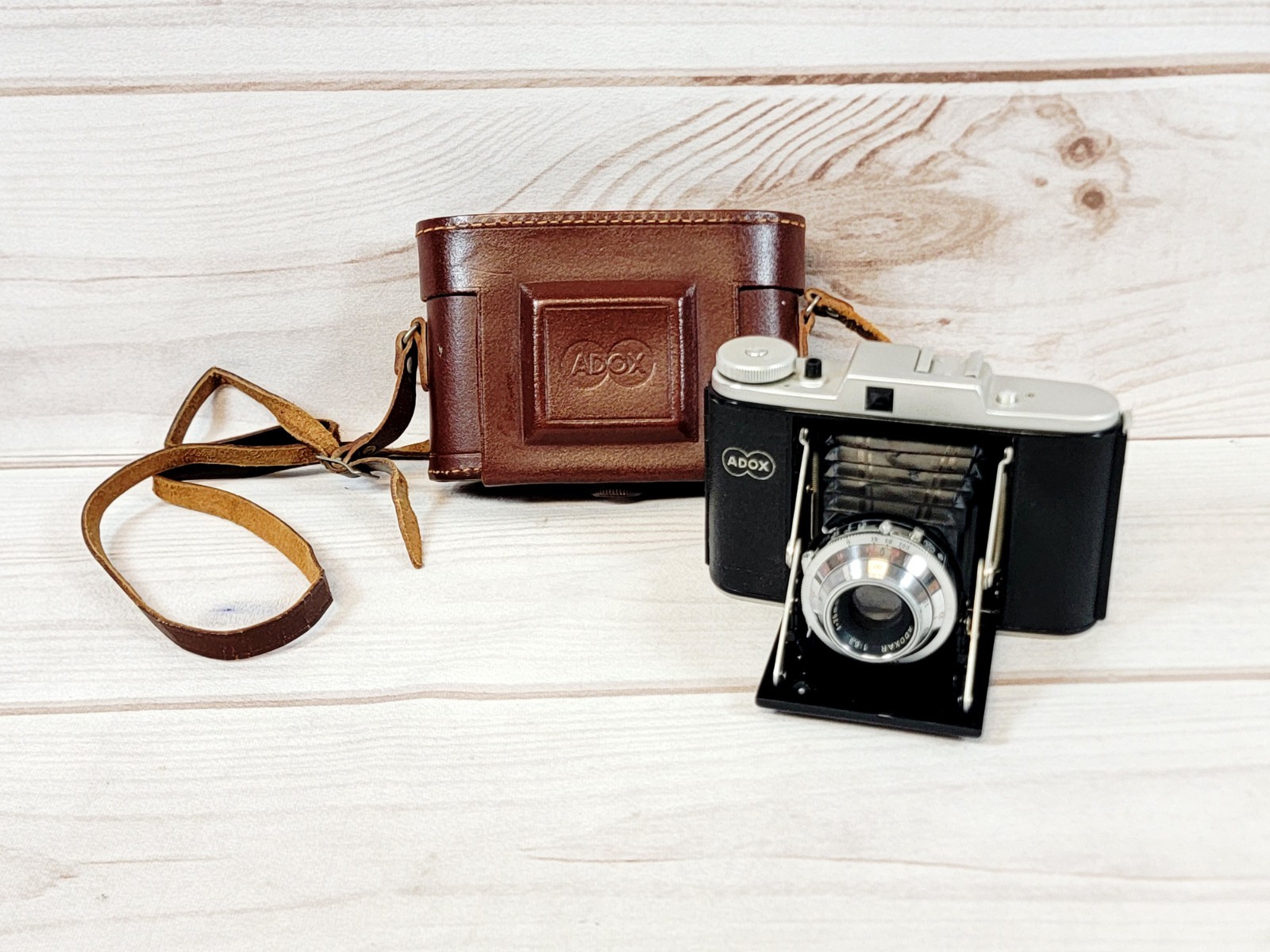
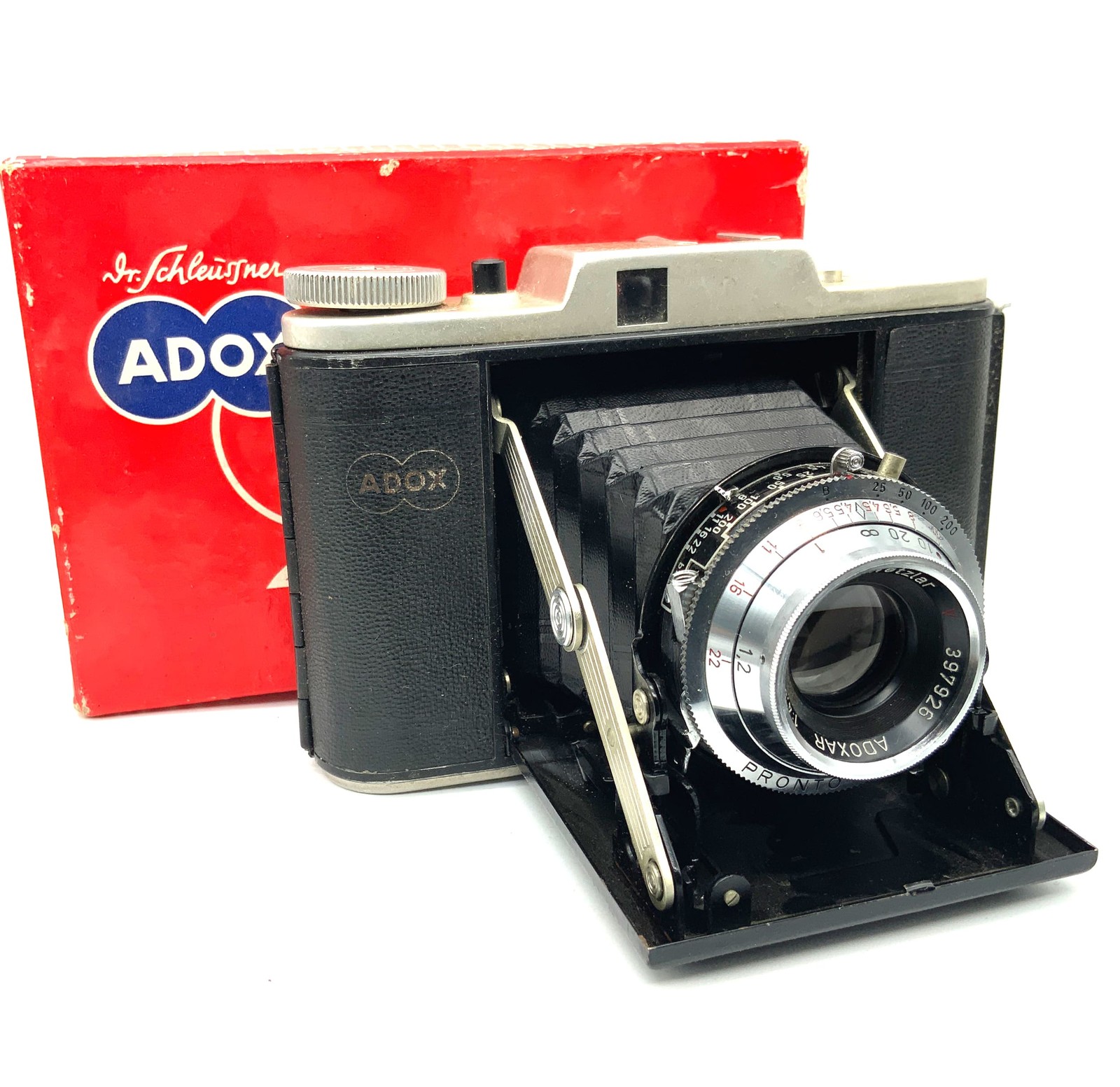
Pop open the front panel and the Adox Golf unfolds like a forgotten lunchbox from a 1950s office desk—compact, utilitarian, but with a quiet elegance in its brass-rimmed lens and knurled focusing knob. It fits in a coat pocket, yet inside it carries the heart of a proper medium format machine: a 75mm lens throwing 6x6cm negatives onto 120 film. That’s twelve square centimeters of image real estate, more than four times what a 35mm frame offers, and it shows. Even with its modest optics, the Golf delivers a depth and tonal richness that feels like stepping out of a tunnel into open air. You don’t just see the photo—you feel the grain, the slight sag in the corners, the way light bleeds softly into shadow like ink on damp paper.
But let’s be clear: this isn’t a precision instrument. The Golf was built in Wiesbaden during the West German economic boom, aimed at the aspiring amateur who wanted something better than a box camera but couldn’t afford a Rolleiflex. It succeeded by being simple, compact, and relatively affordable. Over 400,000 were made across its various models, a sign that plenty of people were happy to trade automation for portability. You set exposure manually, guess focus using a distance scale, and peer through a rudimentary optical viewfinder that’s more of a framing suggestion than a reliable guide. The shutter must be cocked separately with a lever on the lens assembly—easy to forget, especially when you’ve got the camera to your eye and the moment’s slipping away. Miss it, and you’ve got a perfectly composed shot that didn’t expose.
There are multiple versions, and the naming is a tangle. The original Golf I, II, and IV (yes, no III) came with Steinheil Cassar lenses—either f/4.5 or the faster f/3.5—and were paired with Pronto or Prontor-S shutters, the latter offering speeds up to 1/300 sec and a self-timer. Then came the Golf 63 and 63 S in 1954, marketed as the “Volkskamera” (people’s camera), equipped with a slower f/6.3 Adoxar triplet lens made by Will in Wetzlar. The “S” stood for *Selbstauslöser*—self-timer—meaning it had a Pronto shutter instead of the basic Vario. By 1958, ADOX upgraded some models to the brighter Adoxar f/4.5, creating the Golf 45 S. So if you’re hunting for one today, you’re not just buying a Golf—you’re buying a specific chapter in its evolving, cost-conscious design story.
Specifications
| Manufacturer | Adox, Wiesbaden-Biebrich, West Germany |
| Production Years | 1952–1959 |
| Original Price | 49.75 DM (Golf 63, 1954); up to 169 DM (Mess-Golf IV) |
| Film Format | 120 roll film |
| Image Size | 6x6 cm |
| Lens | Adoxar 75mm f/6.3 (triplet, Will, Wetzlar) or Steinheil Cassar 75mm f/4.5 or f/3.5 (Tessar-type) |
| Aperture Range | f/6.3 to f/32 (Adoxar); f/3.5 to f/22 (Cassar) |
| Shutter | Vario, Pronto, or Prontor-S (Alfred Gauthier, Calmbach) |
| Shutter Speeds (Vario) | B, 1/25, 1/50, 1/200 sec |
| Shutter Speeds (Pronto) | B, 1/25, 1/50, 1/100, 1/200 sec (with self-timer) |
| Shutter Speeds (Prontor-S) | B, 1, 1/2, 1/5, 1/10, 1/25, 1/50, 1/100, 1/300 sec (with self-timer and flash sync) |
| Focusing | Manual, via front lens element rotation; distance scale from 1m to infinity |
| Viewfinder | Simple optical (Newton-style) viewfinder |
| Flash Sync | Yes, via PC socket on shutter (Pronto and Prontor-S models) |
| Metering | None |
| Weight | 475 g (1.05 lbs) |
| Dimensions (closed) | 135 x 90 x 40 mm |
| Dimensions (open) | 135 x 90 x 90 mm |
| Accessories | Hot shoe for flash or rangefinder, ISO thread for cable release, 1/4" tripod socket |
| Special Features | Folding bellows design, red window for frame counting, double exposure prevention via shutter release lock |
Key Features
Triplet Lens, Big Character
The Adoxar triplet on the Golf 63 isn’t sharp by modern standards—corners blur early, and contrast softens wide open—but that’s part of its magic. At f/6.3, the lens produces a gentle vignette and a dreamy fall-off that feels more poetic than flawed. Stopped down to f/11 or f/16, it tightens up enough for respectable contact prints or modest enlargements. The earlier Steinheil Cassar lenses, especially the f/3.5 version, are optically superior with better edge-to-edge performance, but they don’t have the same lo-fi romance. If you’re chasing that soft, nostalgic look—slightly hazy skies, faces glowing with imperfection—the f/6.3 triplet is the one to find. And yes, collectors note: the Cassar models command higher prices, but for pure aesthetic pleasure, the “worse” lens might be the better choice.
Folding Design, Pocketable Medium Format
At just 40mm thick when collapsed, the Golf is one of the most portable 6x6 cameras ever made. The bellows fold flat, the lens retracts, and the whole thing slips into a jacket pocket like a pack of cigarettes. This wasn’t accidental—it was a direct response to the success of the Agfa Isolette, which had proven there was a market for compact medium format. The Golf’s design borrows heavily from that lineage, but with a slightly squarer profile and a more industrial finish. The folding mechanism is robust, though age can dry out the leather and stiffen the struts. When opening, the lens standard pops forward with a satisfying snap, but over time the spring tension can weaken, leaving the lens wobbling mid-exposure. It’s a failure mode to watch for: a shaky lens standard means soft images, no matter how steady your hands.
Manual Everything, But That’s the Point
There’s no light meter, no coupled rangefinder (except on the rare Mess-Golf variants), and no automatic film advance. You load the film via the back, advance with a knob, and count frames using the red window—just like a Brownie. Exposure is set by guesswork or external meter, focus by estimating distance. The viewfinder is small and dim, with parallax error that worsens at close range. None of this is a flaw—it’s the ritual. The Golf forces you to slow down, to think about light, distance, and composition before you even cock the shutter. That separate cocking lever? Annoying? Yes. But it also means you can’t fire twice by accident, and the physical separation between cocking and releasing makes each shot feel intentional. This isn’t a camera for street photography sprints. It’s for strolls, for quiet moments, for when you want the process to be part of the picture.
Historical Context
The Adox Golf emerged in 1952, right as West Germany’s postwar economy began to hum. Photography was no longer a luxury—it was becoming a middle-class pastime. Companies like Agfa, Kodak, and Wirgin were churning out affordable cameras to pair with their film, and ADOX was no different. Originally a photochemical firm founded by Carl Schleussner in the 1860s, ADOX had long supplied film and paper. By acquiring Wirgin’s camera operations in Wiesbaden (before returning them postwar), they gained manufacturing expertise and began producing their own cameras to drive film sales. The Golf was part of that strategy: a simple, stylish machine that encouraged people to buy ADOX film.
It entered a crowded field. The Agfa Isolette II was its most direct rival—similar size, same 6x6 format, comparable lens options. Others like the Zeiss Ikon Nettar, Voigtländer Perkeo, and Balda Baldix offered variations on the folding medium format theme. What set the Golf apart was its aggressive pricing and incremental updates. The 1954 Photokina launch of the Golf 63 as a “Volkskamera” signaled a shift toward even broader accessibility. By using a cheaper triplet lens and simplified Vario shutter, ADOX could undercut competitors while still offering the allure of medium format. It wasn’t the best camera in its class, but it was one of the most democratic.
Collectibility & Value
Today, the Adox Golf trades in the “affordable vintage” zone—rarely exceeding $50, even in excellent condition. The base Golf 63 with f/6.3 lens and Vario shutter is the most common, often found in estate sales or online auctions for $10–$20. These are functional but often neglected: dried leather, stiff focusing, fogged viewfinders. The real value lies in the rarer models: the Mess-Golf with uncoupled rangefinder, the Golf IV with f/3.5 Cassar, or late-model Golf 45 S units. These can fetch $60–$100 when fully functional and cosmetically clean.
Common failures are predictable. The Vario shutter often sticks at 1/200 sec, especially if unopened for decades. The cocking lever can seize, and the bellows develop pinholes—check by shining a flashlight inside in a dark room. The red window can fade or crack, making frame counting guesswork. Most critically, the lens mounting can loosen, causing misalignment and soft focus. A tight front standard is essential.
Before buying, test every shutter speed with a timing app, inspect the bellows with bright light, and confirm the film advance is smooth. If the film counter doesn’t reset, the double-exposure lock may be broken. And be wary of “mint” listings with pristine paint but untested mechanics—cosmetic condition means little if the shutter won’t fire. For $20 and a roll of ADOX CHS 50, you can own a piece of German photo history that still produces haunting, lyrical images. Just don’t expect it to be easy.
eBay Listings


As an eBay Partner, we earn from qualifying purchases. This helps support our independent vintage technology research.