Adox Adox 300 (1956–1957)
A 35mm camera that lets you swap film mid-roll like a medium format pro, wrapped in a hulking German chassis that feels like a bank vault with a lens.
Overview
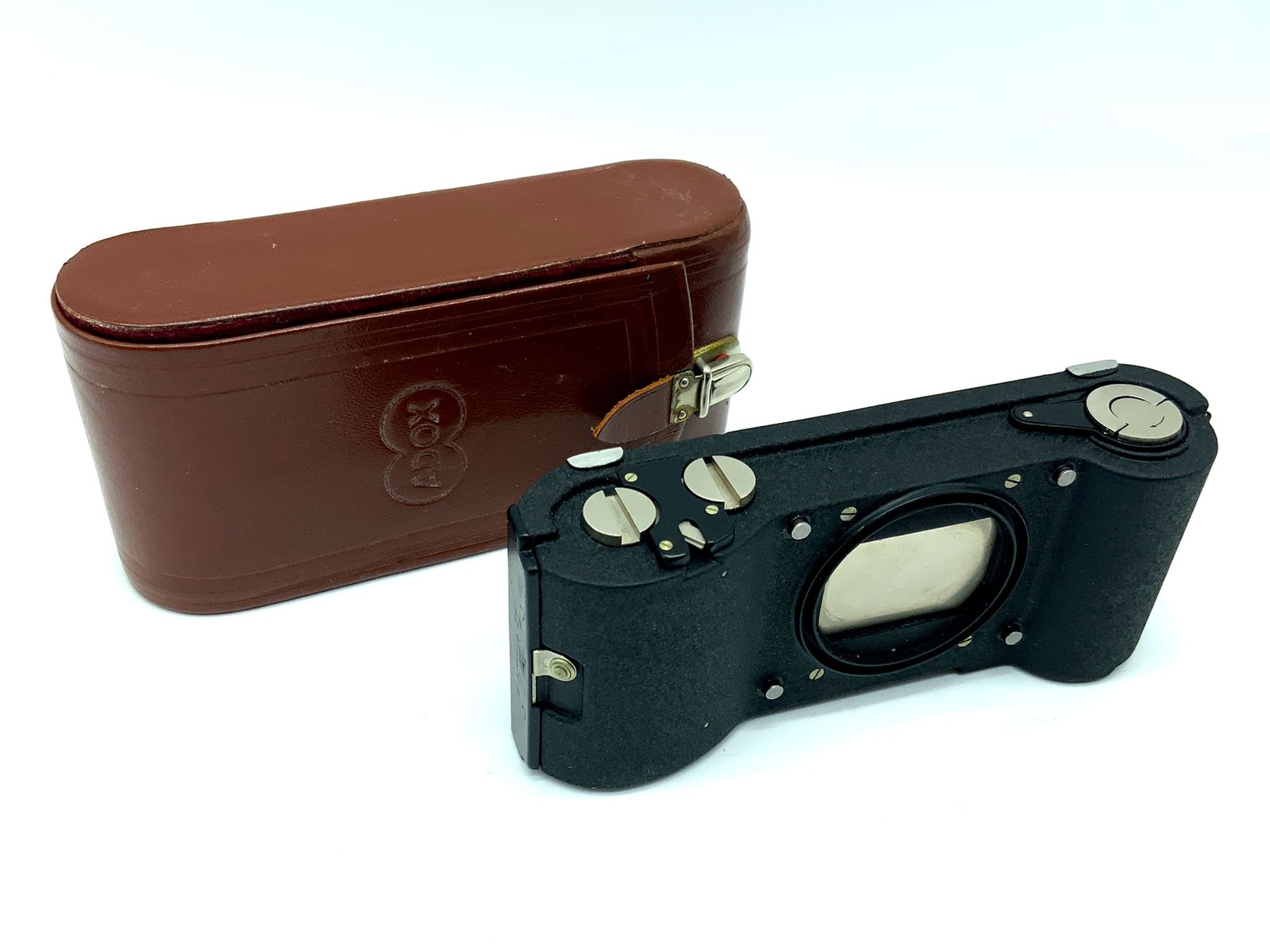
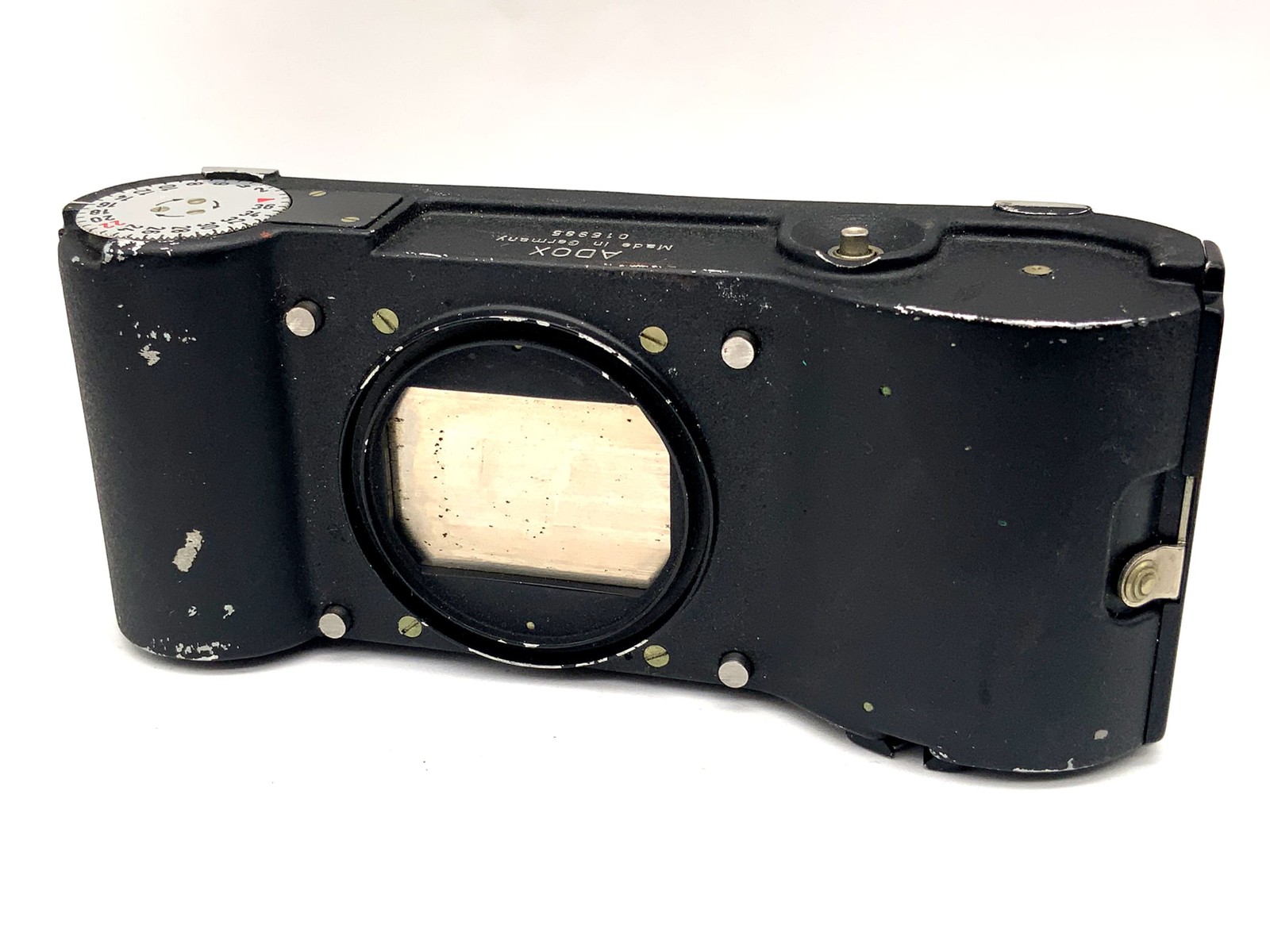
There’s a moment when you first open the back of an Adox 300 and see the film magazine slide out like a drawer from a safe—solid, machined, and sealed with a dark slide—that you realize this isn’t just another 1950s viewfinder camera. It’s a relic of a moment when German engineering flirted with radical ideas, and somehow, a company better known for photo paper and chemicals built a 35mm camera that could hot-swap film like a Hasselblad. You can be halfway through a roll of Tri-X, decide you need slide film for a sunset, and swap in a fresh magazine in seconds—no rewinding, no lost frames, no praying the leader doesn’t snap. That alone makes the Adox 300 one of the rarest birds in the vintage camera world: a 35mm with interchangeable backs, a feature so uncommon it borders on mythical.
But the Adox 300 isn’t just about that one party trick. It’s a full-bodied, all-metal beast that weighs in at over 800 grams—more than a Leica M3—wrapped in thick black leatherette that feels like it could survive a fall down a flight of stairs. It’s not elegant, not really, but it’s imposing. The lens is a 45mm f/2.8, either a Steinheil Cassar (three elements) or the rarer Schneider-Kreuznach Xenar (four elements), both mounted in a Compur-Rapid or Synchro-Compur leaf shutter that clicks with the kind of precision you’d expect from a Swiss watch. The shutter speeds run from 1 second to 1/500th, with a B setting for long exposures, and the whole thing is advanced by a large knurled ring around the lens barrel that you push down in two strokes. It’s a strange, almost industrial action, but it’s satisfying—each click feels like you’re cocking a tiny cannon.
Despite its heft and complexity, the Adox 300 is missing one thing that most photographers from its era would consider essential: a rangefinder. Focus is entirely by scale, meaning you estimate distance and dial it in manually. That’s not a dealbreaker—zone focusing at f/8 or f/11 works fine for street or travel shots—but it does mean you’re not going to nail focus on a fleeting expression at f/2.8 unless you’re very good at guessing. The viewfinder is simple, bright, and uncluttered, but it offers no parallax correction, no frame lines, and no focusing aid. What you see is roughly what you get, and the rest is up to you.
On top of the camera sits an uncoupled selenium light meter—the Bewi Automat—calibrated in Exposure Values (EV). You set your film speed (12–800 ASA), point the meter at your subject, and a needle swings to indicate the correct EV. Then you manually set that EV on the lens barrel, where shutter speed and aperture are linked: turn the ring, and both change in tandem to maintain the same exposure. It’s a clever system, and once you get used to thinking in EVs, it’s fast. But the selenium cells degrade over time, and many of these meters are now dead or erratic. Worse, they can’t be easily replaced—the Bewi Automat was a proprietary unit, and no modern equivalents fit without modification.
Specifications
| Manufacturer | Dr. C. Schleussner Fotowerke GmbH |
| Production Years | 1956–1957 |
| Original Price | Approx. £62 (West Germany, 1956) |
| Film Format | 135 (35mm) |
| Lens | 45mm f/2.8 Steinheil Cassar (3 elements) or Schneider-Kreuznach Xenar (4 elements) |
| Shutter | Compur-Rapid or Synchro-Compur leaf shutter |
| Shutter Speeds | 1 second to 1/500th, B |
| Aperture Range | f/2.8 to f/22 |
| Focus | Manual scale focusing, 3.5 ft to infinity |
| Viewfinder | Direct-vision optical viewfinder, no frame lines or parallax correction |
| Exposure Meter | Uncoupled Bewi Automat selenium cell meter, EV scale |
| Flash Sync | X and M sync via PC terminal and cold shoe |
| Self-Timer | Yes, mechanical |
| Remote Shutter Release | Yes, cable release socket |
| Interchangeable Film Magazines | Yes, proprietary metal cassettes with dark slides |
| Film Advance | Dual-stroke lever around lens barrel |
| Film Counter | Mechanical, visible through top-plate window |
| Weight | 840–850 grams |
| Dimensions | Approx. 150 x 85 x 60 mm |
| Construction | Die-cast metal body, black leatherette covering |
Key Features
The Magazine System: 35mm with Medium Format Flexibility
The Adox 300’s defining feature isn’t just rare—it’s borderline revolutionary for a 35mm camera. Each film magazine is a self-contained unit with its own pressure plate, film rails, and dark slide. You load film into the magazine outside the camera, close the dark slide, and insert it into the body. Once locked in, you open the slide from the outside, advance the film, and start shooting. When you want to switch film, you close the dark slide (preserving the unexposed portion), remove the magazine, and slot in another. It’s the same workflow as a Bronica or Mamiya RB, but in a 35mm body. This wasn’t just for convenience—it was aimed at working photographers who needed to switch between film types quickly, like going from color to black-and-white during an event. Kodak tried something similar with the Ektra, but the Adox system is simpler, more robust, and actually works. The magazines are marked “Adox” or sometimes “Leitz,” suggesting a possible shared manufacturing line, though no official connection has been confirmed.
EV-Coupled Shutter and Aperture
The lens barrel is where the Adox 300 becomes more than just a mechanical tank. The outer ring sets focus, the middle ring links shutter speed and aperture via EV, and the inner ring allows you to decouple them for manual control. At a glance, you can spin the middle ring to match the EV reading from the meter, and both shutter and aperture adjust together. Need 1/125th at f/8? That’s EV 12. See 12 on the meter? Set it, shoot. It’s a system that rewards understanding exposure as a unified concept rather than two separate dials. And because it’s a leaf shutter, flash sync is available at all speeds, including 1/500th—something SLRs wouldn’t achieve for years. The only catch? The EV system only works if the meter is alive. And after 70 years, most aren’t.
Build Quality and Ergonomics
This is a camera that was built to last. The body is all metal, the controls are machined, and the film magazine latch feels like it could survive a bomb blast. The left-hand film advance lever is large and positive, though it requires two strokes to fully cock the shutter—a quirk that prevents accidental double exposures but can feel slow in rapid-fire situations. The shutter release is on top, threaded for a cable, and the self-timer lever is tucked just behind it. The cold shoe is substantial, and the tripod socket is centered and robust. What it lacks in compactness, it makes up for in solidity. Holding it, you don’t feel like you’re using a tool—you feel like you’re operating a machine.
Historical Context
The Adox 300 arrived in 1956, a time when 35mm photography was exploding in popularity, but most cameras were still aimed at amateurs. Leica and Contax dominated the rangefinder market, while Zeiss Ikon and Braun offered elegant, compact options. Adox, primarily a film and paper company, wasn’t known for cameras—but they had dabbled before, rebadging Wirgin models in the 1930s. The 300 was their first original 35mm design in the postwar era, and it showed ambition. Instead of chasing the rangefinder race, they went sideways, borrowing from medium format to solve a real problem: film flexibility.
At the time, only a handful of 35mm cameras offered interchangeable backs—the Kodak Ektra being the most famous, but it was large, expensive, and fragile. The Adox 300 was simpler, more practical, and built like a tank. But it came too late to gain traction. By the late 1950s, SLRs were on the rise, and the future belonged to through-the-lens metering and interchangeable lenses, not interchangeable film backs. Adox didn’t have the marketing muscle of Zeiss or Leica, and the 300 was never exported to the U.S. It remained a European curiosity, advertised in German, Dutch, and Danish publications, but never achieving wide distribution. Production likely lasted only a year or two, which explains its rarity today.
Collectibility & Value
The Adox 300 is a collector’s camera, not a daily shooter—though that doesn’t mean it can’t make great images. In excellent condition, with a working meter and both magazines, it can fetch $800–$1,200 on the open market. More commonly, you’ll find them in the $400–$600 range, often with dead meters, stiff shutters, or missing magazines. The Schneider Xenar version commands a premium, but the Steinheil Cassar is no slouch—it’s a classic anastigmat design that renders images with a soft, vintage character, sharp in the center and gently rolling off at the edges. The Xenar is noticeably sharper, especially wide open, but both lenses are capable of excellent results.
What breaks? Almost everything, given the age. The selenium meter is the first casualty—most are dim or nonfunctional, and replacing them requires either a risky transplant or living without. The Compur shutters can stick, especially at slower speeds, and the self-timer mechanism is prone to gumming up. The film magazine dark slides can warp, leading to light leaks, and the latch mechanism on the camera body can become finicky if not cleaned. The leatherette often peels, and the film counter window can crack. And because the camera was never mass-produced, spare parts are nearly nonexistent.
Before buying, check that the shutter fires cleanly at all speeds, the self-timer works, the film advance cocks the shutter fully, and the magazines seat and lock securely. Test the meter in bright light—if the needle doesn’t move, assume it’s dead. Look for corrosion on the battery-free contacts (yes, it runs on light alone), and make sure the film rails in the magazines aren’t bent. A complete set with two magazines, case, filters, and manual is a unicorn, but it does happen.
eBay Listings


As an eBay Partner, we earn from qualifying purchases. This helps support our independent vintage technology research.