ADOX 66
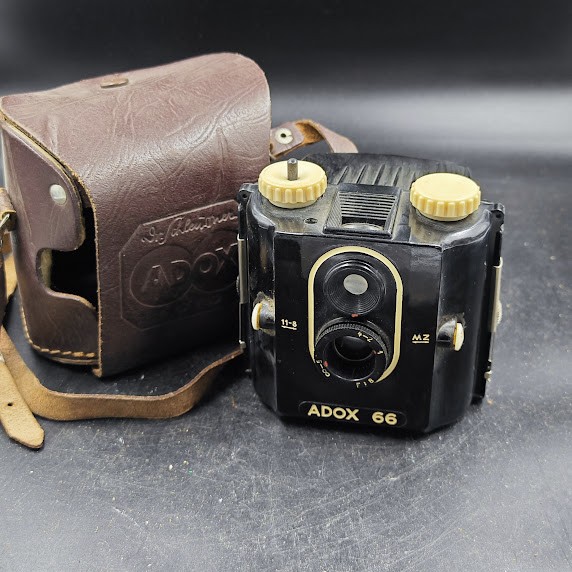
The Adox 66 is a medium-format box camera produced between 1956 and 1960 that mimics the appearance of a twin-lens reflex (TLR) camera but functions as a simple fixed-lens box camera. Despite its TLR-like design, it lacks a true reflex viewing system and instead uses a basic optical viewfinder, making it a stylistic homage rather than a functional TLR.
Overview
Manufactured by Adox Fotowerke GmbH in Bad Saarow, Germany, the Adox 66 was introduced during a period when medium-format cameras were transitioning from professional tools to more accessible consumer products. The camera was marketed toward amateur photographers seeking the prestige and aesthetic of a TLR without the complexity or cost of true reflex mechanisms. Its design clearly borrows from the Rolleiflex and other high-end TLRs of the era, featuring a two-lens facade with a viewing lens positioned above the taking lens. However, internally, the Adox 66 operates as a basic box camera with fixed focus and minimal controls.
The Adox 66 was part of a broader trend in post-war Germany where companies sought to capitalize on the popularity of premium camera designs by offering simplified, lower-cost alternatives. Adox, primarily known for its photographic films and papers, ventured into camera production to expand its brand presence. The Adox 66, along with models like the Adox Franca and Adox Adrette, represented this strategic diversification. While not a technical innovator, the Adox 66 holds historical interest as an example of mid-century design mimicry and mass-market aspirations in the photographic industry.
Specifications
| Specification | Value |
| Type | Box camera (pseudo-TLR design) |
| Film Format | 120 film |
| Image Format | 6×6 cm |
| Years Produced | 1956–1960 |
| Lens Mount | Fixed lens (non-interchangeable) |
| Taking Lens | Adox Anastigmat f/4.5, 75 mm |
| Viewing Lens | Simulated only; no optical function |
| Focus | Fixed focus (optimized for ~10 ft / 3 m to infinity) |
| Shutter | Compur-Rapid shutter |
| Shutter Speeds | B, 1–1/300 second |
| Aperture Range | f/4.5 to f/22 |
| Metering | None (unmetered) |
| Exposure Modes | Manual only |
| Viewfinder | Optical direct-vision viewfinder with frame lines |
| Focusing Screen | N/A |
| Film Advance | Manual knob wind with red window for frame numbering |
| Frame Count | 12 exposures per 120 roll |
| Flash Sync | Yes, via PC sync socket |
| Tripod Socket | 1/4"-20 thread (standard) |
| Dimensions | Approx. 110 mm (H) × 100 mm (W) × 130 mm (D) |
| Weight | Approx. 750 g (without film) |
| Construction | Bakelite body |
Key Features
- Pseudo-TLR Design: Styled to resemble a twin-lens reflex camera with upper and lower lens housings, though the upper lens is purely cosmetic.
- Quality Shutter Mechanism: Equipped with a Compur-Rapid shutter, offering a wide range of shutter speeds from 1 second to 1/300 second plus Bulb, uncommon in similarly priced box cameras.
- 75mm f/4.5 Anastigmat Lens: A multi-coated, four-element lens providing sharp images for a fixed-focus camera, especially in good lighting conditions.
- PC Flash Sync: Includes a standard PC terminal for external flash, enhancing versatility for indoor or low-light photography.
- Red Window Frame Counter: Allows manual verification of film position, typical of 120 film cameras of the era.
Historical Context
The Adox 66 was released at a time when German camera manufacturers were rebuilding their reputations after World War II. While companies like Rollei and Zeiss Ikon produced high-quality TLRs and rangefinders, there was a growing market for affordable alternatives that offered similar aesthetics and medium-format image quality. Adox, originally a subsidiary of Agfa, leveraged its reputation in film production to enter the camera market with budget-friendly models. The Adox 66 was positioned as a step-up from basic 6×6 box cameras, offering a more sophisticated appearance and better optics without the mechanical complexity of a true TLR.
Competitors included the Wirgin Edinex 66, the Flexaret III (a true TLR), and the Soviet-made Lubitel 166. Unlike these models, the Adox 66 did not feature a reflex mirror or ground-glass focusing, limiting its appeal to serious photographers. However, its use of a Compur shutter—a component typically found in higher-end cameras—distinguished it from fully plastic or rudimentary competitors. Market reception was modest; while praised for its build quality and lens performance, the misleading TLR appearance and fixed focus limited its long-term success. Production ceased around 1960 as Adox refocused on its core film and paper business.
Collectibility & Value
The Adox 66 is a niche collectible, sought after primarily by enthusiasts of vintage German cameras and those interested in design curiosities of the mid-20th century. Due to its limited production run and the company’s greater fame for film, original examples in good condition are relatively rare. Current market values typically range from €150 to €300, depending on shutter functionality, lens clarity, and overall condition. Fully operational units with a clean lens and accurate shutter speeds command the higher end of the range.
When purchasing an Adox 66, collectors should verify the functionality of the Compur-Rapid shutter across all speeds, as these leaf shutters are prone to oil drying or sticking over time. The lens should be free of fungus, haze, or separation, though replacements are occasionally available due to the Anastigmat’s similarity to other 75mm lenses of the era. The red window cover mechanism should also be checked for proper alignment to prevent film fogging. Because the camera lacks a light meter and relies on manual settings, no battery is required—adding to its usability for film shooters today.
Similar Cameras
- Wirgin Edinex 66 – Another German-made pseudo-TLR with a fixed-focus lens and simple mechanics.
- Lubitel 166 Universal – A true twin-lens reflex from the USSR, fully functional and more capable, but less refined in build.
- Flexaret III – Czech TLR with fully functional reflex viewing and focusing, representing a more advanced alternative.
- Yashica 44 – Compact 6×4.5 TLR-style camera with actual reflex viewing, though smaller format.
- Rolleicord IIa – Entry-level true TLR from Rollei, offering similar image quality with full manual control and focusing.
Repair & Maintenance
The Adox 66 requires no batteries and is mechanically simple, relying entirely on manual operation. The Compur-Rapid shutter is the most critical component and may require servicing by a technician experienced in vintage leaf shutters. Common issues include slow shutter speeds due to dried lubricants, sticky blades, or misaligned aperture leaves. The fixed-focus lens is generally robust, but disassembly should be avoided unless necessary, as coatings and alignment can be delicate. The film advance knob and red window should be inspected for smooth operation and light-tightness. Regular use with fresh 120 film is recommended to ensure proper frame spacing and to verify the red window alignment. With proper care, the Adox 66 remains a functional and historically interesting medium-format camera for collectors and film photographers alike.
eBay Listings


As an eBay Partner, we earn from qualifying purchases. This helps support our independent vintage technology research.