Adox Polomat 2 (1959–1964)
A selenium meter glinting in the sun, a chassis mostly of plastic, and a Schneider-Kreuznach lens that turns ordinary light into something tender and dreamlike
Overview
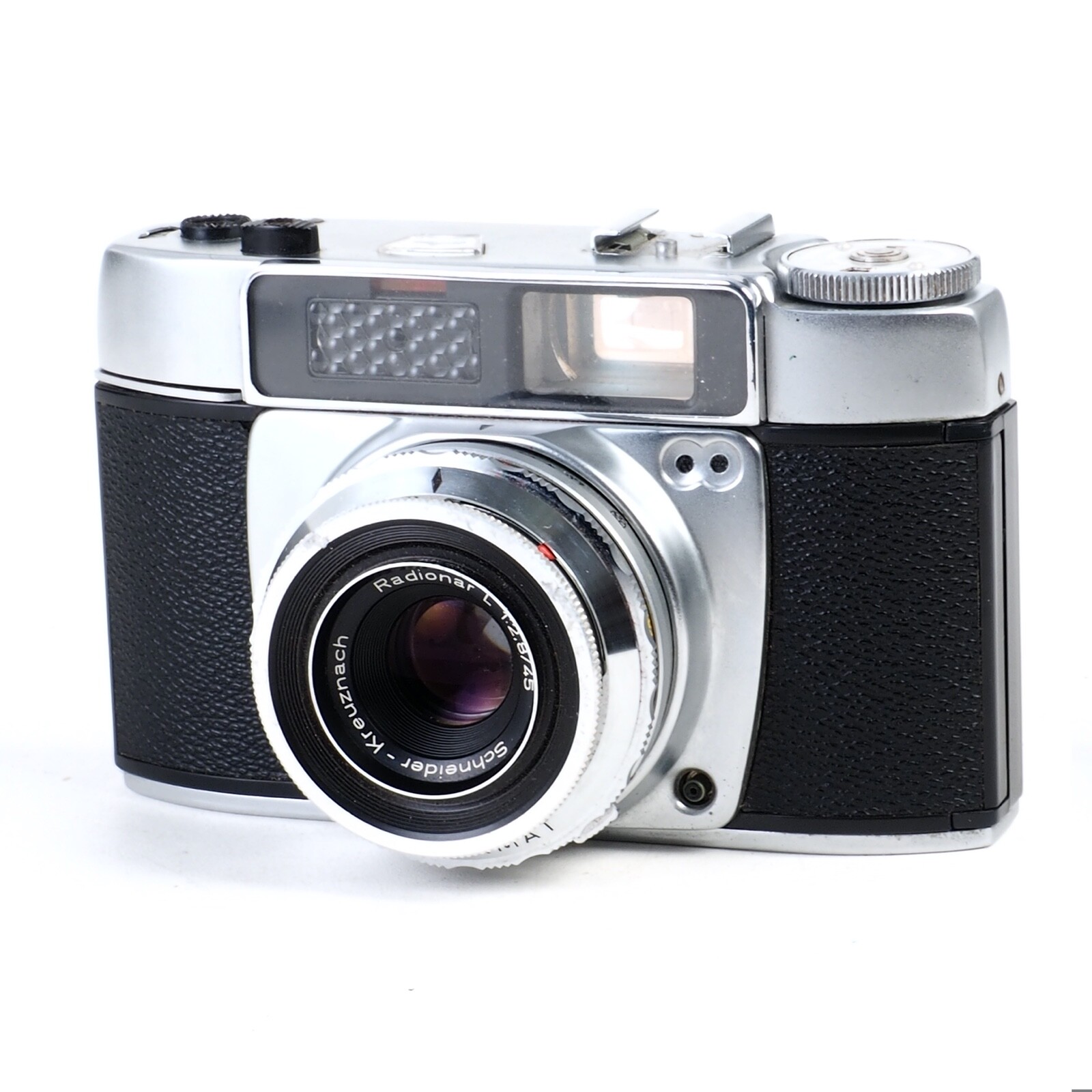
Hold an Adox Polomat 2 and you’ll feel the paradox immediately: it’s featherlight, almost toylike, yet built with enough precision that it doesn’t feel cheap. The body is mostly plastic—a bold choice for 1959—but the top and bottom plates are metal, and the lens mount, film pressure plate, and winding crank are all metal too, suggesting Adox knew where strength mattered. What really catches the eye is the selenium meter dome perched above the lens, its concentric rings catching light like a sunflower. It doesn’t need batteries, of course—this is the early ‘60s—but it does demand clean glass and a gentle hand. The Polomat 2 isn’t a rangefinder, but a viewfinder camera with a simple optical window, and the frame lines? They’re not there. You estimate, guess, compose loosely. That’s part of its charm. Or its frustration, depending on your mood.
It sits in the middle of Adox’s Polo family, above the basic Polo and Polo 1 but below the more advanced Polomat 1S and the fully automatic Polomatic 3S. Where the earlier Polo models had basic Adoxar lenses and limited shutter speeds, the Polomat 2 steps up with a Schneider-Kreuznach Radionar L 1:2.8/45mm—an underrated lens that delivers softness with character, not just blur. It’s not tack-sharp wide open, but it doesn’t try to be. It renders skin tones warmly, handles backlight with surprising grace, and gives a dreamy, almost painterly quality at f/2.8 to f/5.6. Stop it down, and it tightens up enough for competent snapshots. The shutter is a Prontormat unit with speeds from 1/30 to 1/500 second, plus B, and it’s cocked automatically with film advance—no separate cocking lever. That’s convenient, but the winding lever has a short throw and a slightly mushy feel, and some users report needing two cranks to fully advance the film, a quirk that might stem from worn gears or dried lubricant in un-serviced examples.
The real magic—and the real challenge—lives in the exposure system. The selenium meter reads ambient light and projects two needles into a small window on the top plate. You adjust aperture and shutter speed until the needles align, then fire. Simple in theory, but the viewfinder doesn’t show the match-needle display, so you’re constantly looking down and up, breaking your composition. Later models like the Polomat 1S fixed this by reflecting the meter readout into the viewfinder, but the Polomat 2 makes you work for it. And if the meter cell is cloudy, scratched, or just worn out after 60 years? Good luck. These cells degrade over time, and replacements are nonexistent. You can still use the camera—just meter with a handheld device or go full zone system—but the soul of the Polomat 2 is that integrated, battery-free exposure dance. Lose that, and you’ve lost part of the experience.
Specifications
| Manufacturer | Adox |
| Production Years | 1959–1964 |
| Film Format | 135 (35mm) |
| Lens | Schneider-Kreuznach Radionar L 1:2.8/45 mm |
| Aperture Range | f/2.8 to f/16 |
| Shutter Type | Prontormat |
| Shutter Speeds | 1/30, 1/60, 1/125, 1/250, 1/500 second, B |
| Metering | Integrated selenium cell, match-needle (top plate) |
| Viewfinder | Direct optical viewfinder, no parallax correction |
| Focusing | Scale focusing, 1m to ∞ |
| Flash Sync | PC terminal, M/X switch |
| Frame Counting | Manual reset, countdown type |
| Body Material | Plastic body with metal top/bottom plates |
| Weight | Approx. 420 g (without film) |
| Dimensions | 110 x 65 x 40 mm |
| Mount | Fixed lens |
| Accessories | Optional cable release, lens hood |
| Color Options | Black leatherette, chrome trim |
Key Features
Schneider-Kreuznach Radionar L: The Soul of the Camera
The Radionar L isn’t a household name like a Summicron or a Tessar, but it’s a lens with quiet dignity. The “L” stands for lanthanum oxide in the glass formulation—a rare earth element that improves refractive index and reduces aberrations. It’s not a high-speed lens by modern standards, but f/2.8 was respectable in this class. What it lacks in edge-to-edge sharpness it makes up for in character: images have a soft glow wide open, with gentle fall-off and a three-dimensional warmth. The coating helps with flare resistance, though shooting into direct sun can still produce soft veiling. It’s not a lens for architectural precision, but for portraits, street scenes, and moody interiors, it delivers a look that feels distinctly analog. And knowing it’s a Schneider—built to their standards, even if not badged as a Xenar or Curtagon—adds a layer of quiet confidence.
Prontormat Shutter: Simplicity with a Catch
The Prontormat shutter is fully mechanical and self-cocking, meaning every film advance resets the shutter. That’s convenient for rapid shooting, but the mechanism relies on a delicate spring and linkage system. In well-maintained examples, it’s reliable, but in neglected ones, the film advance can feel sticky or incomplete. Some owners report that the shutter fails to fire even after winding, a sign of misalignment or dried grease in the linkage. The speeds themselves are accurate when serviced, but the lack of a self-timer means long exposures require a cable release—fortunately, the shutter button has a threaded insert for one. The B setting works as expected, but there’s no lock, so holding it open for bulb exposures demands a steady hand or a locking cable.
Selenium Meter: Elegant, Fragile, Irreplaceable
The selenium meter is the Polomat 2’s crown jewel and its Achilles’ heel. It requires no battery, ages gracefully if protected from moisture and extreme heat, and gives a direct, intuitive readout. But selenium cells degrade. They lose sensitivity, especially in low light, and if the top layer is cracked or cloudy, they can become useless. Unlike CdS meters, they can’t be recalibrated or replaced with modern equivalents. There’s no workaround beyond external metering. And because the match-needle display is only on the top plate—unlike the Polomat 1S, which projects it into the viewfinder—you have to break your eye from the finder to check exposure. It’s a design compromise that feels dated even for the early ‘60s, but it keeps the camera’s profile clean and the cost down.
Historical Context
The Adox Polomat 2 emerged in 1959, a time when 35mm viewfinder cameras were hitting their stride. Companies like Leica and Contax had long dominated the high end, but the market was swelling with affordable, stylish cameras from Germany, Japan, and beyond. Adox, originally a film company, had dabbled in cameras since the 1930s but re-entered the game in the late ‘50s with the Polo series. The Polomat 2 wasn’t trying to beat a Leica—it was aiming at the snapshot shooter who wanted something better than a Brownie but didn’t need rangefinder precision. It competed with the Kodak Retina IIIS, the Zeiss Ikon Super Ikonta, and early Canon and Minolta models, but at a lower price point. The use of plastic in the body was forward-thinking—reducing weight and cost—but it also signaled that this wasn’t a professional tool. The Schneider lens, however, was a statement: Adox wasn’t cutting corners on optics. And by using a selenium meter instead of CdS, they avoided the battery dependency that would plague later models. It was a camera of its moment—on the cusp of automation but still rooted in mechanical simplicity.
Collectibility & Value
Today, the Adox Polomat 2 is a quiet collector’s piece—respected but not hyped. Clean, working examples sell for $120 to $200 on the open market, with mint+ specimens occasionally reaching $250 if the meter is responsive and the lens is flawless. Non-working or cosmetically damaged units can be had for $60–$90, often as “project cameras.” The biggest red flag is the selenium meter: if it’s dead, the camera loses a significant part of its value and usability. Lens haze, fungus, or separation are also common in un-stored examples, though the Radionar is generally well-sealed. The plastic body can crack at stress points—especially around the film advance and back latch—so check for hairlines or warping. The film pressure plate is metal, which is good, but the film rails are plastic and can wear over time, leading to uneven spacing or transport issues.
Serviceability is a mixed bag. The shutter and lens can be disassembled by a skilled technician, but parts are scarce. The Prontormat shutter isn’t as common as a Compur or Synchro, so replacements aren’t an option. Cleaning the meter cell is possible, but reactivation isn’t. If you’re buying one, test the meter in varying light—see if the needles move smoothly and respond to shadows. Check the film advance: one full stroke should cock the shutter and advance the film reliably. Look through the viewfinder for haze or residue. And always ask if the camera has been recently serviced. A CLA (clean, lubricate, adjust) from a vintage camera specialist runs $80–$120, which might be worth it for a good donor body. But if the meter’s dead and the shutter is sticky, you’re better off saving for a Polomat 1S or a Canonet G-III QL17.
eBay Listings
As an eBay Partner, we earn from qualifying purchases. This helps support our independent vintage technology research.