Yamaha YP-1000 (1976)
At 13.7 kg, it settles onto the shelf like a promise kept—dense, deliberate, and built to last.
Overview
The Yamaha YP-1000 isn’t a flashy showpiece or a mass-market relic. It’s a no-nonsense, high-precision direct-drive turntable engineered during the peak of Japan’s analog audio renaissance. Released in 1976, it arrived when manufacturers were pushing the limits of rotational stability, resonance control, and mechanical accuracy. Priced at ¥140,000—no small sum at the time—it targeted serious listeners and professionals who demanded repeatable performance and rock-solid speed integrity. This wasn’t a toy for casual record flipping; it was a precision instrument, assembled from Yamaha’s best-in-class components and designed to deliver "exceptional performance by virtue of its robust and unerring construction," as one seller put it. Owners report it was built for a lifetime of operation, and given its overbuilt chassis and industrial-grade motor, that claim doesn’t sound like hyperbole.
Specifications
| Manufacturer | Yamaha |
| Model | YP-1000 |
| Type | Direct-drive turntable |
| Production Year | 1976 |
| Drive System | Direct drive system |
| Motor | 20 Pole, 60 Slot Brushless DC Servo Motor |
| Speeds | 33 1/3, 45 rpm |
| Rotational Speed Adjustment Range | +/- 6% (Each speed independent adjustment) |
| Wow Flutter | 0.03%(WRMS) |
| Signal-to-Noise Ratio | 60 dB or more |
| Turntable Diameter | 310 mm / 31-cm |
| Turntable Weight | 2.4 kg |
| Moment of Inertia | 340 kg・cm.2 |
| Turntable Material | Machined from aluminum plank by precision machining of micron order |
| Tone Arm Type | STAX UA-7 Tone arm S-shaped static balance type |
| Tone Arm Effective Length | 240mm |
| Tone Arm Overhang | 13mm |
| Tone Arm Tracking Error | 0.10 ゜ / cm or less |
| Cartridge Weight Range | 2.5g ~ 27g |
| Head Shell | Removable / Cartridge Mounting (EIA) |
| Needle Pressure Adjusting Mechanism | Direct Reading Method 0 ~ 3g, 0.1 Step |
| Tone Arm Lifter | Hydraulic lock piston lever system |
| Anti-Skate System | Counter bar and roller arm system |
| Cartridge | MM Type (SHURE V15typeIII) |
| Cartridge Needle Tip | 0.7milx0.2 mil Diamond |
| Cartridge Exchange Needle | SHURE VN35E(¥17,000) |
| Cartridge Proper Needle Pressure | 1.0g (0.75g ~ 1.25g) |
| Cartridge Weight | 6g |
| Cartridge Optimum Load Resistance | 47k Ω |
| Power Supply Voltage | 100 VAC, 50Hz/60Hz |
| Power Consumption | 10W |
| External Dimensions | Width 481x Height 175x Depth 371 (+ / - 21 hinge) mm |
| Weight | 13.7kg |
| Accessories Included | Headshell / cartridge, Dust cover, Rubber mat, Hinges, 45 adapter |
Key Features
31cm Aluminum Platter Machined to Micron Precision
This isn’t stamped or cast—it’s machined from a solid aluminum plank using micron-level precision. At 2.4 kg with a moment of inertia of 340 kg・cm.2, the platter has serious rotational mass, which helps maintain speed stability and resist external vibration. The surface contact method between the platter and motor eliminates resonant coupling, a thoughtful engineering solution to a common direct-drive issue. Combined with the rubber ring mat—designed specifically to match the record’s contact surface—it creates a stable, damped platform that prioritizes tracking accuracy over sonic coloration.
20 Pole, 60 Slot Brushless DC Servo Motor
The heart of the YP-1000 is its high-pole-count brushless DC servo motor. With 20 poles and 60 slots, it delivers exceptionally smooth rotation and contributes directly to the remarkably low wow and flutter of 0.03% WRMS. The non-contact electronic control system—using a position sensing coil, iron core, transistor, and diode—ensures precise commutation without mechanical wear. Speed control is handled via Yamaha’s proprietary method, reportedly offering "exceptional accuracy," and speed switching happens electronically via a one-touch relay, eliminating mechanical gear shifts or belts.
STAX UA-7 S-Shaped Static Balance Tone Arm
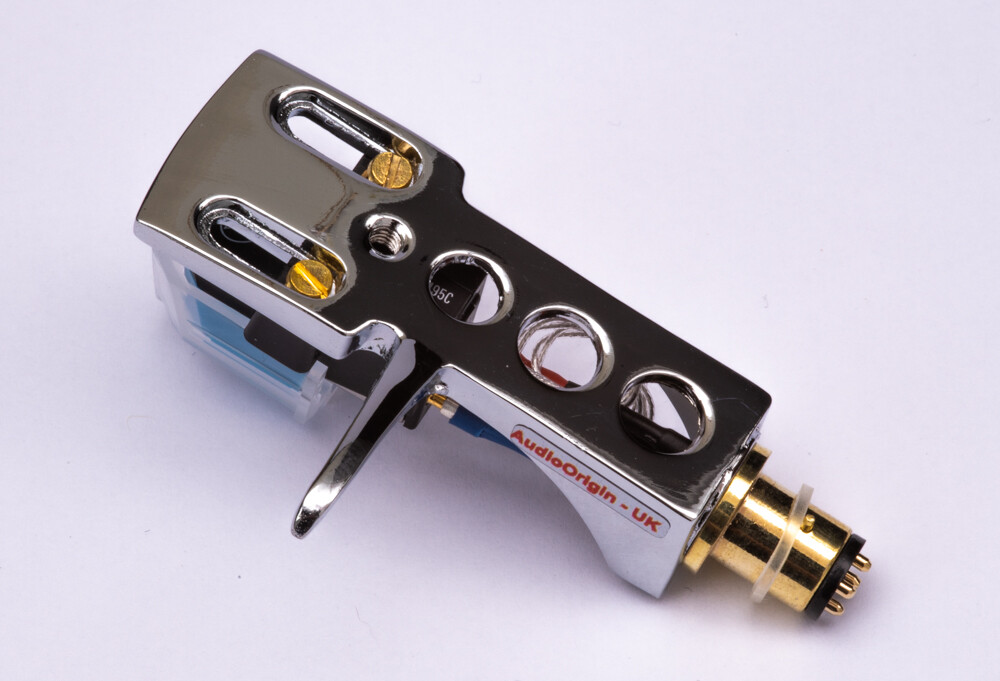
Few tone arms from the era combined this level of engineering sophistication with real-world usability. The STAX UA-7 is an S-shaped static-balance design with a one-point pivot support structure and stabilizer, delivering a tracking error of just 0.10°/cm or less. Its initial motion sensitivity is rated at 5 mg, meaning it responds to the slightest groove modulations. The hydraulic lock piston lever system ensures smooth, controlled lifting and lowering, while the counter bar and roller arm anti-skate system provides reliable force adjustment. The removable headshell, made of light alloy die-cast with a tapered rib design, resists twisting and resonance, making it a stable platform for cartridges up to 27g.
Shure V15 Type III Moving Magnet Cartridge
The YP-1000 came factory-equipped with the Shure V15 Type III—a cartridge that was itself a benchmark in the 1970s. It featured a newly developed laminated magnetic core and stylus assembly with 25% reduced effective mass, improving high-frequency tracking and reducing record wear. With a 0.7mil x 0.2mil elliptical diamond tip and a recommended tracking force of 1.0g (adjustable between 0.75g and 1.25g), it was designed for accuracy, not warmth. The cartridge weighs 6g and requires a 47kΩ load, making it a straightforward match for most standard phono stages. Replacement styli were available as the Shure VN35E, priced at ¥17,000—a testament to its premium status.
Die-Cast Aluminum Player Board and Ribbed Chassis
The internal structure reflects Yamaha’s obsession with rigidity and damping. The player board is aluminum die-cast with rib processing, and the bottom plate is made of punching metal, also ribbed for stiffness. These elements work together to resist flex and dissipate vibrations before they reach the tonearm. The entire cabinet is engineered to resist external vibrations through "various damping and engineering efforts," though specifics aren’t documented. The acrylic dust cover is thick and hinged for free stop removal, but collectors note these covers can occasionally break in transit—a known vulnerability in an otherwise overbuilt machine.
Historical Context
Launched in 1976, the YP-1000 emerged during what many consider the golden era of Japanese high-fidelity audio. Yamaha positioned it as a flagship-grade direct-drive turntable, integrating the best components from its engineering arsenal: a precision-machined platter, a high-pole-count servo motor, and the advanced STAX UA-7 tonearm. It wasn’t part of a clearly defined product family, nor was it marketed as a successor or predecessor to any other model. Instead, it stood as a singular expression of Yamaha’s technical capabilities at the time—built not for mass appeal, but for uncompromising performance.
Collectibility & Value
The YP-1000 is rare but not mythical. A listing on Reverb five years ago asked $1,250, suggesting strong collector interest even then. While no detailed market trend data exists, accessory listings from 2021 to 2024 show headshell, cartridge, and stylus combos selling between £34 and £137, indicating ongoing demand for replacement parts. A modern titanium-plated headshell and cartridge assembly compatible with the YP-1000 is currently listed at $69.99, hinting at niche aftermarket support. The only commonly reported issue is the fragility of the acrylic dust cover during shipping. No widespread mechanical failures or standard maintenance procedures are documented, though units listed for sale are often described as having been "thoroughly checked and tested" by technicians, with both 33 and 45 rpm speeds confirmed working.
eBay Listings



As an eBay Partner, we earn from qualifying purchases. This helps support our independent vintage technology research.
Related Models
- Yamaha YP-511 (1975)
- Yamaha YP-701 (1985)
- Yamaha YP-B2 (1981)
- Yamaha YP-D4 (1993)
- Yamaha YP-D8 (1985)
- Luxman PD-272 (1983)
- Garrard 2025tc (1968)
- Onkyo CP-1010 (1976)
- Pioneer PL-15R (1975)
- Pioneer PL-250 (1979)