Yamaha T-80: The Unsung FM Tuner from Yamaha’s Golden Era
In the late 1970s, Yamaha was rapidly gaining a reputation not just for musical instruments, but for high-performance audio electronics that combined precision engineering with audiophile-grade sound. Among their lineup of receivers, amplifiers, and CD players, the Yamaha T-80 stands as a refined example of analog FM tuner design from a time when radio still held a central place in home audio. Released in 1978, the T-80 may not be as famous as Yamaha’s powerhouse receivers like the B-2 or the legendary CR-800, but it remains a respected piece among vintage tuner enthusiasts for its excellent reception, clean signal path, and robust build quality.
While Yamaha is often celebrated for its integrated amplifiers and receivers, standalone tuners like the T-80 were designed for audiophiles who wanted to separate their signal sources for optimal performance. The T-80 was built during a golden age of FM broadcasting in Japan and North America, when stereo radio offered high-fidelity music programming, and serious listeners sought out tuners capable of extracting every nuance from the airwaves.
Technical Specifications
The Yamaha T-80 was engineered with a focus on sensitivity, selectivity, and low distortion—key metrics for any high-end FM tuner of its era. It features a dual-conversion superheterodyne circuit, a design favored for its ability to reject adjacent channel interference and deliver stable reception across the FM band (87.5–108 MHz). The T-80 also includes a quartz-locked digital frequency synthesizer, a relatively advanced feature at the time that allowed for precise tuning and station memory.
| Specification | Detail |
| Model | Yamaha T-80 |
| Year Released | 1978 |
| Tuner Type | FM Stereo |
| Tuning Method | Digital Synthesizer (Quartz Locked) |
| Frequency Range | 87.5 – 108.0 MHz |
| Tuning Steps | 50 kHz, 100 kHz, 200 kHz (switchable) |
| Intermediate Frequencies | 10.7 MHz (1st), 450 kHz (2nd) |
| Sensitivity (Mono) | 1.8 µV for 30 dB SNR |
| Selectivity | ±400 kHz: 70 dB |
| Signal-to-Noise Ratio | 70 dB (weighted) |
| Harmonic Distortion | <0.3% |
| Channel Separation | >40 dB at 1 kHz |
| Output Level | 200 mV (1.8 µV input) |
| Output Impedance | 1 kΩ |
| Power Requirement | 120V AC, 60 Hz, 20W |
| Dimensions (W×H×D) | 435 × 146 × 321 mm |
| Weight | 9.5 kg (20.9 lbs) |
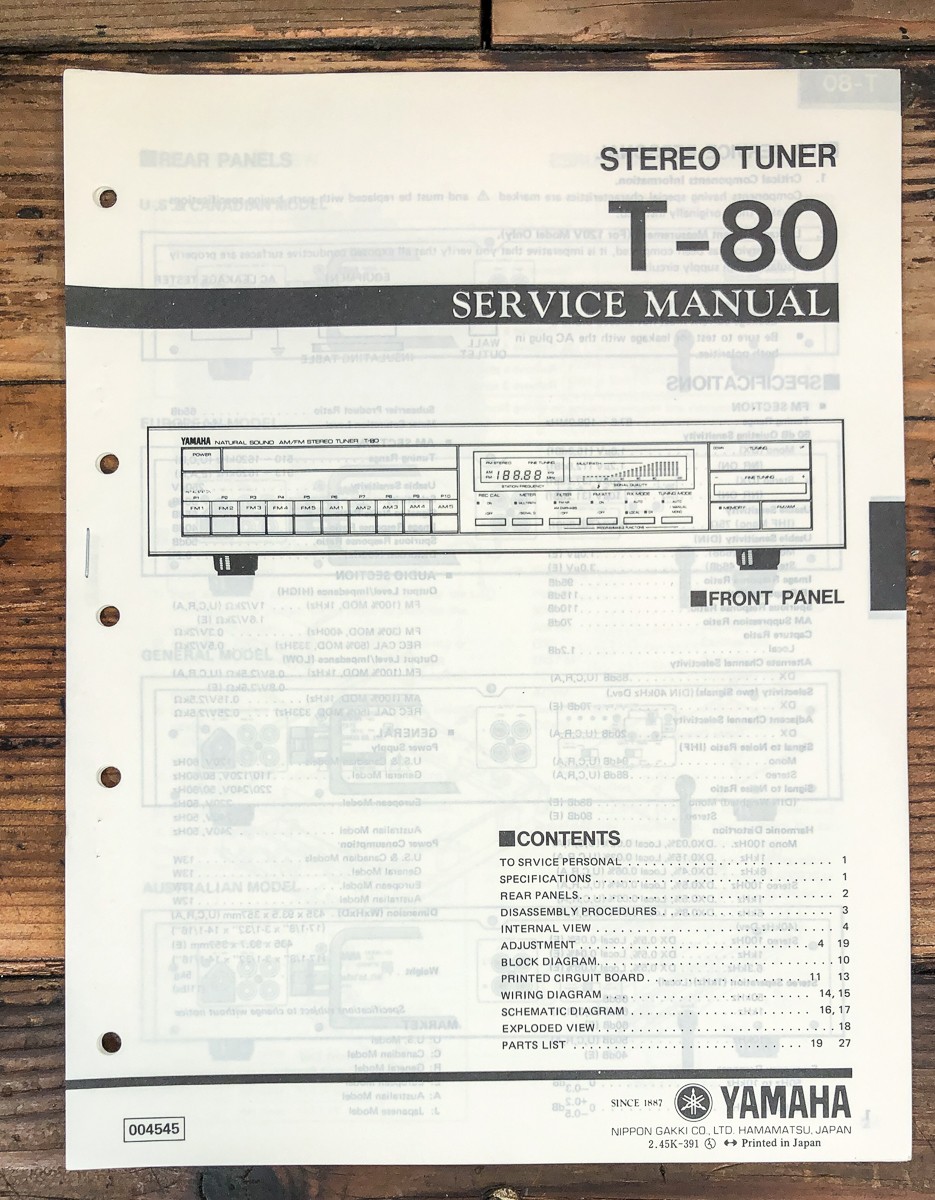
The T-80 features dual analog VU meters for stereo channel level monitoring, a hallmark of Yamaha’s design language in the 1970s. These meters not only add visual appeal but also help users assess signal strength and stereo balance. The front panel includes a large tuning dial with a digital frequency display (using red LED readout), manual tuning knob, and switches for bandwidth (wide/narrow), stereo/mono, and tuning steps.
Sound Characteristics and Performance
The Yamaha T-80 delivers a clean, transparent sound that faithfully reproduces the broadcast signal without coloration. Its low distortion and high channel separation ensure that stereo imaging remains precise, making it ideal for listening to classical, jazz, and live FM broadcasts. The tuner’s wide/narrow IF bandwidth switch allows users to optimize reception: use "wide" for strong local stations to preserve full frequency response, and "narrow" to reduce noise and interference when pulling in distant or weak signals.
Thanks to its high signal-to-noise ratio and effective filtering, the T-80 handles multipath distortion and co-channel interference better than many of its contemporaries. When paired with a good outdoor antenna or even a well-positioned dipole, the T-80 can pull in distant stations with remarkable clarity—especially in areas with strong FM coverage.
While it lacks the RDS (Radio Data System) and digital processing of modern tuners, the T-80’s analog signal path preserves the warmth and natural dynamics that many vintage audio enthusiasts seek. It’s a tuner that doesn’t try to impress with gimmicks, but instead delivers consistent, high-fidelity performance.
Notable Features and Innovations
The Yamaha T-80 was ahead of its time in several ways:
- Digital Frequency Synthesis: Unlike older analog tuners that used variable capacitors, the T-80 employs a digital synthesizer with quartz crystal reference, ensuring tuning accuracy and stability. This allows for precise station recall and eliminates frequency drift.
- Selectable Tuning Steps: Users can switch between 50, 100, and 200 kHz steps, accommodating different regional broadcast standards (e.g., 50 kHz spacing in Japan, 100 kHz in North America).
- Dual VU Meters: These are not just decorative—they provide real-time feedback on stereo balance and signal strength, helping users optimize antenna positioning.
- Robust Build Quality: Housed in a heavy-gauge steel chassis with a brushed aluminum front panel, the T-80 feels solid and well-shielded against interference. The internal layout is clean, with high-quality capacitors and discrete components.
Common Issues and Maintenance
Like any vintage electronic device, the Yamaha T-80 may require servicing after decades of use. Common issues include:
- Dried-up Electrolytic Capacitors: The power supply and audio coupling capacitors may need replacement to restore optimal performance and prevent hum or distortion.
- Tuning Knob Wear: The mechanical tuning knob and associated potentiometer can wear over time, leading to erratic tuning or dead spots.
- LED Display Dimming: The red LED frequency display may dim with age. While not repairable, it can often be replaced with modern equivalents.
- Antenna Input Corrosion: The 75Ω coaxial and 300Ω twin-lead inputs may suffer from oxidation; cleaning with contact spray can restore connectivity.
Regular cleaning of controls and switches with DeoxIT or similar contact cleaner is recommended. For long-term reliability, a full recapping by a qualified technician is advisable—especially if the unit has been in storage.
Current Market Value and Collectibility
The Yamaha T-80 is not as widely collected as some of Yamaha’s more famous receivers, but it has a loyal following among tuner specialists and vintage audio purists. In good working condition, it typically sells for $150–$300 on the secondary market, depending on cosmetic condition, functionality, and included accessories.
Units with bright LED displays, clean meters, and full functionality command higher prices. Because it was not produced in the same quantities as integrated receivers, the T-80 is relatively rare today, adding to its appeal for collectors focused on complete Yamaha systems or vintage tuner restoration projects.
Conclusion and Legacy
The Yamaha T-80 may not be a household name, but it represents the quiet excellence of Yamaha’s engineering during one of the most innovative periods in audio history. As a dedicated FM tuner, it offers performance that surpasses the built-in tuners of many contemporary receivers. Its combination of digital tuning precision, analog warmth, and solid construction makes it a worthy addition to any vintage audio system.
For those who still appreciate the art of FM listening—whether for high-quality music broadcasts, live concerts, or nostalgic radio experiences—the T-80 remains a capable and rewarding component. It’s a reminder that in the age before streaming, the airwaves themselves could be a source of high-fidelity sound, and Yamaha was there to help us hear it at its best.
If you’re building a period-correct 1970s setup or simply want a no-nonsense tuner with excellent reception, the Yamaha T-80 deserves a place on your rack.
eBay Listings


As an eBay Partner, we earn from qualifying purchases. This helps support our independent vintage technology research.
Related Models
- Yamaha CR-450 (1972)
- Yamaha CR-820 (1977)
- Yamaha CR-840 (1978)
- Yamaha R-300 (1977)
- Yamaha R-5 (1972)
- Aiwa CS-250 (1978)
- Denon TU-1500RD (1995)
- Denon TU-280 (1976)
- Denon TU-501 (1977)
- Denon TU-550 (1978)