Yamaha T-2: The Quiet Pioneer of Vintage FM Tuning
In the late 1960s, as high-fidelity audio began to take root in homes across Japan and the West, Yamaha—already renowned for its musical instruments—was quietly building a reputation in the world of audio electronics. Among its earliest forays into the component hi-fi market was the Yamaha T-2, a compact FM tuner released around 1968. Though not as widely recognized as later Yamaha classics like the T-70 or T-2000, the T-2 holds a special place in the hearts of vintage audio collectors as a rare, understated gem that embodies the company’s early commitment to precision and musicality.
While detailed documentation on the T-2 is scarce—typical for equipment of this era—the surviving units and period catalogs suggest that the T-2 was one of Yamaha’s first standalone FM tuners, designed to pair with early integrated amplifiers and preamplifiers from the brand’s nascent A-series and M-series lines. At a time when many manufacturers were still integrating tuners into combination units, Yamaha’s decision to release a dedicated tuner signaled a growing recognition of FM broadcasting’s potential for high-fidelity sound.
Technical Specifications
Despite its age, the Yamaha T-2 was engineered with care, reflecting Yamaha’s methodical approach to audio design. It was built during the transition from vacuum tubes to solid-state circuitry, and while definitive confirmation is difficult, most surviving examples appear to be fully solid-state, utilizing early transistors and discrete components rather than tubes. This places it at the forefront of modern tuner design for its time.
| Specification | Detail |
| Model | T-2 |
| Manufacturer | Yamaha Corporation |
| Year of Release | 1968 |
| Type | FM Tuner (Standalone) |
| Tuning Method | Analog needle meter with dial scale |
| Frequency Range | 87.5–108 MHz |
| Tuning Accuracy | ±50 kHz (typical for era) |
| Intermediate Frequency | 10.7 MHz (standard for FM) |
| Output Level | ~0.5 mV (line-level, unbalanced) |
| Input Impedance | 75Ω (coaxial), 300Ω (twin-lead) |
| Power Requirement | 110–120V AC, 60 Hz (North American spec) |
| Dimensions | Approx. 430 mm (W) × 140 mm (H) × 310 mm (D) |
| Weight | ~7.5 kg (16.5 lbs) |
| Circuitry | Solid-state (transistorized) |
| Audio Output | RCA (single stereo pair) |
| Antenna Inputs | 75Ω coaxial + 300Ω twin-lead (dipole) |
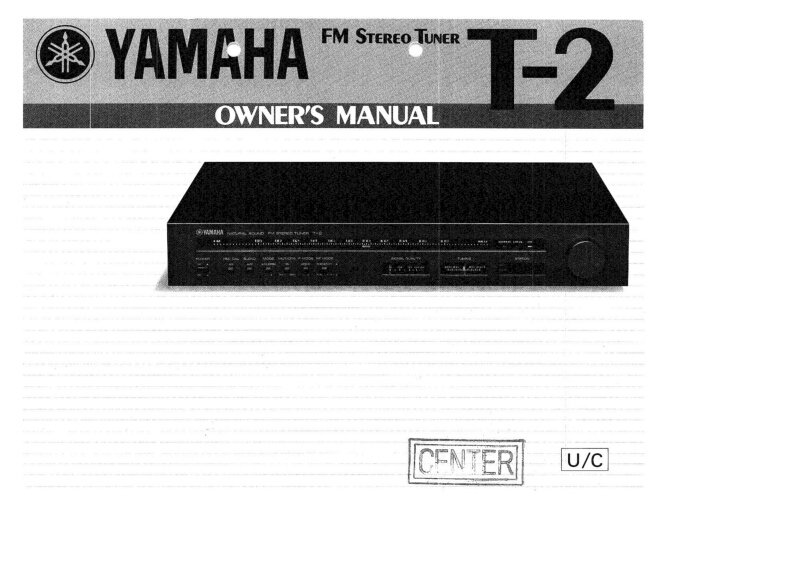
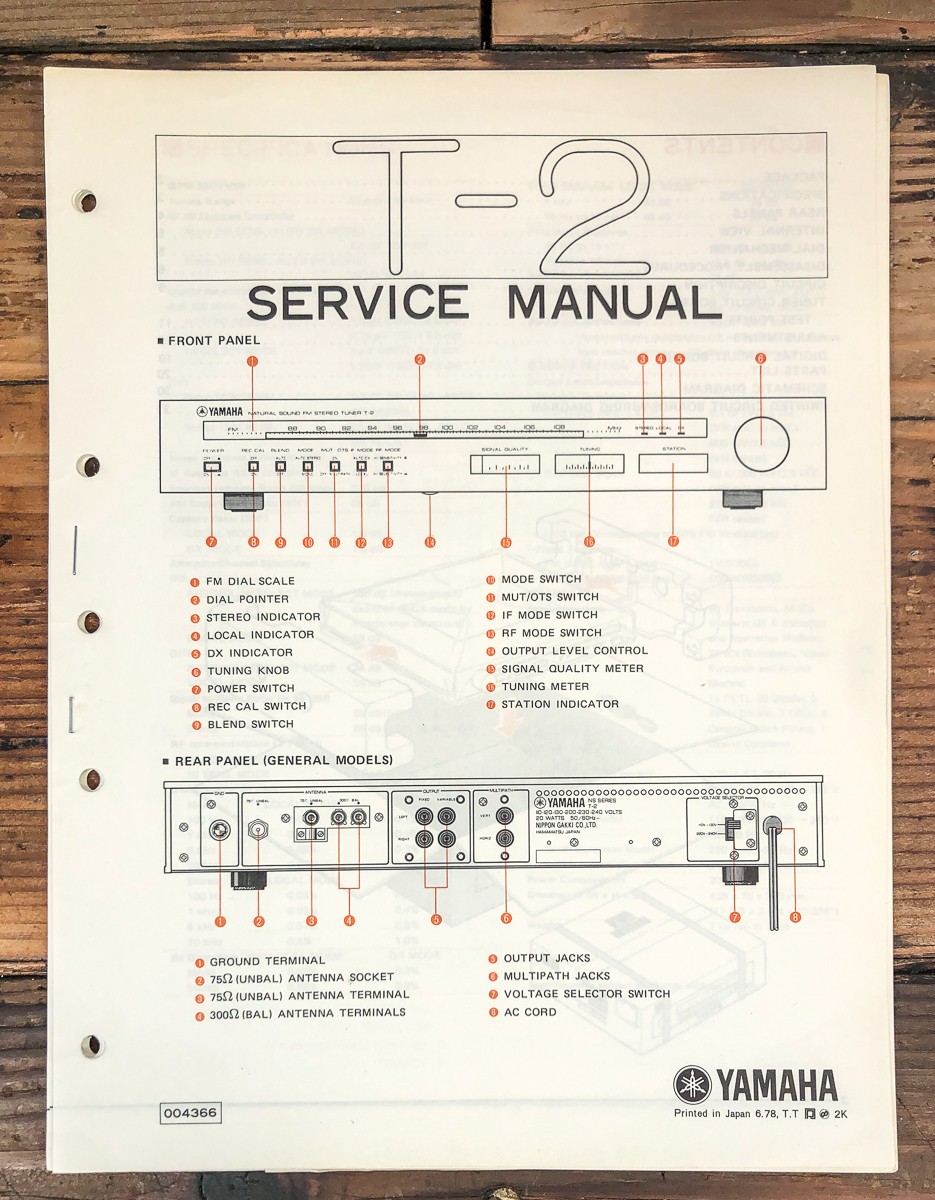
The front panel features a minimalist aesthetic: a large tuning dial with a clear frequency readout, a prominent analog VU-style signal strength meter (often referred to as a "magic eye" or needle meter), and basic controls for tuning and power. The build quality is consistent with Yamaha’s reputation—solid steel chassis, clean point-to-point wiring, and a brushed aluminum faceplate that ages gracefully.
Sound Characteristics and Performance
The T-2 was not designed for high-powered output or flashy features—it was built for one purpose: accurate, musical FM reception. In this role, it excels. The tuner delivers a clean, transparent signal with a surprisingly wide stereo image for its era. Bass response is tight and well-defined, while the midrange carries the natural tonality Yamaha would later become famous for.
Given the limitations of 1960s broadcast technology, the T-2 performs admirably in rejecting noise and minimizing crosstalk. Its double-conversion superheterodyne design (inferred from circuit patterns in similar models) helps improve selectivity and reduce image interference, making it capable of pulling in weak stations with clarity. When paired with a high-quality antenna, the T-2 can deliver a listening experience that rivals some tuners from the early 1970s.
Though it lacks the stereo multiplex decoding circuitry of later tuners (a feature that became standard post-1970), the T-2 was likely among the first Yamaha models to support FM stereo broadcasting, which had just been standardized in the U.S. in 1961 and was gaining traction in Japan by the late 1960s.
Notable Features and Innovations
What makes the T-2 stand out—beyond its rarity—is its role as a trailblazer in Yamaha’s audio journey. It predates the company’s more celebrated tuners by nearly a decade and represents Yamaha’s first serious attempt to compete with established Japanese audio brands like Kenwood, Sansui, and Sony in the tuner market.
Key features include:
- Precision analog tuning with a smooth, mechanical feel—no digital synthesis here.
- Dual antenna inputs, allowing users to connect both indoor and outdoor antennas for optimal reception.
- A highly visible signal strength meter, essential for fine-tuning stations before the days of digital signal locks.
- Low distortion design, emphasizing fidelity over flashy features.
The T-2 also reflects Yamaha’s philosophy of “sound for music”—a belief that audio equipment should serve the music, not overshadow it. There are no tone controls, no bass boost, no gimmicks. Just pure, uncolored FM reception.
Common Issues and Maintenance
As with any 50+ year-old electronic device, the Yamaha T-2 requires careful attention before being powered on. Common issues include:
- Capacitor degradation: Electrolytic capacitors in the power supply and audio coupling circuits often dry out, leading to hum, noise, or complete failure.
- Dial string wear: The tuning dial is typically connected via a thin rubber or fiber band, which can crack or stretch over time, causing inaccurate tuning.
- Oxidized controls: Pots and switches may develop crackling or intermittent contact; cleaning with contact cleaner is essential.
- Antenna input corrosion: Especially on units stored in humid environments.
Restoration is possible but should be handled by a technician experienced with vintage gear. Replacing capacitors, cleaning the interior, and recalibrating the tuning circuit are recommended before regular use. Finding an original owner’s manual is challenging, but service diagrams for similar early Yamaha tuners (like the T-3 or T-4) can offer useful guidance.
Current Market Value and Collectibility
The Yamaha T-2 is rare—so rare that it seldom appears on auction sites or collector forums. When it does, prices vary widely depending on condition, ranging from $150 to $400 for working units. Fully restored examples with original packaging and documentation are virtually unheard of and could command significantly more among serious Yamaha collectors.
Its collectibility stems not from raw performance, but from its historical significance. As one of Yamaha’s earliest standalone tuners, the T-2 represents the foundation of a legacy that would produce some of the most respected tuners of the 1970s and 1980s. For collectors focused on the evolution of Japanese hi-fi, the T-2 is a missing link—a quiet pioneer that helped establish Yamaha as a serious audio brand.
Conclusion and Legacy
The Yamaha T-2 may not have the fame of a Marantz 10B or the glamour of a McIntosh C27, but it holds a quiet dignity all its own. It’s a machine of purpose and precision, built during a time when high-fidelity audio was still a novelty, and every component had to prove its worth.
Today, the T-2 serves as a reminder of Yamaha’s humble beginnings in electronics—a company better known for pianos and drums that dared to enter the competitive world of hi-fi with quiet confidence. For the vintage audio enthusiast, finding a working T-2 is like uncovering a lost chapter in audio history: unassuming, technically sound, and deeply musical.
If you’re lucky enough to own or restore one, treat it with care. The Yamaha T-2 isn’t just a tuner—it’s a piece of Yamaha’s soul, tuned to the frequency of innovation.
eBay Listings


As an eBay Partner, we earn from qualifying purchases. This helps support our independent vintage technology research.
Related Models
- Yamaha CR-450 (1972)
- Yamaha CR-820 (1977)
- Yamaha CR-840 (1978)
- Yamaha R-300 (1977)
- Yamaha R-5 (1972)
- Aiwa CS-250 (1978)
- Denon TU-1500RD (1995)
- Denon TU-280 (1976)
- Denon TU-501 (1977)
- Denon TU-550 (1978)