Yamaha R-50: The Understated Elegance of a Vintage Passive Preamplifier
In the late 1970s, Yamaha was rapidly establishing itself as a serious contender in the high-fidelity audio market. Known for their meticulous engineering, musical tonality, and robust build quality, Yamaha components from this era have earned a lasting reputation among vintage audio enthusiasts. While the company’s receivers and power amplifiers often steal the spotlight, the Yamaha R-50 stands as a quiet yet significant milestone—a passive preamplifier that embodies the minimalist philosophy long before it became a trend in high-end audio.
Released in 1977, the R-50 was designed for audiophiles who valued purity of signal path and transparency over feature-laden complexity. At a time when active preamplifiers with tone controls, loudness compensation, and multiple gain stages were the norm, Yamaha took a bold step by offering a passive design that prioritized signal integrity. The R-50 was not a receiver, nor did it include a phono stage or headphone output—it was a dedicated line-level passive preamp built for purists who already had high-quality sources and amplification.
Technical Specifications
The Yamaha R-50 was engineered with simplicity and high-grade components in mind. As a passive unit, it contains no internal power supply or amplification circuitry. Instead, it relies on precision attenuators and high-quality passive components to manage volume and source selection.
| Specification | Detail |
| Model | Yamaha R-50 |
| Year Introduced | 1977 |
| Type | Passive Preamplifier |
| Number of Inputs | 4 (Tuner, Phono, Aux, Tape) |
| Volume Control | Dual-gang logarithmic potentiometer |
| Tone Controls | None |
| Power Requirement | None (passive design) |
| Impedance | Not applicable |
| Output Impedance | Low (via direct passive coupling) |
| Construction | Steel chassis, aluminum front panel |
| Dimensions (W×H×D) | 430 × 146 × 318 mm |
| Weight | 5.5 kg (approx.) |
| Finish | Black or silver (depending on market) |
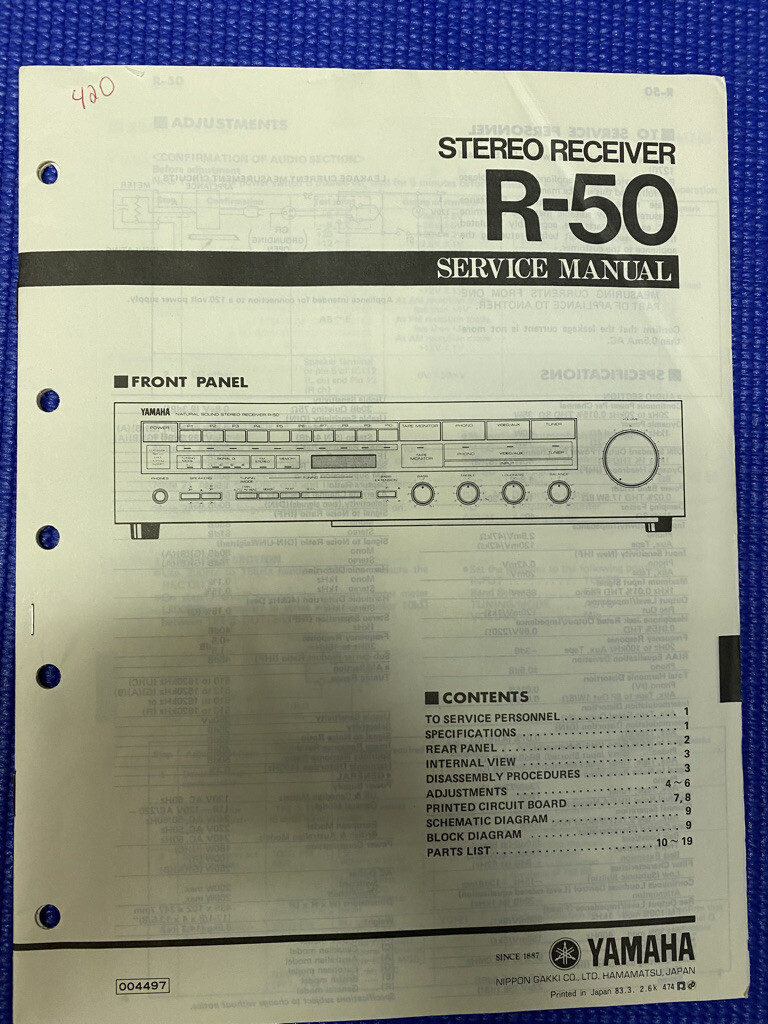
The R-50 features a clean, minimalist front panel with large rotary knobs for input selection and volume, both machined from aluminum for durability and aesthetic appeal. The rear panel includes gold-plated RCA jacks for all inputs and outputs, ensuring low resistance and good long-term connectivity. The internal wiring uses high-purity copper, and the circuit layout emphasizes short signal paths to minimize degradation.
Sound Characteristics and Performance
The sonic signature of the Yamaha R-50 is best described as transparent, neutral, and uncolored. Without active circuitry or feedback loops, the preamp introduces virtually no noise, distortion, or coloration to the audio signal. What you hear is exactly what your source components and power amplifier deliver—nothing added, nothing subtracted.
This makes the R-50 an ideal match for warm-sounding tube sources or slightly bright solid-state gear, as it won’t exaggerate tonal imbalances. Its passive nature ensures a wide frequency response and excellent channel separation, contributing to a spacious and well-defined soundstage. Bass remains tight and controlled, while highs retain their natural air and detail.
Because it lacks gain, the R-50 works best when paired with sources that have strong output levels (such as high-end CD players or modern DACs) and power amplifiers with high input sensitivity. It’s not recommended for use with low-output phono cartridges or weak preamp outputs, as volume levels may be insufficient.
Notable Features and Innovations
While the R-50 may appear simple, its design reflects Yamaha’s deep understanding of signal integrity and user experience:
- True Passive Design: No internal power supply or active components means no power-related noise or hum.
- High-Quality Potentiometer: The dual-gang volume control is smooth and precise, with excellent channel tracking even at low volume levels.
- Gold-Plated RCA Jacks: Provide reliable, corrosion-resistant connections for long-term use.
- Minimalist Signal Path: Only the essential components are used between input and output, preserving signal purity.
- Robust Build Quality: Typical of Yamaha’s 1970s construction, the R-50 features a heavy steel chassis and solid mechanical assembly that resists microphonics and vibration.
One of the R-50’s most appealing aspects is its timelessness. With no digital circuitry or obsolete features, it remains fully functional and relevant in modern systems. Audiophiles today still seek it out for minimalist setups, especially in tube or single-ended triode (SET) amplifier configurations where signal purity is paramount.
Common Issues and Maintenance
Given its passive nature, the Yamaha R-50 is remarkably reliable. However, like any vintage component, it can develop issues over time—most commonly related to age and usage:
- Crackling or Popping in Volume Control: This is the most frequent complaint and is typically due to oxidation in the potentiometer. Cleaning with high-quality contact cleaner (e.g., DeoxIT) can often restore smooth operation. Replacement with a modern high-end pot (such as Alps or Noble) is possible but should be done carefully to preserve originality.
- Loose Input Selector Switch: Mechanical wear can cause intermittent connections. Cleaning the switch contacts and ensuring proper alignment usually resolves this.
- Faded or Scratched Front Panel: Cosmetic wear is common, especially on silver models. While not affecting performance, it can impact resale value.
- Oxidized RCA Jacks: Over decades, even gold-plated jacks can tarnish. Gentle cleaning with isopropyl alcohol and a soft cloth can restore conductivity.
Because the R-50 has no power supply or complex circuitry, there are no capacitors or transistors to fail—making it one of the most maintenance-free vintage preamps available.
Current Market Value and Collectibility
The Yamaha R-50 is not as widely known as some of Yamaha’s more famous receivers (like the B-25 or CR-840), but it has developed a loyal following among minimalist audiophiles and vintage gear collectors. In recent years, well-maintained units in good cosmetic and functional condition typically sell for $150–$250 USD, depending on finish, provenance, and included accessories.
Units in original packaging with documentation can command higher prices, especially in Europe and Japan where passive preamps from this era are more highly regarded. While not yet a “blue chip” vintage item like a Marantz 7 or McIntosh C22, the R-50 is increasingly recognized for its engineering integrity and sonic neutrality.
Its value lies not in rarity, but in authenticity and purpose. For listeners building a vintage-centric system or seeking a no-compromise passive stage, the R-50 offers exceptional performance at a modest price.
Conclusion and Legacy
The Yamaha R-50 is a testament to the idea that less can be more. In an age of increasing complexity, Yamaha dared to release a preamplifier that did almost nothing—yet did it exceptionally well. It represents a philosophy of audio purity that resonates strongly with today’s high-end audio trends, where passive preamps and direct-coupled designs are once again in vogue.
Though overshadowed by Yamaha’s more powerful and feature-rich contemporaries, the R-50 holds a special place in the company’s legacy. It showcases Yamaha’s commitment to engineering excellence, even in products designed for a niche audience. For the discerning listener who values transparency, build quality, and timeless design, the Yamaha R-50 remains a compelling choice—over 45 years after its introduction.
If you’re building a vintage system focused on natural sound and minimalist elegance, the R-50 deserves a spot on your rack. It’s not just a preamp—it’s a statement.
eBay Listings


As an eBay Partner, we earn from qualifying purchases. This helps support our independent vintage technology research.
Related Models
- Yamaha HP-1 (1974)
- Yamaha A-1 (1970)
- Yamaha A-1020 (1978)
- Yamaha A-450 (1978)
- Yamaha A-550 (1978)
- Luxman L-530 (1975)
- Luxman R-404 (1975)
- Luxman RV-371 (1975)
- Luxman SQ-38U (1975)
- Luxman T-14 (1972)