Yamaha HP-1 (1976)
The moment you put these on, it’s not just sound you hear—it’s the quiet hum of engineering ambition from an era when headphones weren’t accessories, they were statements.
Overview
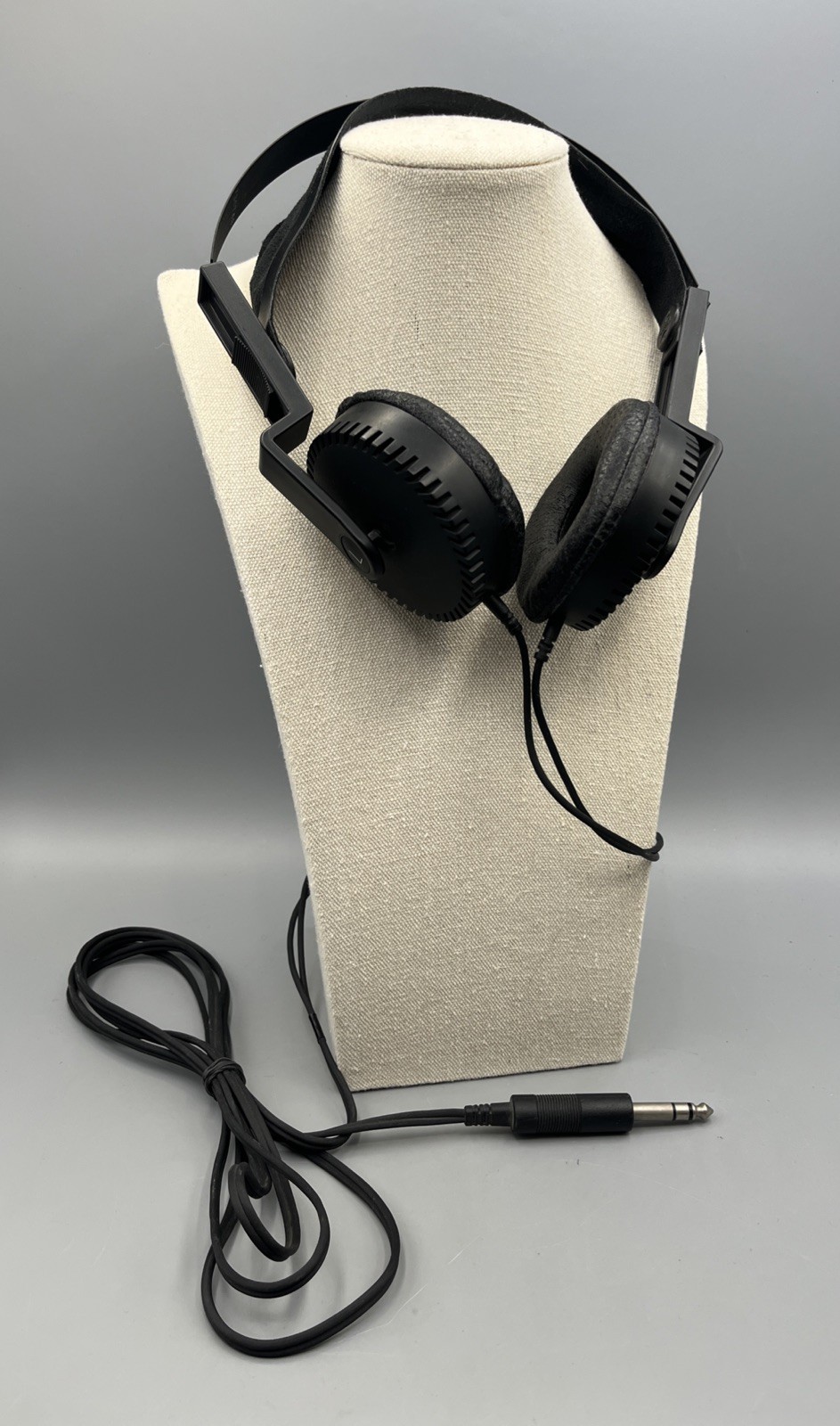
The Yamaha HP-1 wasn’t just Yamaha’s first high-end headphone—it was a declaration that personal listening deserved the same seriousness as studio monitoring. Introduced in 1976, it became the flagship of Yamaha’s orthodynamic line, designed for listeners and engineers who demanded fidelity that matched the ambition of 1970s studio artistry. Engineers at Yamaha weren’t chasing trends; they were solving problems. They wanted to build headphones that could do justice to complex recordings like Pink Floyd’s *Dark Side of the Moon*, where every layer mattered. The result was the HP-1: a closed-back, supra-aural planar magnetic headphone that used a radical “full-drive magnetic” design. This wasn’t just another dynamic driver with a new name—it was a fundamental rethinking of how headphones should work, combining elements of electrostatic and dynamic designs into something Yamaha claimed was a fourth type entirely. And they didn’t just engineer it—they entrusted industrial designer Mario Bellini to shape its form, ensuring it looked as forward-thinking as it sounded.
Specifications
| Manufacturer | Yamaha |
| Model | HP-1 |
| Production Year | 1976 |
| Type | Orthodynamic / Planar magnetic headphone |
| Fit | Supra-aural (on-ear) |
| Driver Size | 55mm |
| Impedance | 150 ohms |
| Sensitivity | about 1mW 90dBspl |
| Maximum SPL | somewhere around 115dBspl |
| Frequency Response | 20 Hz - 20 kHz |
| Magnet Type | Anisotropic ferrite |
| Cable Length | 3.0 m |
| Connector | 6.3 mm (1/4") stereo phone plug |
| Weight | 385 g (without cord) |
| Earpad Material | Leather |
| Enclosure Design | Sealed earcups |
| Headband Material | Plastic and suede |
Key Features
The Bellini Blueprint
Mario Bellini didn’t just design a headphone—he engineered comfort into its bones. The twin headbands aren’t a styling quirk; they form a system that shares support across the entire headset, distributing weight evenly and eliminating pressure points. Paired with an adjustable, padded headband and a universal joint that lets the earpads pivot freely, the HP-1 adapts to your head instead of forcing your head to adapt to it. It’s a design that feels almost alive in its responsiveness. The headband itself combines thin plastic and suede, a detail that looks elegant but has a downside: owners report the plastic can crack over time, especially at stress points like the adjustment sliders, which are prone to becoming brittle. But when it’s intact, the fit is remarkably stable and comfortable, even for extended listening.
Full-Drive Magnetic: No Voice Coil, No Problem
The HP-1’s driver is where the magic happens—and where Yamaha broke from convention. Instead of a traditional voice coil, they embedded a conductive trace—etched in a precise “250μ interval spiral” with five concentric rings—directly onto a 12-micrometer polyester film diaphragm. This entire assembly floats within an isodynamic magnetic field created by anisotropic ferrite magnets. When the signal hits, the whole diaphragm moves uniformly, eliminating breakup modes and delivering exceptional transient response. Yamaha’s real breakthrough wasn’t just the idea—it was figuring out how to economically print the conductive coil directly onto the diaphragm, solving a manufacturing hurdle that had doomed earlier attempts. The result? A driver that’s nearly indestructible under normal use—owners say they’re “almost impossible to blow up”—and capable of clean, linear performance from 20 Hz to 20 kHz.
Sealed, On-Ear Precision
Unlike many modern planars, the HP-1 uses a sealed, supra-aural (on-ear) design. This means the earcups sit on the ears rather than enclosing them, and the enclosure is acoustically closed. The sealed design helps with isolation and bass control, though it doesn’t create the expansive soundstage some expect today. Instead, the HP-1 delivers a focused, intimate presentation—especially in the midrange, which many describe as “very involving” and “human.” The leather earpads contribute to both comfort and seal, but they wear out over decades; replacements are available through niche vendors like Yaxi, and some owners maintain them with leather treatment and conditioning. While not airy or expansive by modern standards, the HP-1’s strength lies in its coherence and natural tonality—smooth, detailed, and free of harshness.
The Elusive Anisotropic Variant
Among collectors, the HP-1 Anisotropic is the stuff of legend. This rare version adds thin metal plates over the driver assembly, subtly altering the magnetic field and boosting sensitivity by about 3dB. That might not sound like much, but in a headphone that’s already relatively inefficient—needing serious amplification—it makes a noticeable difference, especially when driven by vintage gear with modest headphone outputs. These units are exceptionally scarce, and when they surface, they command premium prices. Most HP-1s you’ll find are the standard version, but if you stumble on an Anisotropic, you’re holding a piece of headphone history that even most enthusiasts have only read about.
Historical Context
The HP-1 arrived in 1976, a moment when albums like *Dark Side of the Moon* were revealing the depth of studio production, making high-fidelity headphones essential for serious listeners. Yamaha responded not with a compromise, but with a ground-up reinvention. They weren’t the first to attempt planar magnetic headphones, but earlier efforts failed due to manufacturing complexity and cost. Yamaha’s breakthrough was economic as much as technical—figuring out how to mass-produce the etched diaphragm made the HP-1 viable. It became Yamaha’s first mass-produced audiophile orthodynamic headphone, immediately praised for both its sound quality and industrial design. Prior to the HP-1, a few products had tried the same concept but weren’t successful. The HP-1 stood out not just sonically, but in its ambition—engineers wanted it to match the artistry of the most ambitious musicians and studio wizards of the era. It was even used by ABC 2JJ announcers in the late 1970s, a testament to its professional credibility. Production ended not because the tech failed, but because it was too expensive—the cost of materials and precision manufacturing made it unsustainable, even for a flagship.
Collectibility & Value
When it launched in 1976, the HP-1 carried a price tag of about US $200—a serious investment, comparable to high-end receivers of the era. As of 2023, working units in good condition fetch between $200 and $400 USD on the used market. Some appear for less, especially if non-functional or heavily worn, but a fully restored pair is worth the premium. One owner reported being told by a Yamaha engineer that building the HP-1 today would cost over $1000, a testament to its craftsmanship. Common issues include cracked headband plastic, broken headpad supports, and deteriorated leather earpads—all repairable with care. The drivers themselves are robust, though the ultra-thin diaphragm can be damaged if mishandled. Step-by-step disassembly guides exist online, and replacement parts are available through dedicated vendors. Owners note these headphones stand the test of time well, with some still using their original pairs daily since the late 1970s. They’re not just collectible—they’re durable, repairable, and musically relevant.
eBay Listings



As an eBay Partner, we earn from qualifying purchases. This helps support our independent vintage technology research.
Related Models
- Yamaha A-1 (1970)
- Yamaha A-1020 (1978)
- Yamaha A-450 (1978)
- Yamaha A-550 (1978)
- Yamaha A-7 (1975)
- Luxman L-530 (1975)
- Luxman R-404 (1975)
- Luxman RV-371 (1975)
- Luxman SQ-38U (1975)
- Luxman T-14 (1972)