Yamaha CR-820: A Refined Vintage Tuner from Yamaha’s Golden Era
In the late 1970s, Yamaha was rapidly establishing itself as a serious contender in the high-fidelity audio market, producing equipment that balanced technical precision with musicality. While the company is perhaps best known for its legendary receivers like the CR-840 and integrated amplifiers such as the B-7, the Yamaha CR-820 holds a quiet but respected place in the brand’s tuner lineage. Released in 1977, the CR-820 is a compact AM/FM stereo tuner that embodies Yamaha’s commitment to clean design, reliable performance, and accessible hi-fi for the discerning listener.
Though not as widely documented or celebrated as some of its siblings, the CR-820 was designed for audiophiles who valued accurate tuning, low distortion, and a no-frills aesthetic. It was often paired with other components in Yamaha’s modular “CR” series, such as the M-820 amplifier or preamplifiers like the CP-820, forming part of a cohesive, stackable system that defined mid-tier hi-fi setups of the era.
Technical Specifications
The CR-820 was engineered during a transitional period in tuner design—when solid-state circuitry had matured, but before digital tuning became widespread. It features analog tuning with a traditional dial and mechanical counter, offering a tactile experience that many vintage enthusiasts still prefer today.
| Specification | Detail |
| Model | CR-820 |
| Year of Release | 1977 |
| Manufacturer | Yamaha Corporation |
| Type | AM/FM Stereo Tuner |
| Tuning Method | Analog (Vernier dial with mechanical counter) |
| Frequency Range (FM) | 87.5–108 MHz |
| Frequency Range (AM) | 530–1600 kHz (standard broadcast band) |
| Tuner Sensitivity (FM) | Approx. 1.8 µV for 30 dB SNR |
| Selectivity (FM) | ~75 dB at ±400 kHz offset |
| Harmonic Distortion | <0.8% (typical) |
| Output Level | 150 mV (line-level output) |
| Output Impedance | 1 kΩ |
| Power Requirements | 120V AC, 60 Hz, 20W |
| Dimensions (W×H×D) | 430 × 146 × 312 mm (17 × 5.75 × 12.3 in) |
| Weight | 5.8 kg (12.8 lbs) |
| Finish | Black or woodgrain vinyl (regional variations) |
The CR-820 features dual speaker-level inputs for AM and FM, along with a single pair of RCA line outputs, allowing it to integrate easily into both vintage and modern systems. It lacks advanced features like stereo multiplex decoding indicators or digital frequency readouts, which were just beginning to appear on higher-end models at the time. Instead, it relies on a simple stereo LED and a smooth, well-damped tuning knob for station selection.
Sound Characteristics and Performance
The Yamaha CR-820 delivers a warm, balanced sound signature typical of Yamaha’s analog-era tuners. Its FM section is particularly praised for its smooth high-frequency response and stable stereo imaging, avoiding the harshness that sometimes plagues budget tuners of the period. The audio path uses discrete transistor circuitry with minimal feedback, contributing to a natural, organic presentation.
In real-world use, the CR-820 performs admirably in urban and suburban environments with moderate signal strength. Its selectivity and sensitivity are sufficient to pull in distant stations with a decent external antenna, though it may struggle in fringe reception areas compared to more advanced tuners like the Sony STR-D100 or higher-end Yamaha models such as the CR-840.
AM reception is competent for its class, with decent noise rejection and midrange clarity—ideal for talk radio, news, and vintage broadcasts. While not a dedicated shortwave receiver, the CR-820’s AM band is well-tuned for local and regional stations, making it a reliable daily driver for radio enthusiasts.
Notable Features and Design
The CR-820 reflects Yamaha’s minimalist design philosophy of the late 1970s. Its front panel is clean and uncluttered, featuring only essential controls: a large tuning knob, a smaller band selector, a power switch, and a stereo indicator. The use of a mechanical frequency counter—while not as precise as digital displays—adds to the charm and authenticity of the user experience.
One of the standout design elements is the modular chassis format, which matches other components in Yamaha’s CR series. This allowed users to build a vertically stacked system with perfect alignment and a unified aesthetic. The chassis is made of steel with a matte finish, and the internal layout prioritizes serviceability and component spacing, a hallmark of Yamaha’s engineering standards.
Though it lacks advanced features like AFC (Automatic Frequency Control) or RDS (Radio Data System), the CR-820’s simplicity is part of its appeal. It’s a “tuner’s tuner”—focused purely on the task of receiving and delivering broadcast audio without distractions.
Common Issues and Maintenance
As with any vintage electronic equipment from the 1970s, the Yamaha CR-820 may require some maintenance to perform at its best today. Common issues include:
- Dried-up lubrication in the tuning capacitor: This can cause rough tuning or dead spots in the dial. Re-lubrication with dielectric grease can restore smooth operation.
- Worn potentiometers or switches: The band selector and power switch may develop crackling or intermittent contact. Cleaning with contact cleaner often resolves this.
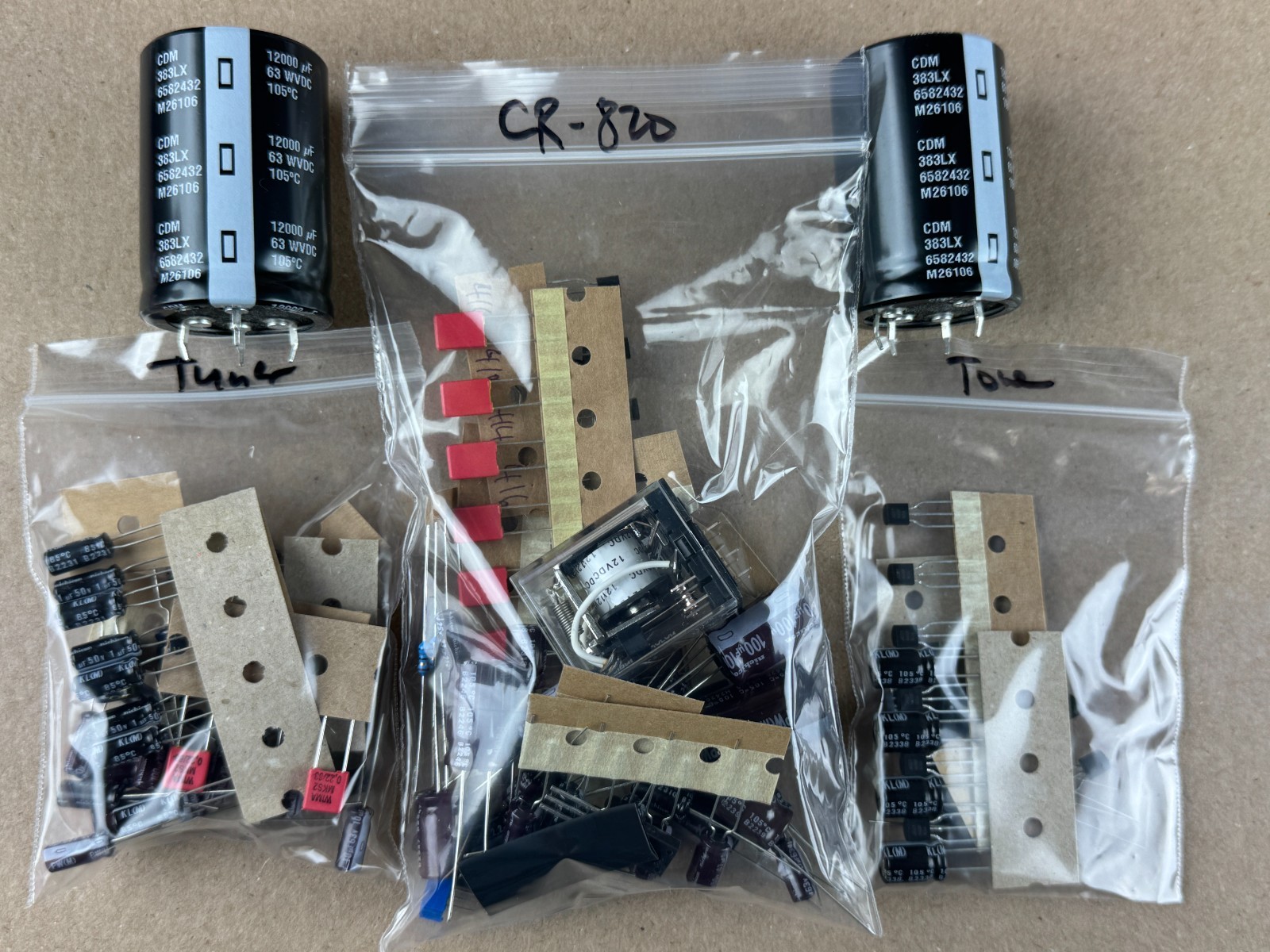
- Capacitor aging: Electrolytic capacitors in the power supply may have degraded over time, potentially causing hum or power instability. A recapping by a qualified technician is recommended for long-term reliability.
- Antenna connector corrosion: The 75-ohm FM and 300-ohm AM screw terminals can oxidize, leading to poor reception. Cleaning with isopropyl alcohol and proper antenna cabling can greatly improve performance.
Overall, the CR-820 is a robust unit with a reputation for durability. Its use of high-quality components and conservative circuit design means that with basic care, it can continue to perform well for decades.
Current Market Value and Collectibility
The Yamaha CR-820 is not a high-profile collector’s item like the Marantz 2270 or the Sansui 5000 series, but it holds steady appeal among Yamaha enthusiasts and those building period-correct systems. Units in good working condition with original finish typically sell for $75–$150 on the secondary market, depending on region and cosmetic condition.
Fully restored or NOS (New Old Stock) examples may command slightly higher prices, especially when sold as part of a matching CR-series stack. Its value lies more in usability than rarity—audiophiles who appreciate analog tuning and warm broadcast sound often seek it out as a functional vintage component rather than a display piece.
Conclusion and Legacy
The Yamaha CR-820 may not be the most powerful or feature-rich tuner of its era, but it represents the quiet excellence of Yamaha’s mid-tier engineering in the 1970s. It’s a no-nonsense, well-built tuner that delivers satisfying performance with a touch of vintage charm.
For those building a classic Yamaha system or seeking an authentic analog radio experience, the CR-820 is a worthy addition. It may not have the flash of digital tuning or the depth of a high-end receiver, but in its simplicity and reliability, it captures the essence of what made vintage hi-fi so enduring: honest sound, solid construction, and a design that serves the music.
If you stumble upon a working CR-820 at a garage sale or audio show, it’s worth a second look—this understated tuner might just be the perfect companion for rediscovering the golden age of FM broadcasting.
eBay Listings



As an eBay Partner, we earn from qualifying purchases. This helps support our independent vintage technology research.
Related Models
- Yamaha CR-450 (1972)
- Yamaha CR-840 (1978)
- Yamaha R-300 (1977)
- Yamaha R-5 (1972)
- Yamaha R-500 (1975)
- Aiwa CS-250 (1978)
- Denon TU-1500RD (1995)
- Denon TU-280 (1976)
- Denon TU-501 (1977)
- Denon TU-550 (1978)