Yamaha CR-3020 (1978–1979)
The rare, hand-built Japanese flagship that ended the "power war" with precision, not just brute force.
Overview
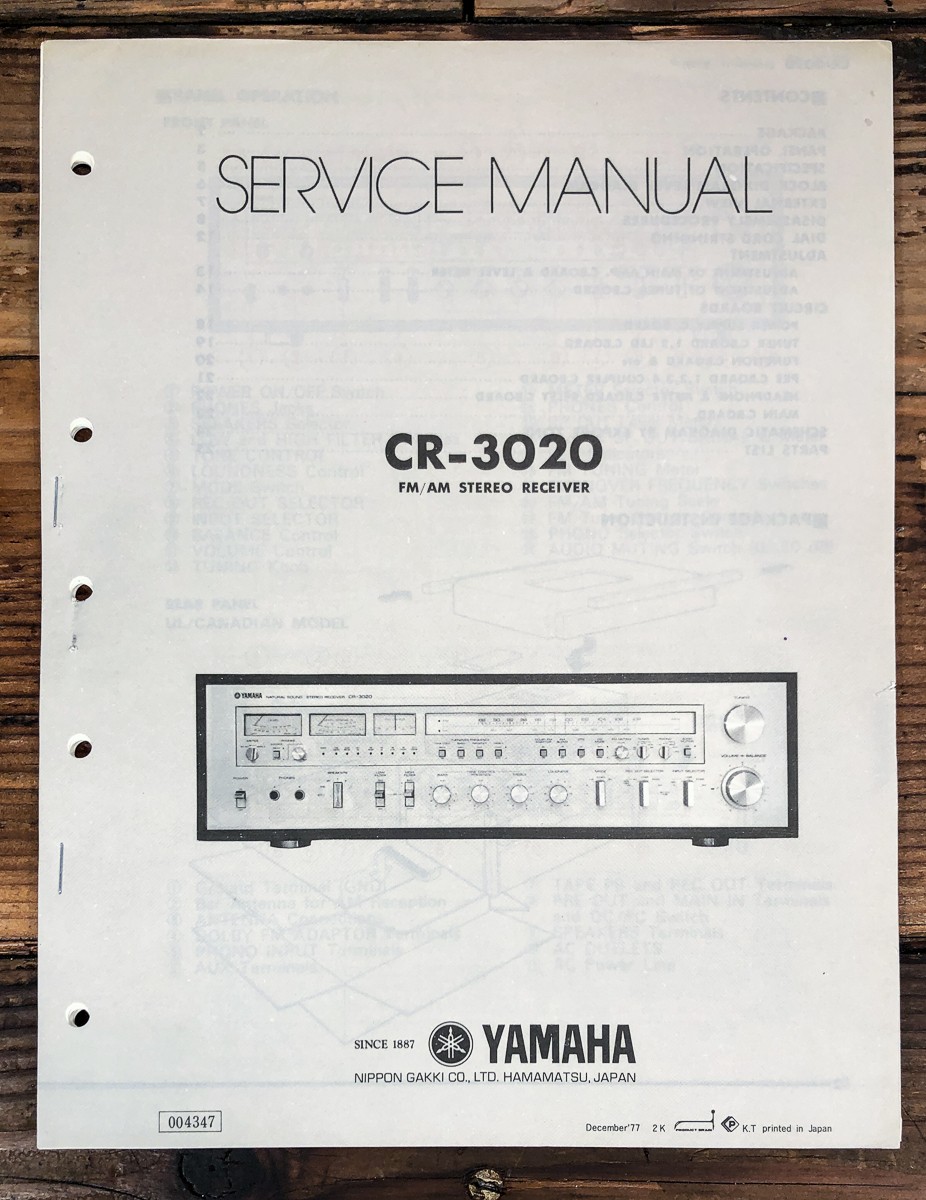
You don’t just turn on a Yamaha CR-3020—you engage with it. From the moment you press the heavy-duty power switch and watch the twin tuning meters glow to life, you know this isn’t another mass-market receiver from the late '70s. This was Yamaha’s statement piece: a hand-built, no-compromise stereo receiver released in 1978 as the undisputed flagship of their lineup. While competitors were still shouting about wattage, Yamaha quietly engineered something different—a machine that delivered not just power, but control, clarity, and a level of build quality that bordered on obsessive.
The CR-3020 wasn’t chasing trends. It arrived as the "power war" between Pioneer, Sansui, and Marantz was cooling, a time when many manufacturers were scaling back on massive transformers and heavy chassis in favor of lighter, cheaper designs. Yamaha went the opposite direction. This was the final evolution of the CR-x020 series, a direct and larger sibling to the CR-1020 and CR-2020, but with engineering pushed to its limits. Built in Japan with a Macassar ebony wood case that feels more like furniture than electronics, the CR-3020 was designed to be the centerpiece of a high-end system—and it weighs like one at 37 kg (81.6 lbs).
It’s not just big. It’s smart. Every input, every meter, every switch feels deliberate. The dual mono, fully discrete, direct-coupled circuitry runs from phono stage to output transistors—no capacitors in the signal path to color or degrade the sound. Two massive power transformers feed separate supplies to each channel. Three pairs of power transistors per channel deliver 160 watts RMS into 8 ohms, clean and stable across the full 20 Hz–20 kHz range. This isn’t just a receiver. It’s a declaration.
Specifications
| Manufacturer | Yamaha |
| Model | CR-3020 |
| Production Years | 1978–1979 |
| Product Type | Stereo receiver |
| Power Output (RMS) | 160 watts per channel into 8 ohms (20 Hz–20 kHz) |
| Maximum Power Output (DIN) | 180 watts per channel into 8 ohms |
| Frequency Response (Aux/Tape to SP Out) | 5 Hz to 100 kHz ±2.0 dB |
| Power Bandwidth (IHF) | 10 Hz to 50 kHz (0.03% THD) |
| Total Harmonic Distortion (rated output) | 0.15% |
| Damping Factor | 100 at 8 ohms |
| Input Sensitivity | 0.25mV (MC), 2mV (MM), 120mV (line) |
| Signal-to-Noise Ratio (IHF-A) | 85 dB (Phono MC), 96 dB (Phono MM), 100 dB (Aux/Tape), 118 dB (Main In) |
| Output Level (Rec Out) | 120 mV (rated) |
| Output Level (Pre Out) | 775 mV (rated) |
| Speaker Load Impedance | 4Ω to 16Ω |
| Dimensions | 632 mm (24.9") x 191 mm (7.5") x 494.5 mm (19.5") |
| Weight | 37 kg (81.6 lbs) |
| Tuning Range | FM (87.6–108 MHz), MW (AM) |
| Power Consumption | 920W max. |
Key Features
The Console That Thinks
The CR-3020 doesn’t just play music—it manages it. The front panel is a symphony of switches and meters, each serving a purpose. Dual power output level meters, scaled from 0.1W to 200W, give real-time feedback on performance, while the FM tuning meter ensures precise station alignment. The right-hand meter doubles as a signal quality indicator, a subtle but brilliant touch for audiophiles who care about reception integrity.
Input selection is comprehensive: Phono 1 (switchable MC/MM), Phono 2 (MM), Tuner, Aux, Tape 1, and Tape 2. The dual phono inputs are a rarity, especially with a dedicated moving-coil head amp on Phono 1—no external step-up transformer needed. For tape enthusiasts, dual tape monitors with two-way dubbing allow flexible routing, and the REC CAL function at 333 Hz helps align record decks with surgical precision.
Tone Shaping with Surgical Precision
Yamaha didn’t just slap on bass and treble controls. The CR-3020 includes Bass, Treble, and Presence controls, each with switchable turnover frequencies. Bass can be tuned to 125 Hz or 500 Hz, treble to 2.5 kHz or 8 kHz, and presence boost hits at either 2 kHz or 4 kHz. A defeat switch lets you bypass them entirely—critical for purists who want uncolored sound. The separate loudness compensation is continuously variable, so you can tailor it to your listening level without the usual all-or-nothing toggle.
Speaker selection is equally flexible: Off, A, B, C, A+C, or A+B. Three sets of speakers? No problem. Want to run A and C together in a party setup? Done. The system even includes low and high filter switches to tame problem frequencies, and a mode switch for L, R, Stereo, or Reverse—useful for checking phase or isolating channel issues.
Engineered Like a Tank, Built to Last
Under the hood, the CR-3020 is a marvel of late-'70s analog engineering. The dual-mono power supply uses two large transformers and four 15,000µF filter capacitors—overkill by most standards, but essential for maintaining stability under load. The output stage uses three pairs of power transistors per channel, ensuring headroom and reliability even at high volumes.
The entire signal path—from phono input to speaker terminals—is fully discrete and direct-coupled (DC), meaning no coupling capacitors to degrade transient response or introduce phase shift. With 178 transistors, 9 ICs, 14 FETs, and 64 diodes on board, this is one of the most densely packed receivers of its era. The result? A sound that’s fast, detailed, and dynamically alive—more like a high-end preamp/power amp combo than a receiver.
Historical Context
The CR-3020 was born at a turning point. By 1978, the audiophile market was shifting. The "monster receiver" era—defined by ever-escalating wattage claims—was fading. Brands like Pioneer and Sansui had already released their flagships (the SX-1980 and G-33000, respectively), and consumers were beginning to question whether more watts meant better sound. Yamaha didn’t try to out-power them. Instead, they out-engineered them.
Positioned as the top-of-the-line model in the CR-x020 series, the CR-3020 was a direct response to the export success of the CR-1020 and CR-2020. But where those models were respected workhorses, the CR-3020 was a halo product—a showcase of what Yamaha could do when cost was no object. It was built in limited numbers, with estimates suggesting only around 2,000 units were ever made. That scarcity, combined with its advanced design and premium finish, has cemented its status as one of the most sought-after vintage receivers ever produced.
Collectibility & Value
If you’re looking for a bargain, keep walking. The Yamaha CR-3020 is not just rare—it’s legendary. Original list price was approximately $1,500 USD, a king’s ransom in 1978 (over $6,500 today). In 2023, a fully functional unit in good condition commands between $2,500 and $4,000 on the open market. A non-working example still sells for over $800—proof that even as a parts unit, it’s valuable.
But ownership comes with responsibility. These units are nearly 50 years old, and age takes its toll. Common issues include failing electrolytic capacitors—especially in the power supply—hot-running power supply boards, and brittle solder joints. The power switches and speaker relays are known failure points, and the indicator lamps often burn out. Imbalance from dirty potentiometers or worn controls is also frequently reported.
A proper restoration typically involves a full recapping, cleaning of all switches and pots, and verification of transistor health. Given the complexity, it’s not a project for beginners. But for those willing to invest the time and money, the payoff is a receiver that still competes with modern high-end gear in clarity, dynamics, and sheer presence.
eBay Listings


As an eBay Partner, we earn from qualifying purchases. This helps support our independent vintage technology research.
Related Models
- Yamaha HP-1 (1974)
- Yamaha A-1 (1970)
- Yamaha A-1020 (1978)
- Yamaha A-450 (1978)
- Yamaha A-550 (1978)
- Luxman L-530 (1975)
- Luxman R-404 (1975)
- Luxman RV-371 (1975)
- Luxman SQ-38U (1975)
- Luxman T-14 (1972)