Yamaha CA-800: The Forgotten Precision Control Amplifier
In the golden era of high-fidelity audio during the late 1970s, Yamaha stood out not only for its musical instruments but also for its growing reputation in the world of hi-fi electronics. While the company is often celebrated for its iconic receivers like the B-200 series or the legendary M-60 power amplifier, one lesser-known but technically fascinating component from this period is the Yamaha CA-800. Classified as a control amplifier — a hybrid between a preamplifier and a system controller — the CA-800 was a forward-thinking design aimed at audiophiles who demanded precision, flexibility, and clean signal routing in their audio systems.
Though not as widely recognized as Yamaha’s more powerful or mass-market offerings, the CA-800 holds a quiet prestige among vintage audio connoisseurs. It represents a transitional moment in audio design, bridging the gap between simple volume controls and the sophisticated preamplifiers that would dominate the 1980s.
Historical Context
Released in 1978, the CA-800 arrived during a time of rapid innovation in audio electronics. Japanese manufacturers like Yamaha, Pioneer, and Sansui were pushing the boundaries of solid-state design, emphasizing reliability, measured performance, and elegant aesthetics. The CA-800 was not a power amplifier, nor was it a full-featured receiver. Instead, it served as a control center — a preamplifier with advanced source selection, level management, and system integration capabilities.
Designed for use with separate power amplifiers (such as Yamaha’s M-series or other high-end contemporaries), the CA-800 allowed users to manage multiple inputs with surgical precision. It was part of Yamaha’s push into the upper echelon of audiophile gear, where sound purity and build quality were paramount.
Technical Specifications
| Specification | Detail |
| Model | Yamaha CA-800 |
| Year of Release | 1978 |
| Category | Control Amplifier / Preamplifier |
| Number of Inputs | 5 (Phono MM, Tuner, Tape, Aux, Phono MC*) |
| Number of Outputs | 2 (Tape Out, Main Out) |
| Gain (Line Stage) | Approx. 10 dB |
| Frequency Response | 20Hz – 20kHz (±0.5dB) |
| Total Harmonic Distortion | < 0.05% (1kHz, rated output) |
| Signal-to-Noise Ratio | > 90 dB (A-weighted) |
| Input Impedance | 47kΩ (line), 1MΩ (MC optional) |
| Output Impedance | < 1kΩ |
| Power Supply | Internal linear transformer |
| Dimensions (W×H×D) | 435 × 146 × 340 mm |
| Weight | 10.5 kg (23.1 lbs) |
| Finish | Black or Titanium (brushed aluminum) |
*Note: The CA-800 is one of the few Yamaha units of its era to offer a dedicated moving coil (MC) phono input, accessible via internal jumpers or an optional step-up module, making it highly desirable for vinyl enthusiasts.
Sound Characteristics and Performance
The CA-800 is renowned for its neutral, transparent sonic signature. Unlike some preamplifiers of the era that added warmth or coloration, the CA-800 aimed for accuracy. Its solid-state circuitry, built with high-quality discrete components and a robust power supply, delivers a wide bandwidth and excellent channel separation.
In practice, the CA-800 excels in systems where clarity and detail retrieval are priorities. Its phono stage — particularly when configured for MC cartridges — is remarkably quiet and dynamic, capable of extracting fine textures from vinyl without harshness. The line stage is equally impressive, offering a black background and precise imaging that allows downstream amplifiers and speakers to perform at their best.
Many users report that the CA-800 pairs exceptionally well with Yamaha’s M-60 or M-100 power amplifiers, creating a synergistic system with balanced tonality and strong bass control. However, it also integrates seamlessly with non-Yamaha components, making it a versatile centerpiece in mixed-brand setups.
Notable Features and Innovations
The CA-800 was ahead of its time in several respects:
- Dual Phono Inputs: Offering both MM (Moving Magnet) and MC (Moving Coil) inputs was rare in 1978, especially from a mainstream manufacturer. This flexibility catered to serious turntable owners.
- Precision Attenuation: The stepped volume control uses high-tolerance resistors, ensuring consistent left/right balance at all levels — a feature typically found in much more expensive gear.
- Tape Monitor Function: A dedicated switch allows users to route any input to the tape recorder and monitor the tape output, essential for tape lovers and archivists.
- High Build Quality: The chassis is constructed from thick steel with a heavy aluminum front panel, minimizing vibration and RFI interference. Knobs are large, knurled, and tactile, typical of Yamaha’s high-end aesthetic.
- Independent Power Supply Section: The internal transformer and filtering are isolated to reduce noise, contributing to the unit’s excellent signal-to-noise ratio.
Common Issues and Maintenance
Despite its robust construction, the CA-800 is now over 45 years old, and several maintenance concerns should be addressed by potential buyers:
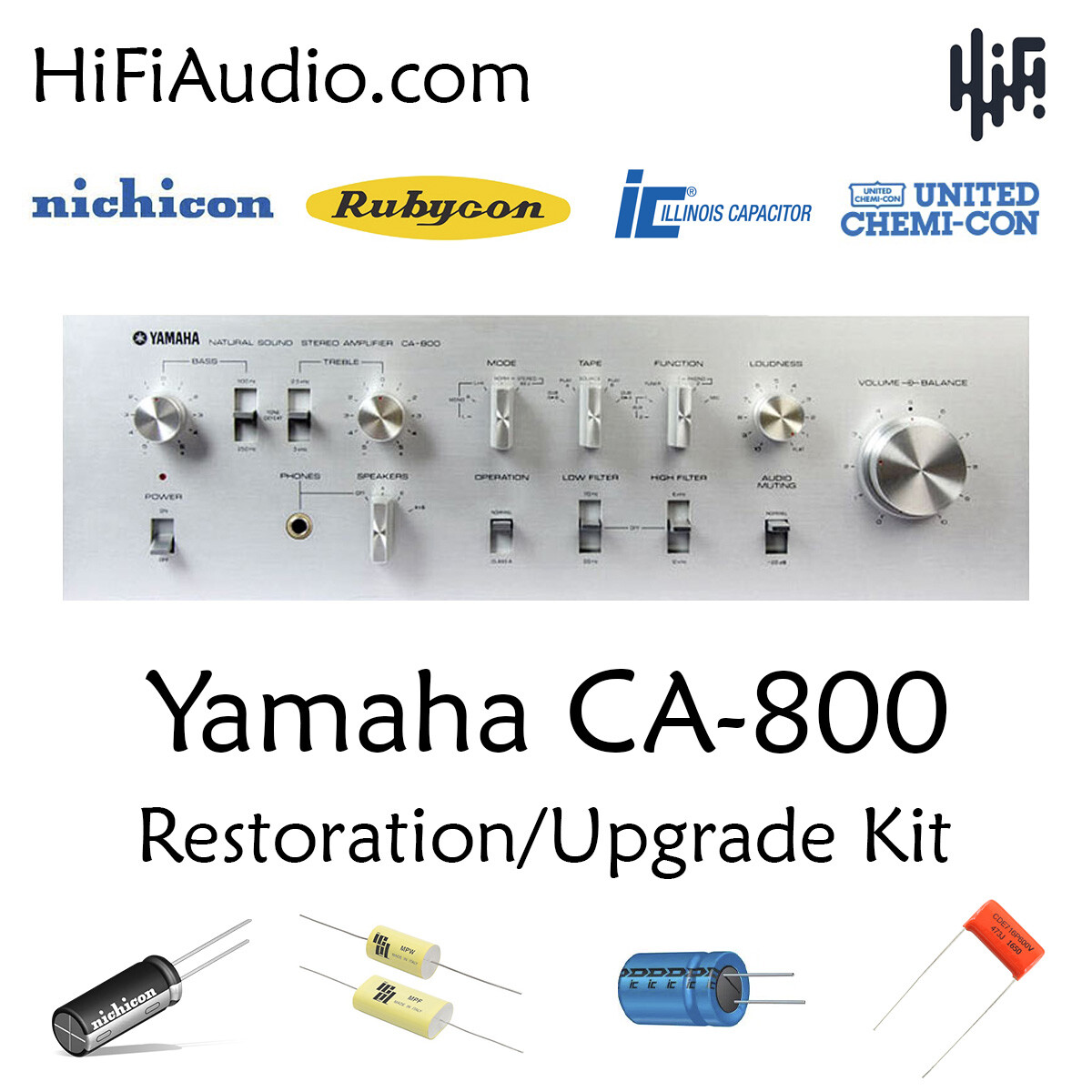
- Capacitor Aging: The electrolytic capacitors in the power supply and signal path may have degraded. A full recapping by a qualified technician is recommended for optimal performance and safety.
- Potentiometer Noise: The volume and balance pots can develop crackling over time. Cleaning with contact cleaner may help, but replacement with modern high-quality alternatives is often necessary.
- Phono Stage Sensitivity: The MC input, if present, relies on internal jumpers or an optional transformer. These can become loose or corroded; inspection and cleaning are advised.
- Tape Relay Wear: The internal tape monitor relays can stick or oxidize. Testing all switching functions is essential during evaluation.
Given its complexity, the CA-800 is not a "plug-and-play" vintage unit for beginners. However, with proper servicing, it can deliver decades of reliable performance.
Current Market Value and Collectibility
The Yamaha CA-800 remains rare and underappreciated in the vintage audio market. Unlike flashier receivers or power amps, it doesn’t command attention at flea markets or online auctions. However, its scarcity and technical sophistication are slowly gaining recognition.
As of 2024, a fully functional CA-800 in good cosmetic condition typically sells for $400–$700, depending on finish, included accessories, and whether the MC option is present. Units with verified service history or original packaging may fetch higher prices among collectors.
It is particularly sought after by:
- Yamaha enthusiasts completing a vintage system
- Audiophiles restoring 1970s-era high-end rigs
- Vinyl purists who value the rare MC input
While not yet a "blue-chip" vintage component like a McIntosh C27 or a Marantz 7, the CA-800 is increasingly seen as a sleeper gem — a well-engineered, musically honest preamp that deserves a second look.
Conclusion and Legacy
The Yamaha CA-800 may not have achieved the fame of its more powerful siblings, but it embodies the quiet excellence that defined Yamaha’s approach to high-fidelity audio in the 1970s. It was never about flash or brute force — the CA-800 was designed for the listener who valued precision, flexibility, and purity of signal.
Today, it stands as a testament to an era when electronics were built to last, engineered with care, and designed to serve the music above all else. For the discerning collector or restorer, the CA-800 offers a rare opportunity: a sophisticated, under-the-radar component that delivers performance far beyond its reputation.
If you’re lucky enough to find one in good condition — or willing to invest in a proper restoration — the Yamaha CA-800 might just become the quiet heart of your vintage audio system.
eBay Listings



As an eBay Partner, we earn from qualifying purchases. This helps support our independent vintage technology research.
Related Models
- Yamaha HP-1 (1974)
- Yamaha A-1 (1970)
- Yamaha A-1020 (1978)
- Yamaha A-450 (1978)
- Yamaha A-550 (1978)
- Luxman L-530 (1975)
- Luxman R-404 (1975)
- Luxman RV-371 (1975)
- Luxman SQ-38U (1975)
- Luxman T-14 (1972)