Yamaha CA-500: The Forgotten Pioneer of Yamaha’s High-Fidelity Era
In the early 1970s, Yamaha was rapidly expanding its presence in the high-fidelity audio market, transitioning from its roots in musical instruments to become a serious contender in home audio electronics. While the brand would later become synonymous with legendary receivers like the B-2000 and integrated amplifiers such as the M-40, earlier models like the Yamaha CA-500 represent a crucial, often overlooked chapter in that evolution. Released around 1972, the CA-500 is not a receiver or power amplifier, but rather a control amplifier—a hybrid device that blends preamplifier functions with selective amplification and source management. Though rare and less documented than its successors, the CA-500 holds a quiet significance among vintage audio enthusiasts for its minimalist design, discrete circuitry, and early embodiment of Yamaha’s engineering philosophy.
Historical Context: Yamaha’s Entry into Hi-Fi
By the late 1960s and early 1970s, Japanese electronics manufacturers were reshaping the global audio landscape. Yamaha, already respected for its pianos and professional audio gear, began producing consumer hi-fi components to compete with Denon, Kenwood, and Pioneer. The CA-500 emerged during this formative period—a time when the concept of modular audio systems (separate preamps, power amps, tuners) was gaining popularity among audiophiles. Unlike later integrated receivers that combined AM/FM, phono stages, and power amplification, the CA-500 was designed as a source selector and control center, likely intended to pair with external power amplifiers and tuners.
Its release predates Yamaha’s more famous solid-state amplifiers of the mid-70s, making the CA-500 a transitional model that reflects the company’s early experimentation with circuit topology, build quality, and user interface design.
Technical Specifications
Despite its obscurity, surviving units and service manuals confirm the CA-500’s core specifications and design choices. It is a fully passive control amplifier in some functions, with active gain stages in others—particularly in the phono input section. It features a mix of discrete transistors and early op-amp designs, avoiding integrated circuits common in later models.
| Specification | Detail |
| Model | CA-500 |
| Year of Release | 1972 |
| Type | Control Amplifier / Preamplifier |
| Inputs | 2x Line (Aux, Tape), 1x Phono (MM) |
| Outputs | Main Out, Tape Out |
| Tone Controls | Bass, Treble (±12dB at 100Hz/10kHz) |
| Volume Control | Dual-gang potentiometer |
| Power Supply | Internal transformer, dual rail supply |
| Power Consumption | 30W (estimated) |
| Dimensions (W×H×D) | 430 × 145 × 315 mm |
| Weight | 8.5 kg (approx.) |
| Impedance | Not applicable (preamp-level device) |
| Output Level | 150 mV (nominal) |
| Frequency Response | 20Hz – 20kHz (±1dB, line); 30Hz–15kHz (phono) |
| Signal-to-Noise Ratio | >70 dB (A-weighted, line input) |
| Construction | Steel chassis, aluminum front panel |
The CA-500 uses a dual power supply to support clean amplification of low-level signals, particularly from the moving magnet (MM) phono input. This was a thoughtful design choice for its time, reducing crosstalk and hum in sensitive analog circuits.
Sound Characteristics and Performance
The CA-500 delivers a sound signature that is best described as neutral with a slight warmth, typical of early Japanese solid-state designs. It lacks the aggressive brightness of some contemporaries and instead offers a smooth, musical presentation. The phono stage, while not as refined as dedicated units from brands like NAD or Marantz, is competent and quiet when properly maintained.
In line-level mode, the CA-500 behaves much like a high-quality passive preamp with a touch of gain. Its discrete transistor buffer stages preserve dynamics and stereo imaging, making it a capable centerpiece for a minimalist vintage system. When paired with high-sensitivity power amplifiers—such as the Yamaha M-40 or even tube amps from the era—the CA-500 reveals its strength: clarity without sterility, with a midrange that remains engaging for vocals and acoustic instruments.
Bass response is tight and controlled, though not particularly deep—reflecting the limitations of early 1970s capacitor technology. Treble is smooth, avoiding sibilance, which makes it forgiving with lower-quality recordings or bright speakers.
Notable Features and Innovations
While not flashy by modern standards, the CA-500 introduced several design philosophies that would become Yamaha hallmarks:
- Dual Power Supply: Rare in preamps of this class at the time, this reduced noise and improved channel separation.
- Modular Internal Layout: Components are arranged in clearly defined sections (phono amp, tone stack, power supply), easing servicing and alignment.
- High-Quality Potentiometer: The Alps volume control is durable and offers smooth, precise adjustment—still functional in many surviving units.
- Tape Loop Functionality: Includes dedicated tape monitor switching, allowing users to record from any source—a feature ahead of its time for non-receivers.
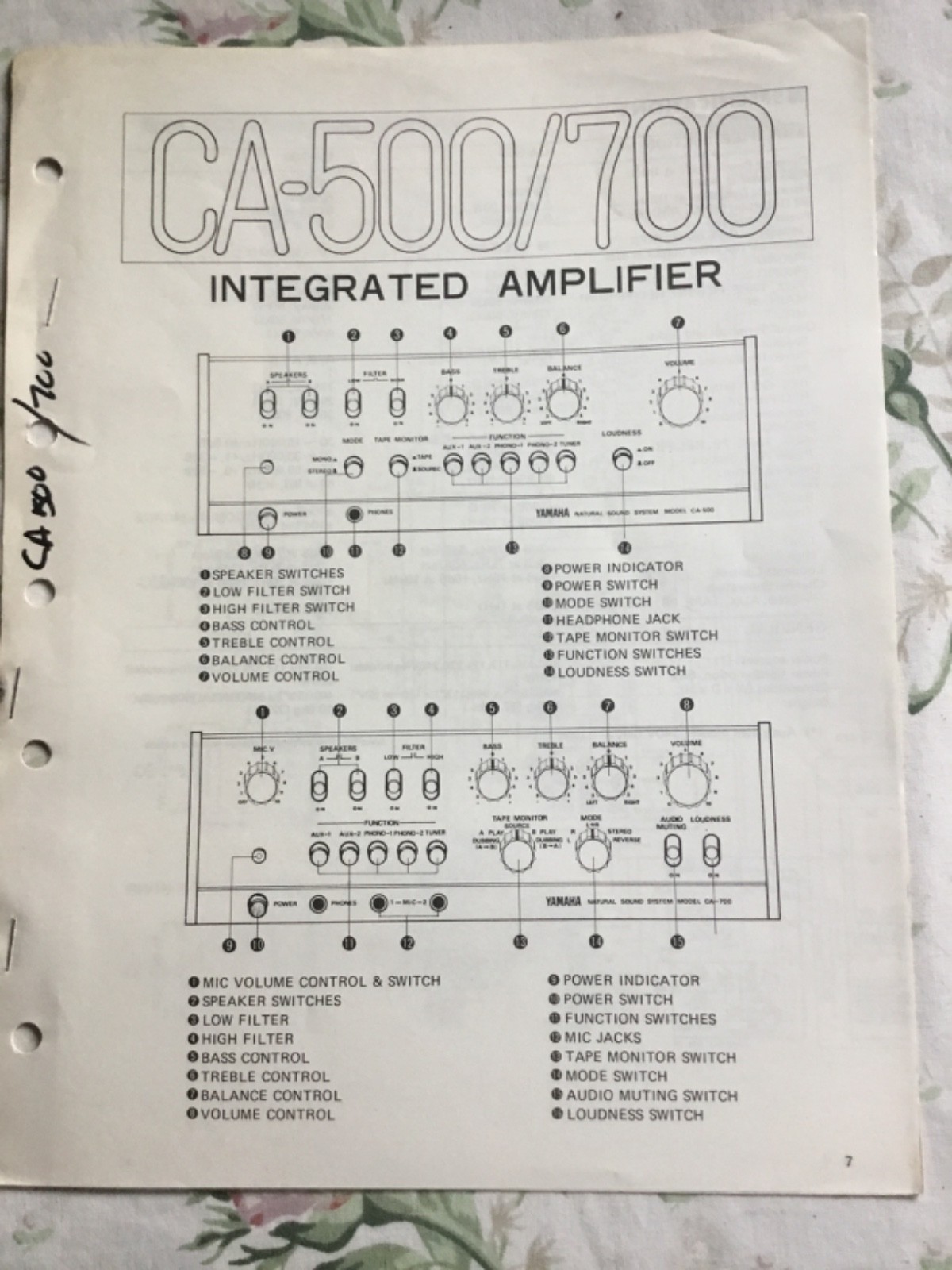
- Minimalist Front Panel: Clean layout with large, knurled aluminum knobs and a brushed steel faceplate, reflecting Yamaha’s growing attention to industrial design.
The CA-500 also lacks a headphone jack or balance control—omissions that suggest it was aimed at purists who valued simplicity and signal integrity over convenience.
Common Issues and Maintenance
Like all vintage electronics from the 1970s, the CA-500 requires careful attention to maintain optimal performance. Common issues include:
- Capacitor Aging: Electrolytic capacitors in the power supply and signal path dry out over time, leading to hum, channel imbalance, or complete failure. A full recapping is strongly recommended for any unit that has been dormant.
- Oxidized Controls: The volume and tone pots can develop crackling noises. Cleaning with contact cleaner may help, but replacement with modern equivalents (e.g., ALPS RK27) is often necessary.
- Phono Stage Noise: The MM input may exhibit increased hiss or hum if transistors have drifted. Checking bias points and replacing noisy transistors can restore performance.
- Dust and Corrosion: Units stored in damp environments may show corrosion on connectors or circuit boards. Gentle cleaning with isopropyl alcohol is advised.
Because service manuals are scarce, repair can be challenging. However, the CA-500’s discrete design makes it more repairable than later IC-based models.
Current Market Value and Collectibility
The Yamaha CA-500 is rare and not widely recognized outside dedicated vintage audio circles. It does not command the high prices of Yamaha’s later power amps or receivers, but its scarcity and historical significance are slowly gaining attention.
As of 2024, working units typically sell for $150–$300, depending on condition and completeness. Refurbished examples with recapped power supplies and cleaned controls may reach $400 in audiophile markets. Fully restored CA-500s are occasionally featured in minimalist vintage setups or used as phono preamps in hybrid systems.
Collectibility is growing among enthusiasts who appreciate early Yamaha engineering and the aesthetic of 1970s Japanese hi-fi. Its understated design and lack of branding make it a sleeper favorite for those who value substance over flash.
Conclusion: A Hidden Gem in Yamaha’s Legacy
The Yamaha CA-500 may not be a household name, but it represents an important step in Yamaha’s journey from instrument maker to hi-fi innovator. As a control amplifier, it bridges the gap between passive signal routing and active preamplification, offering a clean, musical foundation for a high-fidelity system.
While overshadowed by later Yamaha classics, the CA-500 deserves recognition for its thoughtful engineering, solid build, and warm, engaging sound. For the vintage audio collector or restorer, it’s a rewarding project—a quiet piece of history that, when brought back to life, still holds its own in a modern analog setup.
If you stumble upon a CA-500 in a thrift store or estate sale, don’t overlook it. Beneath its modest exterior lies a forgotten pioneer of Japanese audio excellence.
eBay Listings


As an eBay Partner, we earn from qualifying purchases. This helps support our independent vintage technology research.
Related Models
- Yamaha HP-1 (1974)
- Yamaha A-1 (1970)
- Yamaha A-1020 (1978)
- Yamaha A-450 (1978)
- Yamaha A-550 (1978)
- Luxman L-530 (1975)
- Luxman R-404 (1975)
- Luxman RV-371 (1975)
- Luxman SQ-38U (1975)
- Luxman T-14 (1972)