Yamaha A-7: The Quiet Master of Vintage Preamplification
In the golden age of high-fidelity audio during the mid-1970s, Yamaha emerged not only as a leader in musical instruments but also as a serious contender in the world of high-end audio electronics. While many remember Yamaha for their powerful receivers and iconic speakers like the NS-1000 series, the brand also produced a line of refined, understated components that catered to the discerning audiophile. Among these was the Yamaha A-7, a passive preamplifier released in 1975 that stood apart from the increasingly complex active designs of its time.
The A-7 may not have the wattage ratings or flashy features of its contemporaries, but it represents a purist philosophy in audio design—one that prioritizes signal transparency, minimalism, and sonic neutrality. At a time when active preamplifiers with tone controls, multiple gain stages, and complex circuitry were becoming the norm, the A-7 quietly championed a different approach: less is more.
Technical Specifications
As a passive preamplifier, the Yamaha A-7 does not include active gain stages or power amplification. Instead, it functions as a high-quality signal router and attenuator, using precision resistive networks to control volume without introducing additional electronic coloration.
| Specification | Detail |
| Model | Yamaha A-7 |
| Year of Release | 1975 |
| Type | Passive Preamplifier |
| Inputs | 4 (Tuner, Phono, Aux, Tape) |
| Outputs | 1 Main, 1 Tape Monitor |
| Volume Control | Dual-gang logarithmic potentiometer |
| Tone Controls | None |
| Power Requirement | None (passive design) |
| Impedance | Not applicable |
| Gain | 0 dB (attenuation only) |
| Construction | Steel chassis, aluminum faceplate |
| Dimensions (W×H×D) | 430 × 146 × 318 mm |
| Weight | 6.5 kg (approx.) |
| Finish | Black or silver (depending on market) |
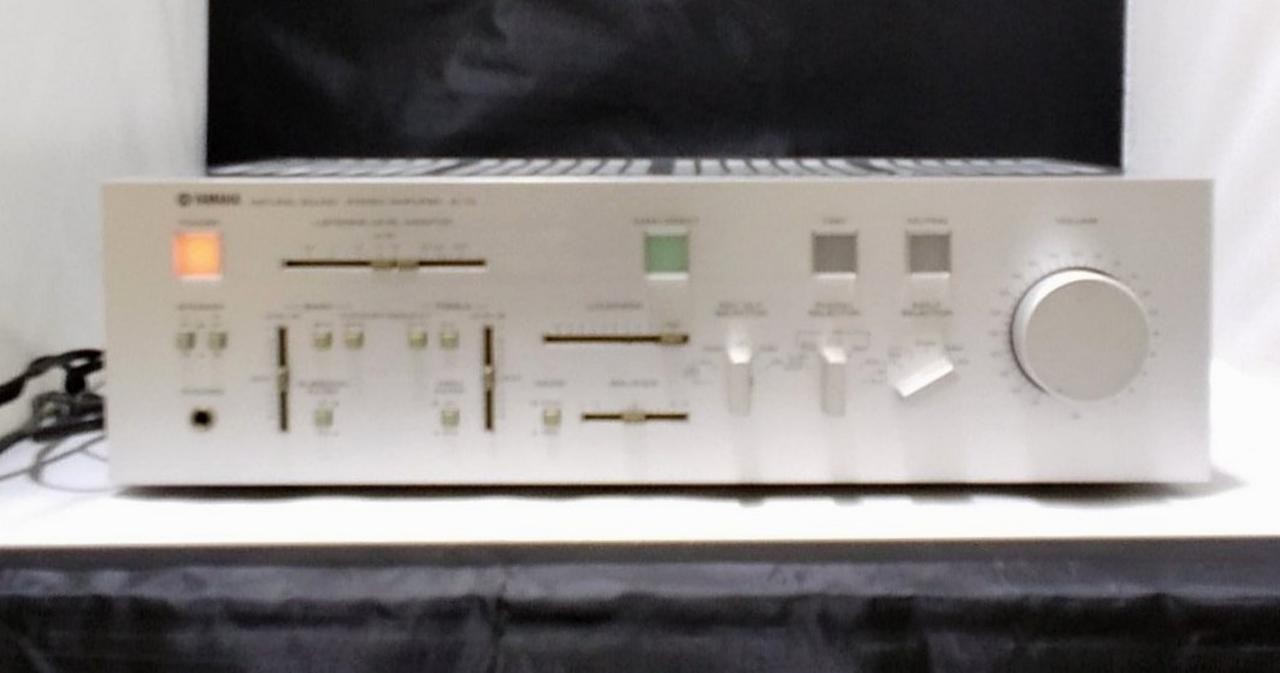
The A-7 features a clean, symmetrical layout with heavy-duty RCA jacks and a large, centrally located volume knob. Its minimalist front panel includes only input selectors and volume control—no balance, no loudness, no power switch (since it doesn’t require power). This simplicity reflects Yamaha’s confidence in the quality of source components and amplifiers used in tandem with the A-7.
Sound Characteristics and Performance
The sonic signature of the Yamaha A-7 is best described as transparent, neutral, and unobtrusive. Without active circuitry, transistors, or op-amps in the signal path, the A-7 avoids the subtle distortions and noise that even high-quality active preamps can introduce. What you hear is essentially the unaltered signal from your source—be it a turntable, tuner, or tape deck—passed through a precision attenuation network.
This makes the A-7 particularly well-suited for use with high-output sources and powerful amplifiers. It excels in systems where the phono stage is external (as the A-7 does not provide phono equalization or amplification) and where the listener values tonal accuracy and dynamic integrity over convenience.
Many users report that the A-7 delivers a “wired straight-through” sound with excellent stereo imaging, tight bass control, and a natural midrange. Its passive nature means it cannot boost weak signals, but in a properly matched system, it preserves the original character of recordings with remarkable fidelity.
Notable Features and Design Philosophy
The Yamaha A-7 embodies a design philosophy that was relatively rare among mainstream manufacturers at the time: passive preamplification as a high-end solution. While brands like Audio Research and Mark Levinson were pioneering active tube preamps, Yamaha took a different path, betting that audiophiles would appreciate a component that added nothing and took away as little as possible.
Key features include:
- High-quality potentiometer: The dual-gang volume control is smooth and precise, with minimal channel imbalance across the range.
- Direct-coupled signal path: No capacitors in the audio path (in most configurations), reducing phase shift and preserving transient detail.
- Robust build quality: Typical of Yamaha’s 1970s components, the A-7 features a heavy steel chassis, solid knobs, and durable connectors.
- Input switching via high-grade switches: Mechanical switches ensure reliable contact and long-term durability.
The A-7 was likely intended to pair with Yamaha’s contemporary power amplifiers such as the B-7 or M-7, forming a minimalist high-fidelity chain. It also complements high-output moving magnet (MM) cartridges when used with a standalone phono preamp.
Common Issues and Maintenance
Being a passive device with no power supply or active electronics, the Yamaha A-7 is exceptionally reliable. However, after nearly 50 years, a few maintenance concerns may arise:
- Potentiometer wear: The most common issue is crackling or channel imbalance due to oxidation or wear in the volume pot. This can usually be resolved with careful cleaning using contact cleaner (non-residue type) or, in severe cases, replacement with a modern high-quality potentiometer.
- Switch degradation: Input selector switches may develop intermittent connections. Regular use and occasional cleaning can prevent this.
- Cable and connector fatigue: Original RCA jacks may loosen over time. Tightening or replacing them ensures optimal signal transfer.
- Dust and oxidation: Internal dust buildup can affect performance. A gentle cleaning of internal connections (though minimal in this design) is recommended during servicing.
Because the circuitry is so simple—essentially just wires, switches, and a potentiometer—the A-7 is one of the easiest vintage components to restore to like-new condition.
Current Market Value and Collectibility
The Yamaha A-7 is not a widely known or commonly collected piece, which keeps its market value relatively modest. However, among vintage audio enthusiasts who appreciate passive preamps, it is gaining recognition as a sleeper classic.
As of 2024, a working Yamaha A-7 in good cosmetic condition typically sells for $150–$300, depending on region and finish. Units in mint condition with original packaging may fetch slightly more, especially in Japan or Europe where Yamaha’s vintage gear is more highly regarded.
Its collectibility is growing due to:
- Increasing interest in passive preamplifiers among minimalist audiophiles.
- Yamaha’s strong reputation for build quality and musicality.
- The resurgence of interest in 1970s analog audio gear.
While it may never reach the prices of rare tube preamps or exotic brands, the A-7 offers exceptional value for those seeking a transparent, no-nonsense preamplifier.
Conclusion and Legacy
The Yamaha A-7 may not have the fame of the RX-5000 receiver or the NS-1000M speaker, but it holds a special place in the history of vintage audio as a statement of purity in design. At a time when audio gear was becoming more complex, Yamaha chose to build a preamp that did nothing but its job—faithfully passing the signal with minimal interference.
It represents a philosophy that still resonates today: that the best audio equipment is often the one you don’t hear. For the listener who values clarity, simplicity, and honesty in sound reproduction, the A-7 remains a compelling choice—even in the modern era of high-resolution digital audio.
If you encounter a Yamaha A-7 in your vintage audio journey, don’t overlook it. Behind its unassuming front panel lies a quiet master of signal integrity—a forgotten gem from Yamaha’s golden age.
eBay Listings



As an eBay Partner, we earn from qualifying purchases. This helps support our independent vintage technology research.
Related Models
- Yamaha HP-1 (1974)
- Yamaha A-1 (1970)
- Yamaha A-1020 (1978)
- Yamaha A-450 (1978)
- Yamaha A-550 (1978)
- Luxman L-530 (1975)
- Luxman R-404 (1975)
- Luxman RV-371 (1975)
- Luxman SQ-38U (1975)
- Luxman T-14 (1972)