Yamaha A-1020: The Powerhouse Integrated Amplifier from Yamaha’s Golden Era
In the late 1970s, Yamaha solidified its reputation as a serious contender in the high-fidelity audio world, producing amplifiers and receivers that balanced technical excellence with musical refinement. Among these was the Yamaha A-1020, a high-powered integrated amplifier released in 1978 that stood out for its bold engineering, dual-monaural design, and exceptional output capability. Though less commonly discussed than some of its contemporaries, the A-1020 remains a sought-after piece among vintage audio enthusiasts for its rare combination of brute power and sonic finesse.
Built during a time when Japanese manufacturers were pushing the boundaries of solid-state amplifier design, the A-1020 was Yamaha’s answer to the demand for high-wattage, high-current amplification—without sacrificing audio quality. It represented the pinnacle of Yamaha’s integrated amplifier lineup at the time and was engineered to drive even the most demanding loudspeakers with authority.
Technical Specifications
The A-1020 was designed with a no-compromise approach, evident in its substantial build and advanced circuitry for the era. It delivered 100 watts per channel into 8 ohms, with the ability to double that into 4 ohms, making it one of the most powerful integrated amplifiers of its time. This was achieved through a robust dual-monaural power supply and output stage, minimizing channel crosstalk and ensuring stable performance under load.
| Specification | Detail |
| Model | Yamaha A-1020 |
| Year Introduced | 1978 |
| Type | Solid-state integrated amplifier |
| Power Output | 100W per channel (8Ω), 160W (4Ω) |
| Total Harmonic Distortion | <0.02% (20Hz–20kHz) |
| Frequency Response | 20Hz–20kHz (+0, -0.5dB) |
| Input Sensitivity | 2.5mV (MM), 150mV (Line) |
| Input Impedance | 47kΩ (Line), 47kΩ / 1kΩ / 100pF (MM) |
| Output Impedance | 0.03Ω |
| Damping Factor | 80 (8Ω, 1kHz) |
| Signal-to-Noise Ratio | 90dB (MM), 100dB (Line) |
| Speaker Impedance | 8Ω minimum |
| Dimensions | 435mm (W) × 156mm (H) × 400mm (D) |
| Weight | 22.5 kg (approx. 49.6 lbs) |
| Finish | Black or titanium (brushed aluminum) |
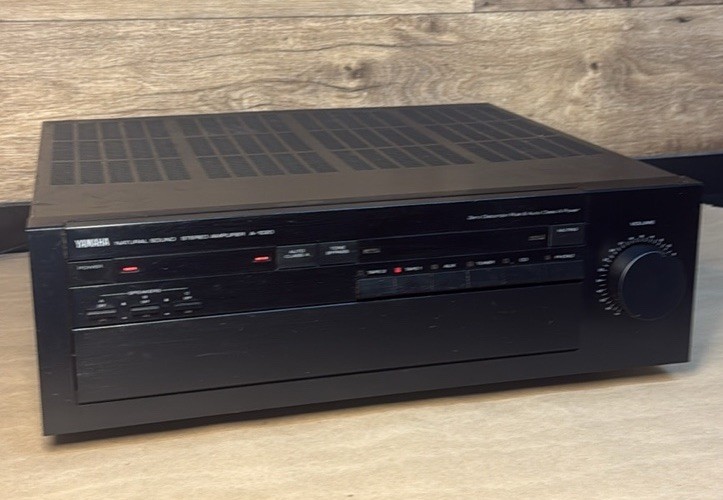
The amplifier featured four line-level inputs (including a dedicated tape monitor loop), a high-quality moving magnet (MM) phono stage with RIAA equalization, and both preamp and power amp bypass options—unusual flexibility for an integrated unit of this era. The front panel included a large central VU meter, dual level controls (for fine-tuning channel balance), and a distinctive stepped attenuator volume control, contributing to precise signal handling and long-term reliability.
Sound Characteristics and Performance
The Yamaha A-1020 is renowned for its dynamic, controlled, and neutral sound signature. Unlike some amplifiers of the era that leaned toward warmth or brightness, the A-1020 aimed for accuracy and transparency, making it an excellent match for a wide range of speakers and musical genres.
Its dual-monaural design—where each channel has its own dedicated power supply and amplification path—results in exceptional channel separation and a wide, stable soundstage. Bass response is tight and deep, thanks to a high damping factor and robust current delivery, while the midrange remains clear and detailed. High frequencies are extended but never harsh, preserving the natural timbre of instruments and vocals.
Because of its high power output and low output impedance, the A-1020 excels at driving difficult speaker loads, including high-sensitivity electrostatics or low-impedance planar magnetics. It delivers a sense of ease and authority, even at high volumes, with minimal compression or distortion.
Notable Features and Innovations
The A-1020 was packed with features that set it apart from typical integrated amplifiers:
- Dual-Monaural Construction: Independent power supplies and amplification circuits for each channel reduced interference and improved stereo imaging.
- High-Current Output Stage: Designed to maintain stability with reactive speaker loads, ensuring consistent performance across different speaker types.
- Precision Stepped Attenuator: Instead of a traditional potentiometer, the A-1020 used a relay-switched resistor ladder for volume control, offering superior channel balance and longevity.
- VU Meter with Input Monitoring: The large central VU meter could monitor input levels or speaker output, aiding in system calibration and providing visual feedback during playback.
- Tape Monitor and Bypass Options: Full tape loop functionality and the ability to use the A-1020 as a preamp or power amp alone added versatility in multi-component systems.
- Heavy-Duty Build Quality: With a massive toroidal transformer, large heatsinks, and a rigid chassis, the A-1020 was built to last.
These features made the A-1020 not just an amplifier, but a centerpiece for a high-end audio system in its day.
Common Issues and Maintenance
Like all vintage electronics, the Yamaha A-1020 benefits from periodic maintenance to ensure optimal performance. While generally reliable, aging components can lead to issues:
- Capacitor Aging: The electrolytic capacitors in the power supply and signal path may dry out over time, leading to hum, reduced power, or channel imbalance. A full recapping by a qualified technician is recommended for units that haven’t been serviced in decades.
- Relay Wear: The stepped attenuator uses relays, which can degrade or become noisy. Cleaning or replacing these relays can restore smooth operation.
- Thermal Management: The large heatsinks are effective, but dust buildup can reduce cooling efficiency. Regular cleaning ensures proper thermal performance.
- Binding Post Corrosion: The speaker terminals may develop oxidation; cleaning with contact enhancer or replacing with modern posts improves connectivity.
- VU Meter Calibration: The analog meter may drift or stick over time and may require recalibration or servicing.
Despite these potential issues, the A-1020’s modular design and high-quality parts make it relatively straightforward to restore to like-new condition.
Current Market Value and Collectibility
The Yamaha A-1020 is not as widely known as some of its peers (like the iconic A-1 or A-303), but it has developed a loyal following among vintage audio collectors and DIY restorers. Its combination of power, build quality, and advanced features makes it a standout in Yamaha’s late-’70s lineup.
In today’s market, a fully functional A-1020 typically sells for $400–$700, depending on condition, finish, and whether it has been recently serviced. Units in original, unmodified condition with clean cosmetics and a working VU meter command premium prices. The titanium (brushed aluminum) finish is especially prized for its classic aesthetic.
While not yet a “blue-chip” vintage amplifier, the A-1020 is increasingly recognized for its engineering merits and is considered a hidden gem among high-powered vintage integrations.
Conclusion and Legacy
The Yamaha A-1020 stands as a testament to Yamaha’s commitment to high-performance audio engineering during the golden age of analog. It bridged the gap between the convenience of an integrated amplifier and the performance of separates, offering audiophiles a powerful, flexible, and sonically transparent solution.
Though overshadowed in popularity by other models, the A-1020 delivers a listening experience that rivals far more expensive amplifiers—then and now. For those seeking a vintage integrated with serious power, exceptional build, and musical integrity, the Yamaha A-1020 remains a compelling and rewarding choice.
In an era where “integrated” often meant compromise, the A-1020 proved that it didn’t have to. It remains a powerful reminder of what vintage audio can achieve when engineering ambition meets musical purpose.
eBay Listings


As an eBay Partner, we earn from qualifying purchases. This helps support our independent vintage technology research.
Related Models
- Yamaha HP-1 (1974)
- Yamaha A-1 (1970)
- Yamaha A-450 (1978)
- Yamaha A-550 (1978)
- Yamaha A-7 (1975)
- Luxman L-530 (1975)
- Luxman R-404 (1975)
- Luxman RV-371 (1975)
- Luxman SQ-38U (1975)
- Luxman T-14 (1972)