Wharfedale W2 (1951)
The Wharfedale W2 is a landmark loudspeaker in the history of British audio engineering, representing a pivotal moment in the evolution of high-fidelity sound reproduction. Introduced in 1951 by Wharfedale Wireless Works, founded by Gilbert Briggs in 1932, the W2 emerged during a period of rapid advancement in audio technology and growing public interest in home music systems. As one of the company's flagship models of the early 1950s, the W2 was designed to deliver exceptional sound quality for its time, combining innovative driver design, thoughtful cabinet engineering, and a commitment to musical realism that would become hallmarks of the Wharfedale brand.
Historical Context and Design Philosophy
In the years following World War II, there was a surge in consumer demand for high-quality audio equipment. Radio broadcasting had matured, vinyl records were becoming more widely available, and the concept of "hi-fi" was beginning to take root. Wharfedale, already established as a leader in speaker design, sought to create a product that balanced performance, reliability, and accessibility. The W2 was developed as a successor to earlier models like the W1 and L1, incorporating lessons learned from extensive listening tests and acoustic research.
Gilbert Briggs was a pioneer in the field of subjective audio evaluation. He believed that measurements alone could not capture the essence of good sound — listening experience was paramount. This philosophy deeply influenced the design of the W2, which was tuned not just for technical accuracy but for musicality and emotional engagement. The speaker was intended for use in domestic environments, where natural tonal balance and vocal clarity were highly valued.
Technical Specifications and Construction
The Wharfedale W2 is a two-way bass-reflex loudspeaker, although its bass-reflex design was somewhat unconventional by modern standards. It features a 12-inch (305 mm) paper-cone bass driver paired with a 3-inch (76 mm) midrange unit and a separate high-frequency horn tweeter. Some variants may include a combined midrange-tweeter unit, depending on production year and market. The crossover network, built with high-quality passive components for the era, directs frequencies appropriately to each driver, aiming for a smooth transition between ranges.
The nominal impedance of the W2 is 15 ohms, which was typical for British speakers of the period and matched well with the output transformers of contemporary valve (tube) amplifiers. This higher impedance helped reduce current demands and minimized damping factor issues common in early amplifier designs.
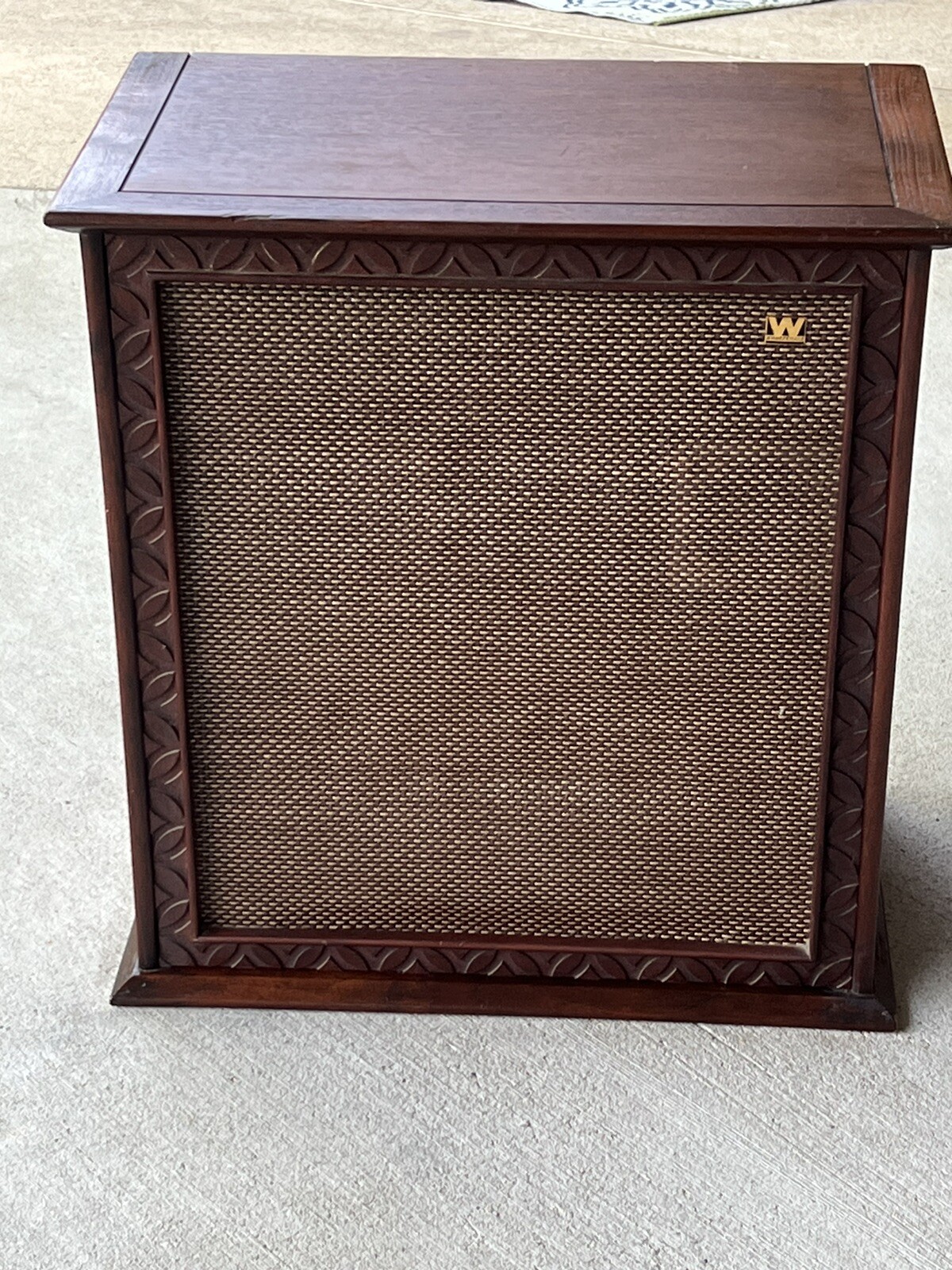
The cabinet is constructed from solid hardwood, typically walnut or mahogany veneer, with internal bracing to reduce resonance and coloration. The enclosure is relatively large by modern standards, measuring approximately 28 inches (71 cm) in height, 14 inches (35.5 cm) in width, and 12 inches (30.5 cm) in depth. The size allowed for adequate internal volume to support bass response without requiring excessive porting or complex loading schemes.
One of the W2’s distinguishing features is its use of Wharfedale’s proprietary cone materials and suspension systems. The bass driver employed a doped paper cone with a cloth surround, designed to provide a balance of stiffness and compliance. The tweeter, often a compression-type horn design, was engineered for extended high-frequency response while avoiding harshness — a common problem in early high-frequency drivers.
Performance Characteristics
In its time, the Wharfedale W2 was praised for its rich, full-bodied sound. Reviewers and listeners noted its strong midrange presence, which made it particularly well-suited for vocal and acoustic music. The bass, while not as deep or tight as modern standards, was considered impressive for a speaker of its era, extending down to around 50 Hz with reasonable authority. The treble was smooth and detailed, avoiding the sibilance and fatigue associated with some contemporary designs.
The speaker’s sensitivity was rated at approximately 92 dB (1W/1m), making it relatively easy to drive with low-powered valve amplifiers such as those from Leak, Mullard, or Williamson. This compatibility helped the W2 gain popularity among audiophiles who valued synergy between components.
Stereo reproduction was still in its infancy when the W2 was introduced, and many users employed the speakers in mono setups. However, as stereo records and amplifiers became available in the mid-1950s, pairs of W2s were increasingly used in stereo configurations, where their imaging and soundstage capabilities were found to be surprisingly effective.
Legacy and Collectibility
The Wharfedale W2 is now considered a classic of vintage audio. While it was eventually superseded by models like the W3, W4, and later the famous Diamond series, the W2 holds a special place in the lineage of British loudspeaker development. It represents a transition from early experimental designs to more refined, scientifically informed engineering.
Today, original W2 speakers are sought after by collectors and vintage audio enthusiasts. Restored pairs in good condition can command high prices, especially when equipped with original drivers and cabinets. However, due to their age, many components — particularly the foam or cloth surrounds on the bass drivers — have degraded and require reconing or replacement. Skilled restorers often use period-correct materials to preserve the speaker’s authentic sound.
The W2 also serves as a testament to Wharfedale’s enduring influence. The company continued to innovate throughout the 20th century and remains active today, producing modern speakers that still emphasize musicality and value — principles first embodied in classics like the W2.
Conclusion
The Wharfedale W2 is more than just a relic of the past; it is a milestone in the pursuit of high-fidelity sound. Its combination of thoughtful design, robust construction, and musical character made it a favorite among discerning listeners in the 1950s. While modern speakers surpass it in technical specifications, few match its unique sonic signature and historical significance.
For those interested in the roots of hi-fi audio, the W2 offers a window into a formative era of speaker development. It reflects a time when audio engineering was as much an art as a science — a philosophy that continues to resonate with audiophiles today. Whether displayed as a collector’s item or carefully restored for listening, the Wharfedale W2 stands as a symbol of British innovation and the timeless quest for beautiful sound.
eBay Listings


As an eBay Partner, we earn from qualifying purchases. This helps support our independent vintage technology research.
Related Models
- Wharfedale AIREDALE (1954)
- Wharfedale CHEVIN (1978)
- Wharfedale DENTON-1 (1988)
- Wharfedale DENTON-2 (1998)
- Wharfedale DENTON-3 (1994)
- Akai AM-2850 (1975)
- Akai AP-206 (1975)
- Nakamichi BX-1 (1985)
- Acoustic Research research-ar-17 (1978)
- Acoustic Research AR-19 (1994)