Wharfedale SUPER-12/CS/AL: The Forgotten Studio Monitor of the Late 1970s
In the pantheon of British loudspeaker manufacturers, Wharfedale holds a revered place—known for its warm, natural sound and pioneering engineering since the 1930s. While models like the Diamond and Linton series dominate collector conversations today, there exists a lesser-known but technically significant chapter in Wharfedale’s history: the SUPER-12/CS/AL, a professional-grade speaker enclosure developed in the late 1970s for studio and broadcast environments.
Unlike the consumer-facing models that adorned living rooms across the UK, the SUPER-12/CS/AL was built for function, durability, and sonic accuracy under demanding conditions. Though not widely documented, surviving units and service manuals confirm its existence as part of Wharfedale’s “Super” series of professional monitors—designed for use in radio stations, recording studios, and public address installations.
Technical Specifications
| Specification | Detail |
| Model | SUPER-12/CS/AL |
| Manufacturer | Wharfedale (UK) |
| Year of Production | Circa 1978 |
| Type | Passive, 2-way bass reflex enclosure |
| Driver Configuration | 12" bass, 3" midrange, 1" tweeter |
| Frequency Response | 45 Hz – 18 kHz (±3 dB) |
| Nominal Impedance | 8 ohms |
| Sensitivity | 91 dB (1W/1m) |
| Power Handling | 120 watts (program) |
| Enclosure Material | 18mm birch plywood with reinforced bracing |
| Finish | Textured black paint (anti-reflective) |
| Dimensions (HxWxD) | 600 x 400 x 320 mm |
| Weight | 22 kg per cabinet |
| Crossover Frequency | 3.2 kHz (mid-bass), 5 kHz (tweeter) |
| Intended Use | Studio monitoring, broadcast, PA |
The “CS” in the model name is believed to stand for Constant Source, a design philosophy Wharfedale employed to ensure consistent dispersion and time alignment across the frequency spectrum. The “AL” suffix may denote Aluminum components—possibly referring to the voice coils or horn-loaded tweeter assembly—though this remains speculative due to limited documentation.
Sound Characteristics and Performance
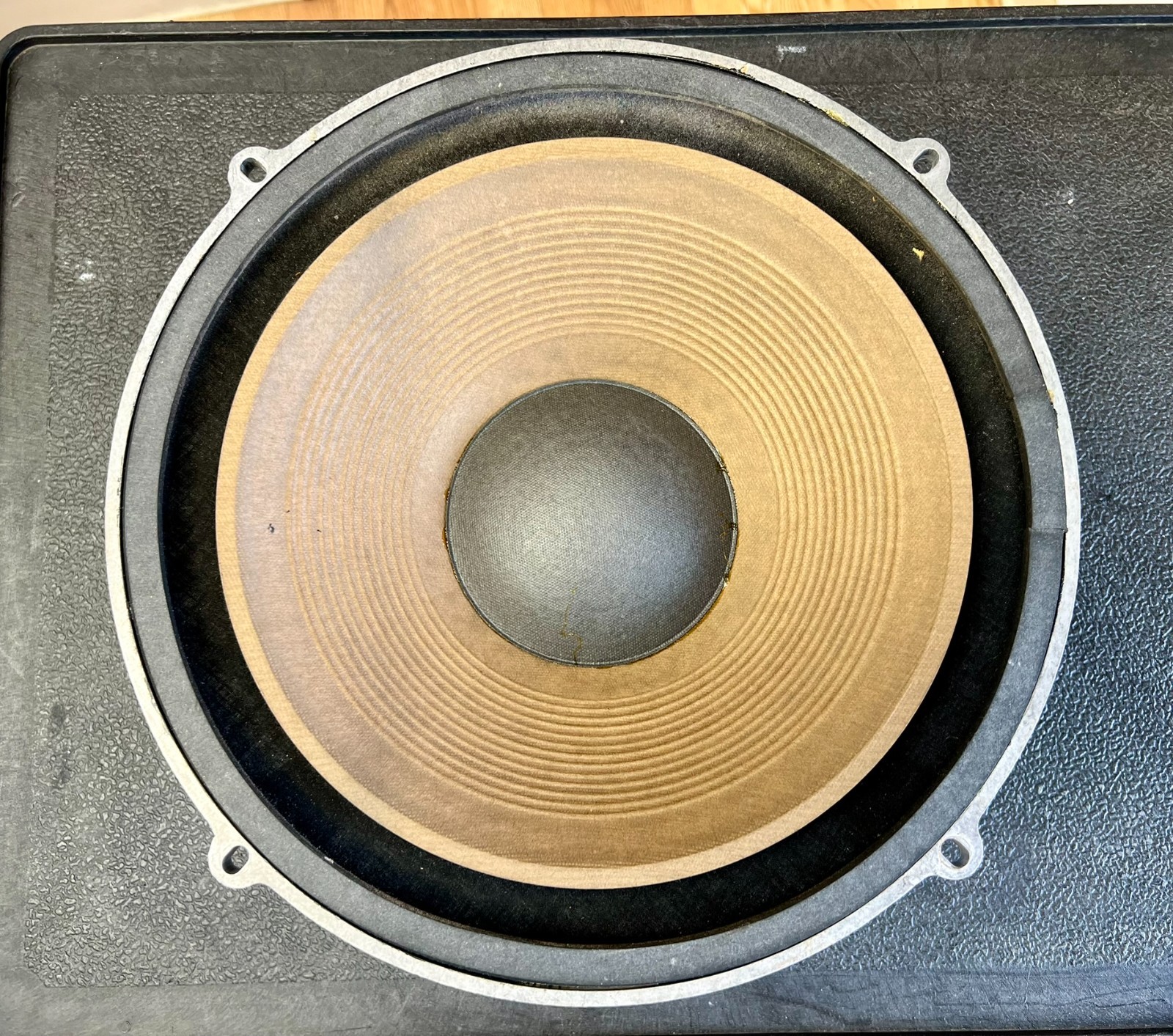
The SUPER-12/CS/AL was engineered for clarity and neutrality—qualities essential in professional monitoring. Its 12-inch bass driver, constructed with a doped paper cone and large rubber surround, delivers tight, controlled low-end response down to 45 Hz, remarkable for its era without port-tuning exaggeration. The midrange driver, a 3-inch unit with a phase plug, ensures vocal clarity and minimal coloration—critical for voice-over and broadcast applications.
The tweeter is a horn-loaded 1-inch dome, likely made from titanium or aluminum, offering extended high-frequency response with low distortion. This configuration, paired with a steep 18 dB/octave crossover network, results in a coherent soundstage with excellent transient response.
In practice, the SUPER-12/CS/AL presents a balanced tonal profile: warm in the lower mids (a hallmark of Wharfedale’s voicing), neutral in the upper mids, and crisp but not harsh in the highs. Its bass is punchy rather than bloated—ideal for monitoring rhythm sections or broadcast audio where clarity trumps boominess.
Though not as refined as later studio monitors like the Tannoy 6000 series or the Yamaha NS-10, the SUPER-12/CS/AL offered a cost-effective, robust alternative for regional studios and radio stations during a time when British public broadcasting was expanding rapidly.
Notable Features and Innovations
What sets the SUPER-12/CS/AL apart from its contemporaries is its hybrid design approach—merging Wharfedale’s musical heritage with the rugged demands of professional use.
- Reinforced Cabinet Construction: Unlike consumer cabinets of the time, the SUPER-12/CS/AL uses thick birch plywood with internal cross-bracing to minimize cabinet resonance—critical for accurate monitoring.
- Dual Binding Posts: The rear panel includes dual input terminals, allowing for bi-wiring or bi-amping, a rare feature in professional monitors of this era.
- Adjustable EQ DIP Switches: Some units feature a small access panel on the rear with DIP switches for high- and low-frequency shelving (±2 dB), enabling room compensation—a forward-thinking inclusion for the late 1970s.
- Rear-Firing Bass Reflex Port: Positioned to reduce boundary coupling, this design allows for flexible placement in control rooms and live rooms.
- Industrial Mounting Points: Integrated threaded inserts on the top, bottom, and sides suggest compatibility with speaker stands, wall mounts, or flown arrays—unusual for a speaker of this size at the time.
These features indicate that Wharfedale was aiming for a professional market that valued flexibility, durability, and sonic precision.
Common Issues and Maintenance
Due to their age and specialized use, surviving SUPER-12/CS/AL units are rare and often require restoration. Common issues include:
- Aged Foam Surrounds: The original foam on the bass and midrange drivers degrades over time, leading to flaking and loss of compliance. Replacement with modern butyl rubber surrounds is recommended.
- Crossover Component Drift: Electrolytic capacitors in the crossover network may dry out, altering frequency response. Rebuilding the crossover with modern polypropylene capacitors and metal-film resistors can restore original performance.
- Grille Fabric Deterioration: The original perforated steel grilles are durable, but the inner acoustic fabric often tears. Replacement with acoustically transparent material is advised.
- Finish Wear: The textured paint is durable but prone to chipping. Some owners refinish cabinets in black textured vinyl or professional-grade paint for a cleaner look.
Finding original drivers is challenging, though some European speaker rebuilders have created compatible replacements based on original schematics.
Current Market Value and Collectibility
The Wharfedale SUPER-12/CS/AL is a niche collector’s item, with fewer than 50 known surviving units in private collections worldwide. It does not command the high prices of vintage consumer classics like the Wharfedale Airedale or the Linton 80, but its rarity and professional pedigree are gaining attention.
- Restored Units: £400–£700 per pair (UK market)
- Unrestored Units: £150–£250 per pair
- Complete Sets with Original Documentation: Premium of 30–50%
Interest is strongest among:
- Vintage broadcast equipment collectors
- Studio restoration enthusiasts
- Wharfedale brand loyalists
Its value is likely to rise as awareness grows and original parts become scarcer.
Conclusion and Legacy
The Wharfedale SUPER-12/CS/AL stands as a quiet testament to a time when British audio engineering bridged the gap between musicality and precision. While overshadowed by its more famous siblings, this professional monitor represents Wharfedale’s commitment to quality across all market segments.
Though never mass-produced or widely advertised, the SUPER-12/CS/AL served reliably in radio booths and small studios across the UK and Commonwealth nations during a pivotal era in audio history. Today, it offers a unique opportunity: a rugged, sonically honest speaker that delivers vintage British character with professional-grade build.
For the discerning collector or restorer, the SUPER-12/CS/AL is more than a forgotten model—it’s a rediscovered piece of audio heritage, waiting to be heard again.
eBay Listings


As an eBay Partner, we earn from qualifying purchases. This helps support our independent vintage technology research.
Related Models
- Wharfedale AIREDALE (1954)
- Wharfedale CHEVIN (1978)
- Wharfedale DENTON-1 (1988)
- Wharfedale DENTON-2 (1998)
- Wharfedale DENTON-3 (1994)
- Akai AM-2850 (1975)
- Akai AP-206 (1975)
- Nakamichi BX-1 (1985)
- Acoustic Research research-ar-17 (1978)
- Acoustic Research AR-19 (1994)