Wharfedale ROSEDALE: A Timeless Icon of British Hi-Fi Heritage
In the pantheon of vintage loudspeakers, few names evoke the golden age of British audio engineering quite like Wharfedale. Among its storied lineage of classic designs, the Wharfedale ROSEDALE stands as a quiet yet significant ambassador of postwar British hi-fi. Introduced in 1952, the ROSEDALE emerged during a pivotal era when high-fidelity audio was transitioning from luxury novelty to household aspiration. Though not as widely documented as later Wharfedale legends like the Linton or Diamond series, the ROSEDALE holds a cherished place among collectors and vintage audio enthusiasts for its elegant design, warm sonic signature, and historical importance in Wharfedale’s evolution.
Designed as a compact bookshelf speaker, the ROSEDALE was aimed at the discerning listener who valued both aesthetics and performance in a modest footprint. It arrived at a time when Wharfedale, under the visionary leadership of founder Gilbert Briggs, was pioneering research into speaker enclosure design, driver materials, and room acoustics. The ROSEDALE reflects these early innovations, embodying the company’s commitment to musical accuracy and tonal balance—principles that would define British speaker design for decades.
Technical Specifications
| Specification | Detail |
| Model | ROSEDALE |
| Manufacturer | Wharfedale (Ilkley, West Yorkshire, UK) |
| Year Introduced | 1952 |
| Type | 2-way bookshelf loudspeaker |
| Driver Complement | 8" bass-midrange, 1" dome or horn tweeter (exact variant may vary) |
| Crossover | Passive, 2nd order (estimated) |
| Frequency Response | ~60 Hz – 15 kHz (approximate) |
| Sensitivity | ~86 dB (1W/1m) |
| Nominal Impedance | 15 Ω (typical of era) |
| Enclosure Type | Acoustic suspension (sealed) |
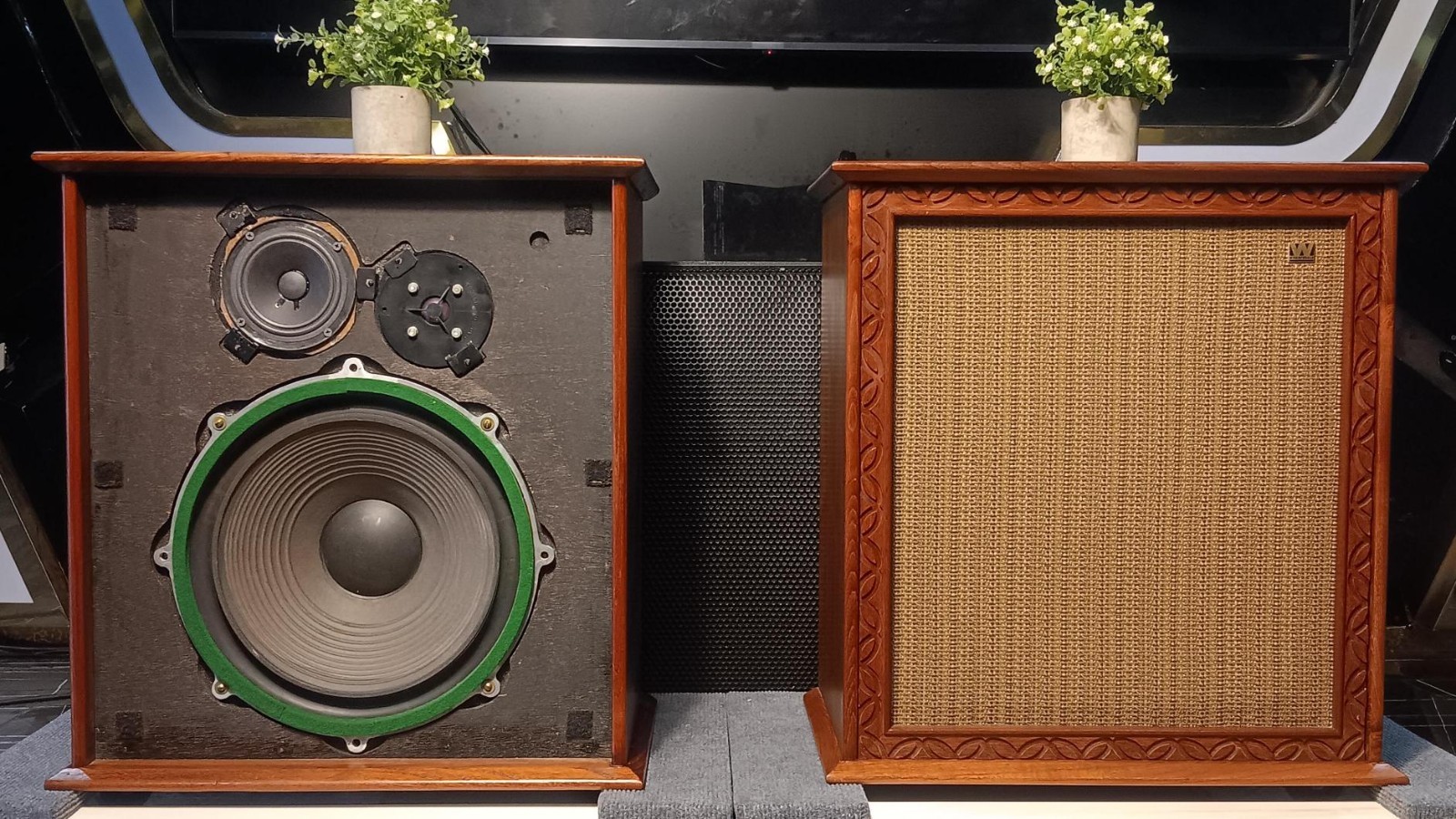
| Cabinet Finish | Real wood veneer (walnut or rosewood) |
| Dimensions (H×W×D) | ~16" × 10" × 9" (40.6 × 25.4 × 22.9 cm) |
| Weight | ~18 lbs (8.2 kg) per speaker |
Note: Exact specifications may vary slightly due to production runs and restoration conditions. Original documentation is rare, and data is reconstructed from period catalogs and collector observations.
Sound Characteristics and Performance
The ROSEDALE delivers a sound signature that is quintessentially British: warm, smooth, and musically engaging. Its 8-inch bass-mid driver provides a surprisingly full-bodied lower midrange, ideal for vocal and acoustic performances. While deep bass extension is limited by modern standards—typical of sealed enclosures of the era—the speaker avoids boominess, offering tight and well-damped low frequencies that integrate naturally with the midband.
The high frequencies are handled by a small dome or horn-loaded tweeter (exact configuration varies), which contributes to a refined and non-fatiguing top end. Cymbals and string harmonics are rendered with a delicate, almost romantic character, avoiding the harshness sometimes found in later mass-market designs. The crossover, though primitive by today’s standards, is well-executed for its time, ensuring a coherent blend between drivers.
Listeners often describe the ROSEDALE’s sound as “organic” and “inviting.” It excels with vinyl playback, tube amplifiers, and acoustic genres—jazz, classical, and vocal recordings in particular. While not suited for high-volume or modern bass-heavy music, the ROSEDALE offers a listening experience that prioritizes emotional connection over analytical precision.
Notable Features and Innovations
The ROSEDALE exemplifies Wharfedale’s mid-century design philosophy: simplicity, craftsmanship, and acoustic integrity. Key features include:
- Handcrafted Cabinet: Constructed from solid wood with real veneer finishes, the cabinet reflects the care and attention typical of 1950s British furniture design. The sealed (acoustic suspension) enclosure was a deliberate choice to ensure tighter bass control and reduced phase distortion.
- Innovative Driver Materials: Wharfedale was among the first to experiment with paper cone formulations and damping techniques to reduce resonance. The ROSEDALE’s bass-mid driver benefits from these early material science advances.
- Aesthetic Elegance: With its gently curved baffle, flush-mounted drivers, and optional fabric grilles, the ROSEDALE was designed to blend into living rooms as much as perform acoustically. Its understated elegance makes it a favorite among vintage furniture and audio collectors alike.
- 15-Ohm Impedance: Unlike modern 8-ohm standards, many Wharfedales of this era used higher impedance designs, making them well-matched to the valve (tube) amplifiers of the time, which often featured multiple output taps.
Common Issues and Maintenance
As with any vintage audio equipment, the ROSEDALE requires careful attention to remain in optimal condition. Common issues include:
- Aged Speaker Cones: The paper cones may suffer from drying, cracking, or warping after 70+ years. Re-coning by a specialist is often necessary and can restore performance close to original.
- Degraded Foam or Cloth Surrounds: Though early models used cloth surrounds (more durable than foam), these can still deteriorate. Replacement or restoration is recommended for speakers in active use.
- Capacitor Drift in Crossovers: The paper and wax capacitors used in original crossovers may leak or lose capacitance. Many owners opt for a careful recapping using period-correct or audiophile-grade components.
- Cabinet Damage: Original veneers can be scratched or faded. Restoration should be done with conservation in mind—preserving original finishes is key to maintaining value.
- Grilles and Hardware: Original fabric grilles are often missing or damaged. Reproduction grilles based on period photos are available from specialty restorers.
Owners are advised to consult experienced vintage speaker technicians and avoid modern amplifiers with high damping factors, which can sound overly clinical with these speakers. A pairing with a vintage valve amp—such as those from Leak, Mullard, or Quad—brings out the ROSEDALE’s best qualities.
Current Market Value and Collectibility
The Wharfedale ROSEDALE is a moderately rare vintage speaker, with complete, original pairs becoming increasingly scarce. While not as high-profile as the Wharfedale Airedale or later Linton models, the ROSEDALE has seen growing interest in recent years, particularly among collectors of 1950s British audio.
- Market Value: A pair in good original condition typically sells for $400–$800, depending on restoration status, finish, and provenance. Fully restored pairs with documented history can command up to $1,200.
- Collectibility Factors: Original finish, working drivers, matching serial numbers, and inclusion of grilles or original packaging significantly enhance value. Speakers from early production runs (1952–1954) are especially sought after.
- Investment Potential: While not a blue-chip vintage speaker, the ROSEDALE represents solid value for collectors interested in the evolution of British hi-fi. Its understated charm and historical significance ensure steady demand.
Conclusion and Legacy
The Wharfedale ROSEDALE may not have the fame of its larger siblings, but it occupies a special niche in the history of high-fidelity audio. As a product of postwar British innovation, it reflects a time when audio engineering was as much an art as a science. Its warm, natural sound, elegant design, and connection to Wharfedale’s golden era make it more than just a speaker—it’s a piece of sonic heritage.
For the vintage audio enthusiast, the ROSEDALE offers a window into the roots of modern hi-fi: a time when listening was an intimate, deliberate act, and speakers were crafted to bring music into the home with grace and soul. Whether displayed as a period centerpiece or enjoyed with a tube amp and vinyl collection, the ROSEDALE remains a testament to Wharfedale’s enduring legacy—where engineering meets emotion, one note at a time.
eBay Listings


As an eBay Partner, we earn from qualifying purchases. This helps support our independent vintage technology research.
Related Models
- Wharfedale AIREDALE (1954)
- Wharfedale CHEVIN (1978)
- Wharfedale DENTON-1 (1988)
- Wharfedale DENTON-2 (1998)
- Wharfedale DENTON-3 (1994)
- Akai AM-2850 (1975)
- Akai AP-206 (1975)
- Nakamichi BX-1 (1985)
- Acoustic Research research-ar-17 (1978)
- Acoustic Research AR-19 (1994)