Wharfedale Glendale (1950)
The Wharfedale Glendale is a vintage loudspeaker model produced by the renowned British audio company Wharfedale in the early 1950s. As part of Wharfedale's domestic speaker lineup during the post-war era, the Glendale represented the company's commitment to delivering high-fidelity sound in an aesthetically refined package suitable for home listening environments. Though not as widely documented as some of Wharfedale’s later models, the Glendale holds a respected place among vintage audio enthusiasts for its craftsmanship, tonal balance, and historical significance in the evolution of British speaker design.
Historical Context and Design Philosophy
Wharfedale, founded in 1932 by Gilbert Briggs, quickly established itself as a pioneer in loudspeaker engineering. By the 1950s, the company was producing a range of speakers that balanced scientific innovation with practical home audio needs. The Glendale was introduced around 1950 as a compact bookshelf or stand-mounted speaker, designed primarily for use in smaller rooms or as part of a high-quality two-channel system paired with valve (tube) amplifiers of the era.
The name "Glendale" follows Wharfedale’s tradition at the time of naming speakers after scenic British locales—echoing models like the Dentdale, Calderdale, and Langdale. This naming convention reflected not only a sense of national pride but also an emphasis on natural, organic sound reproduction.
The Glendale was constructed with a two-way driver configuration, typical of high-end domestic speakers of the period. It featured a 12-inch (30 cm) bass driver paired with a smaller high-frequency unit, likely a horn-loaded tweeter or a direct-radiating dome, though exact specifications vary slightly depending on production batch and regional market. The crossover network, while basic by modern standards, was carefully tuned to ensure smooth integration between the drivers.
Cabinet and Aesthetic Design
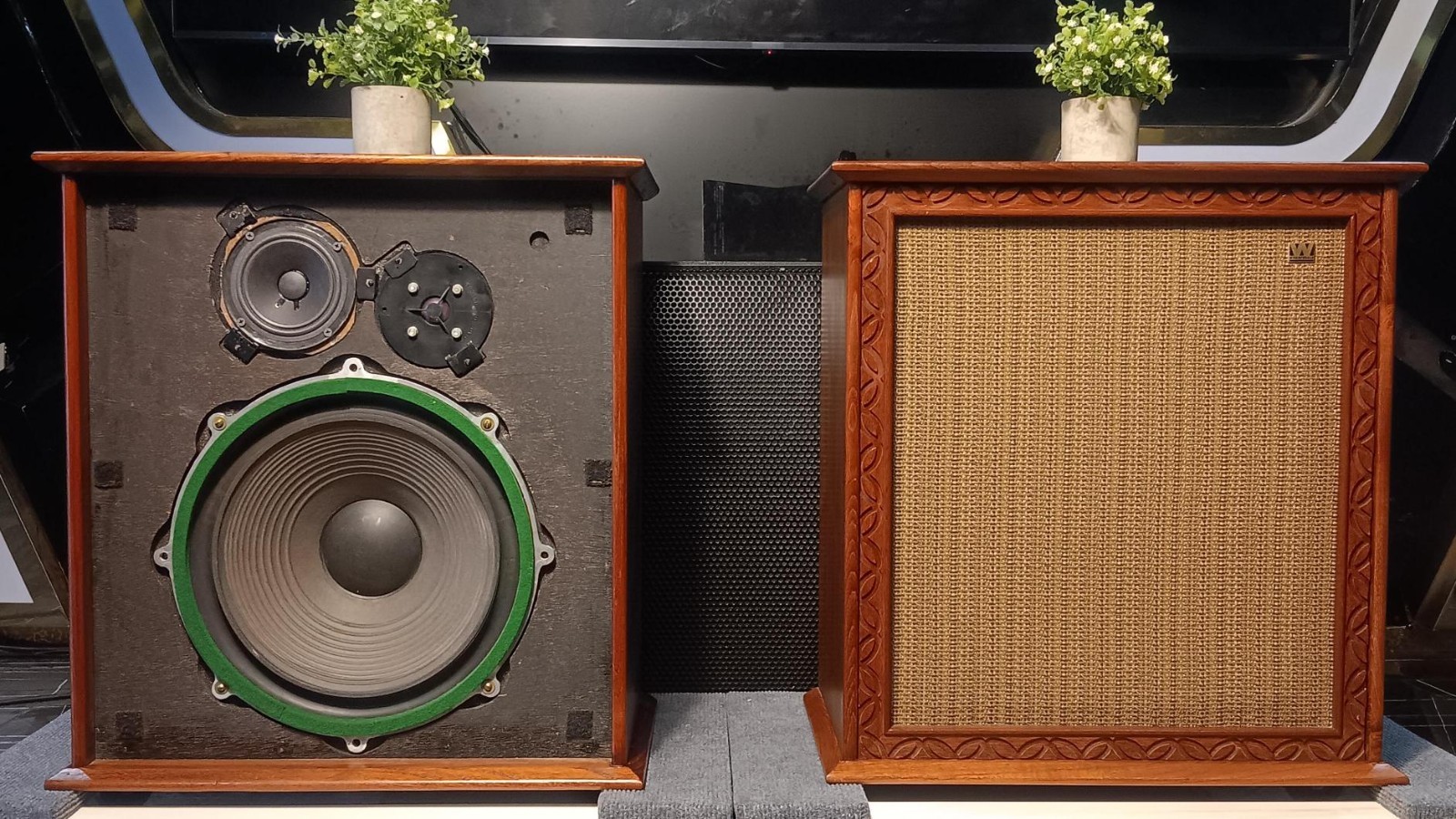
One of the most striking features of the Wharfedale Glendale is its cabinet design. Crafted from solid wood and finished in a rich walnut veneer, the speaker exudes the craftsmanship typical of mid-century British furniture design. The cabinet is relatively large by today’s standards, measuring approximately 24 inches in height, 14 inches in width, and 10 inches in depth, reflecting the acoustic requirements of the large bass driver and the need for a well-damped enclosure.
The front baffle is slightly curved, a design choice that not only enhanced visual appeal but also contributed to improved sound dispersion. The grille, typically made of woven fabric stretched over a wooden frame, was detachable and often bore the Wharfedale logo in elegant script. Some versions of the Glendale featured a distinctive "picture frame" style grille with a solid wooden border, adding to its vintage charm.
Internally, the cabinet was constructed using multi-ply wood panels with internal bracing to minimize resonance. The use of natural materials and hand-finished veneers meant that no two pairs were exactly alike, contributing to their collectible status today.
Acoustic Performance
The Glendale was engineered to deliver a warm, full-bodied sound signature that complemented the valve amplifiers of the time. The 12-inch bass driver provided deep, articulate low-frequency response—remarkable for a speaker of its era—while the high-frequency unit ensured clear, non-fatiguing treble reproduction. The nominal impedance is generally accepted to be 15 ohms, which was common for British speakers designed to work with the output transformers of tube amplifiers.
Frequency response for the Glendale is estimated to range from around 50 Hz to 15 kHz, which was considered excellent for domestic use in the 1950s. Sensitivity is believed to be in the region of 90–92 dB (1W/1m), making the speaker reasonably efficient and capable of producing satisfying volume levels even with low-powered amplifiers.
Sound quality is often described by vintage audio aficionados as "musical" and "engaging," with a pronounced midrange that brings vocals and acoustic instruments to life. The bass, while not as tight or controlled as modern speakers, has a natural bloom that many find pleasing for jazz, classical, and vocal recordings of the period.
Variants and Market Availability
The Glendale was produced in several variants, including differences in driver materials, crossover components, and cabinet finishes. Some later models may have incorporated updated cone materials or improved tweeters, though documentation from the era is sparse. There is also evidence of export versions being sold in North America and Australia, sometimes under slightly different model designations or with modified impedance to suit local amplifier standards.
It is important to note that the Glendale was not a mass-market product. It was positioned as a premium speaker and sold through specialist hi-fi dealers. As such, original pairs in good condition are rare today and highly sought after by collectors and restorers.
Restoration and Modern Use
Restoring a pair of Wharfedale Glendales requires careful attention to detail. Common issues include deteriorated foam or cloth surrounds on the bass drivers, degraded crossover capacitors, and worn binding posts. Many enthusiasts opt to re-foam or recone the original drivers to preserve authenticity, while others choose to upgrade components for improved reliability and performance.
When restored properly, the Glendale can still hold its own in a vintage audio setup. They pair exceptionally well with classic British amplifiers such as those from Leak, Mullard, or Williamson. While not ideal for modern high-resolution audio or home theater applications, they excel at reproducing music from vinyl records and analog sources with a character and warmth that is difficult to replicate with contemporary speakers.
Legacy and Influence
The Wharfedale Glendale stands as a testament to the golden age of British hi-fi. It embodies the design principles that Wharfedale championed: scientific rigor combined with an ear for musicality. Though overshadowed in popularity by later models like the Wharfedale Diamond series, the Glendale laid the groundwork for the company’s reputation for building speakers that deliver emotional connection to music.
Today, the Glendale is recognized not only as a functional audio component but also as a piece of design history. Its blend of elegant aesthetics and sonic character continues to inspire modern speaker designers and audiophiles alike. In the world of vintage audio, where provenance and authenticity matter, the Glendale remains a cherished example of mid-20th-century British engineering and craftsmanship.
For collectors, restorers, or those simply seeking the warm, inviting sound of a bygone era, the Wharfedale Glendale offers a window into the origins of high-fidelity audio—and a reminder that great sound doesn’t always come from the latest technology.
eBay Listings


As an eBay Partner, we earn from qualifying purchases. This helps support our independent vintage technology research.
Related Models
- Wharfedale AIREDALE (1954)
- Wharfedale CHEVIN (1978)
- Wharfedale DENTON-1 (1988)
- Wharfedale DENTON-2 (1998)
- Wharfedale DENTON-3 (1994)
- Akai AM-2850 (1975)
- Akai AP-206 (1975)
- Nakamichi BX-1 (1985)
- Acoustic Research research-ar-17 (1978)
- Acoustic Research AR-19 (1994)