Wharfedale DOVEDALE-3: The Crown Jewel of British Open-Baffle Design
In the pantheon of vintage loudspeakers, few models command the reverence and mystique of the Wharfedale DOVEDALE-3. Crafted during the golden era of British audio engineering in the mid-1950s, the DOVEDALE-3 stands as a monumental achievement in open-baffle speaker design—a bold departure from conventional cabinet-bound acoustics that sought to redefine the very nature of natural sound reproduction.
Born from the visionary mind of Gilbert Briggs, the founder of Wharfedale and a pioneer in high-fidelity audio, the DOVEDALE-3 was not merely a loudspeaker but a philosophical statement about how music should be experienced. It emerged at a time when hi-fi was transitioning from furniture-style radio cabinets to dedicated audio systems focused on accuracy and realism. The DOVEDALE-3, with its towering presence and radical open-baffle architecture, was designed for the serious audiophile who demanded nothing less than lifelike sonic reproduction.
A Monumental Design Philosophy
Unlike most loudspeakers of its era (and even today), the DOVEDALE-3 eschewed the traditional enclosed cabinet. Instead, it employed an open-baffle design, where the drivers are mounted on a large vertical panel without a rear enclosure. This approach eliminates cabinet coloration and standing waves, resulting in a more natural, spacious, and three-dimensional soundstage—qualities that remain highly prized by purists.
The DOVEDALE-3 was a three-way system, featuring separate drivers for bass, midrange, and treble frequencies. Its imposing height—often exceeding 6 feet—allowed for optimal driver spacing and vertical dispersion, mimicking the spatial arrangement of a live orchestra. The design was both acoustically and aesthetically ambitious, reflecting Wharfedale’s commitment to marrying engineering excellence with artistic expression.
Technical Specifications
| Specification | Detail |
| Model | Wharfedale DOVEDALE-3 |
| Manufacturer | Wharfedale (Ilkley, Yorkshire, UK) |
| Year Introduced | 1955 |
| Type | Open-baffle, three-way floorstanding |
| Driver Configuration | 1 x 12" bass, 1 x 8" midrange, 1 x horn tweeter |
| Frequency Response | Approx. 40 Hz – 18 kHz (±3 dB) |
| Sensitivity | ~92 dB (1W/1m) |
| Nominal Impedance | 15 Ω (nominal), varies with frequency |
| Crossover | Passive, external (integrated in stand) |
| Enclosure Type | Open baffle (no rear cabinet) |
| Dimensions (H×W×D) | ~190 cm × 60 cm × 25 cm (75" × 24" × 10") |
| Weight | ~45 kg (99 lbs) per speaker |
| Recommended Amp Power | 15–50 watts (tube amplifiers ideal) |
Sound Characteristics and Performance
The sonic signature of the DOVEDALE-3 is nothing short of magical. Freed from the constraints of a cabinet, the speakers produce a lifelike, airy presentation with exceptional clarity and spatial realism. The open-baffle design allows bass to radiate both forward and backward, creating a dipole radiation pattern that enhances room integration and minimizes boxy resonances.
- Bass: Deep and articulate for its era, the 12" bass driver delivers surprisingly extended low-end, though it rolls off gradually below 40 Hz. The bass is not "tight" in the modern sense but rather organic and resonant, blending seamlessly with the midrange.
- Midrange: The heart of the DOVEDALE-3’s magic lies in its midband. The 8" midrange unit, often a Wharfedale proprietary design, renders vocals and acoustic instruments with uncanny realism—warm, detailed, and free from harshness.
- Treble: The horn-loaded tweeter provides excellent dispersion and dynamic punch, offering a sparkling yet non-fatiguing high end. It avoids the brittleness common in early dome tweeters.
When paired with the right amplifier—typically a low-powered tube amp like a Leak, Mullard, or Williamson—the DOVEDALE-3 achieves a harmonic richness and musical flow that many modern speakers still struggle to match. Its soundstage is vast and holographic, with precise imaging that seems to float in mid-air.
Notable Features and Innovations
- Open-Baffle Architecture: One of the earliest commercially available open-baffle systems, the DOVEDALE-3 demonstrated Wharfedale’s willingness to challenge conventional wisdom.
- Integrated Crossover Network: Housed in a floor-level enclosure or plinth, the crossover was carefully tuned to match the unique acoustic loading of each driver in the open-air environment.
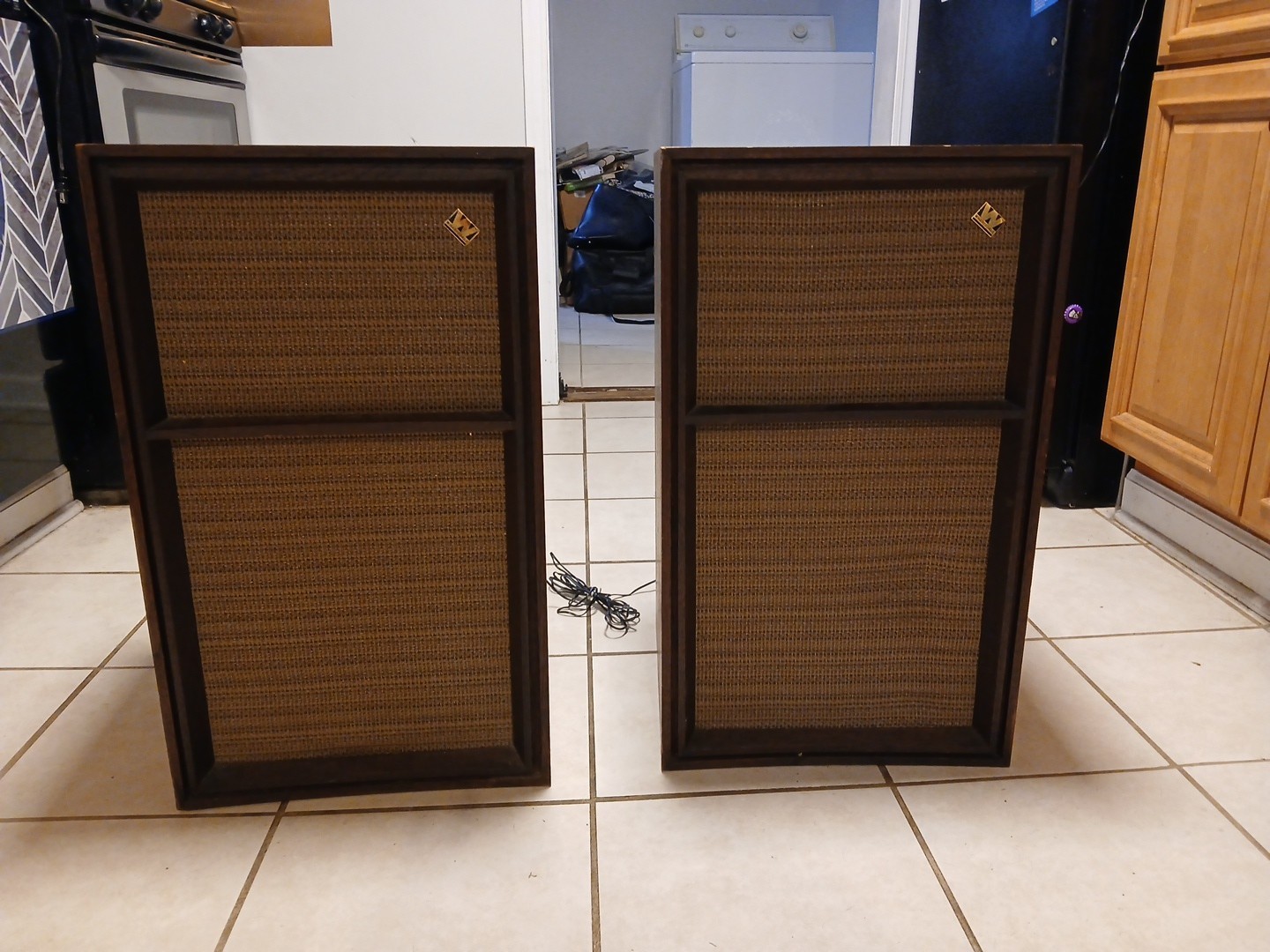
- Hand-Crafted Cabinet: The baffle and support structure were made from high-quality plywood and finished in luxurious walnut veneer, reflecting the craftsmanship of post-war British furniture design.
- Modular Design: Some versions allowed for driver upgrades or system expansion, a rare feature for the time.
Common Issues and Maintenance
Due to their age and rarity, surviving DOVEDALE-3 units require careful attention:
- Aging Drivers: The original paper cones and foam surrounds have likely degraded. Re-coning or replacement with period-correct drivers is often necessary.
- Crossover Components: Capacitors and inductors may have drifted in value or failed. A careful refurbishment using modern audiophile-grade parts is recommended.
- Structural Integrity: The large baffle can warp over time, especially if exposed to humidity. Reinforcement or restoration may be needed.
- Impedance Matching: The unusual 15 Ω nominal impedance can be challenging for modern solid-state amplifiers. Tube amps with multiple output taps are ideal.
Restoration should be undertaken by specialists familiar with vintage British speakers. Finding original parts is difficult, but the Wharfedale Heritage Project and enthusiast forums like The Classic Speaker Pages can be invaluable resources.
Current Market Value and Collectibility
The Wharfedale DOVEDALE-3 is exceedingly rare. Few units survive in working condition, and complete, unrestored examples occasionally appear at auctions or in private collections. When they do, they command significant prices:
- Restored Units: $3,000–$6,000 USD
- Unrestored but Complete: $1,500–$3,000 USD
- Incomplete or Parts Units: $500–$1,000 USD
Collectors prize the DOVEDALE-3 not only for its sound but as a piece of audio history—a testament to the fearless experimentation of the 1950s hi-fi movement. It is often mentioned in the same breath as the Quad ESL-57 and the Lowther horn systems as a landmark in British audio design.
Conclusion: A Legacy of Sonic Purity
The Wharfedale DOVEDALE-3 is more than a loudspeaker—it is a sonic sculpture, a bold experiment in acoustic transparency that continues to inspire audiophiles and designers today. In an age of sealed enclosures and digital processing, the DOVEDALE-3 reminds us of a simpler, more honest approach to sound: let the drivers breathe, let the music flow, and let the room become part of the performance.
For the dedicated vintage audio enthusiast, owning a pair of DOVEDALE-3s is akin to possessing a Stradivarius of the speaker world—rare, temperamental, and utterly transcendent when properly cared for. It stands as a towering achievement from Wharfedale’s golden age, a monument to the belief that true fidelity lies not in specifications, but in the soul of the sound.
If you ever have the chance to hear a restored pair in a quiet, well-set-up room—perhaps driven by a pair of glowing KT66s—don’t hesitate. You’re not just listening to speakers. You’re experiencing the birth of British hi-fi.
eBay Listings
As an eBay Partner, we earn from qualifying purchases. This helps support our independent vintage technology research.
Related Models
- Wharfedale AIREDALE (1954)
- Wharfedale CHEVIN (1978)
- Wharfedale DENTON-1 (1988)
- Wharfedale DENTON-2 (1998)
- Wharfedale DENTON-3 (1994)
- Akai AM-2850 (1975)
- Akai AP-206 (1975)
- Nakamichi BX-1 (1985)
- Acoustic Research research-ar-17 (1978)
- Acoustic Research AR-19 (1994)