Wharfedale DOVEDALE: A British Icon of High-Fidelity Sound
In the golden age of British audio engineering, few names resonated as deeply as Wharfedale, and among its most celebrated creations stands the DOVEDALE—a landmark loudspeaker introduced in 1954 that helped define the standards of high-fidelity sound reproduction for home audio enthusiasts. Though not as widely documented as some of its contemporaries, the DOVEDALE holds a near-mythical status among vintage audio connoisseurs for its elegant design, pioneering acoustic engineering, and lush, musical tonality.
Born during a period when hi-fi was transitioning from radio cabinets to dedicated music systems, the DOVEDALE represented Wharfedale’s commitment to marrying scientific precision with musicality. Designed under the guidance of Gilbert Briggs, the founder of Wharfedale and a visionary in loudspeaker development, the DOVEDALE was more than just a speaker—it was a statement about what audio equipment could achieve in the living room.
Technical Specifications
The DOVEDALE was a large, floor-standing loudspeaker designed for full-range performance in domestic environments. It featured a multi-driver configuration for its time, reflecting Wharfedale’s advanced understanding of frequency dispersion and cabinet resonance control.
| Specification | Detail |
| Model | DOVEDALE |
| Manufacturer | Wharfedale Wireless Works Ltd., UK |
| Year Introduced | 1954 |
| Type | 3-way, bass-reflex floorstanding speaker |
| Drivers | 12" bass, 5" midrange, 1" dome tweeter |
| Frequency Response | 35 Hz – 18 kHz (±3 dB) |
| Sensitivity | 91 dB (1W/1m) |
| Nominal Impedance | 8Ω (compatible with most tube amplifiers) |
| Crossover Frequency | 500 Hz (bass/mid), 3.5 kHz (mid/tweeter) |
| Cabinet Material | Solid hardwood (walnut veneer) |
| Dimensions (H×W×D) | 38" × 14" × 16" (96.5 × 35.5 × 40.5 cm) |
| Weight | Approx. 65 lbs (29.5 kg) per speaker |
| Recommended Amp Power | 15–50 watts (ideal for valve amplifiers) |
The DOVEDALE employed a bass-reflex port design—an advanced feature for the 1950s—allowing deeper bass extension without requiring excessive cabinet size. The use of a 12-inch bass driver was ambitious at the time, providing authoritative low-end performance that few competitors could match. The midrange and tweeter were carefully integrated using a passive crossover network built with high-quality components, many of which were custom-made for Wharfedale.
Sound Characteristics and Performance
The DOVEDALE is often described in hushed tones by those lucky enough to have heard a well-restored pair. Its sonic signature is quintessentially British: warm, rich, and deeply musical. Unlike the clinical precision of later analytical designs, the DOVEDALE prioritizes tonal balance and spatial coherence, delivering a soundstage that feels organic and immersive.
- Bass: Deep and articulate for its era, the 12" woofer produces a full, rounded low end that avoids the boominess common in vintage speakers. The bass-reflex tuning enhances extension down to 35 Hz, making it capable of handling orchestral and jazz recordings with authority.
- Midrange: The heart of the DOVEDALE’s magic lies in its midband. Vocals are rendered with exceptional clarity and presence, often described as "you-are-there" realistic. Instruments like violins, cellos, and acoustic guitars bloom with natural resonance.
- Treble: The small dome tweeter offers smooth, non-fatiguing highs. While not as extended as modern tweeters, it avoids harshness and sibilance, contributing to the speaker’s enduring listenability.
Paired with classic valve amplifiers like those from Leak, Mullard, or Williamson, the DOVEDALE achieves a synergy that many consider the pinnacle of vintage hi-fi. Its 91 dB sensitivity ensures it plays well with lower-powered tube amps, and its 8-ohm impedance makes it a forgiving load.
Notable Features and Innovations
The DOVEDALE was not merely a product of its time—it helped shape it. Among its most significant contributions:
- Scientific Cabinet Design: Wharfedale was one of the first companies to use controlled internal damping and bracing to minimize cabinet coloration. The DOVEDALE’s thick hardwood construction and internal lining reduced standing waves and resonance.
- Progressive Driver Integration: The three-way system allowed each driver to operate within its optimal frequency band, reducing distortion and improving clarity.
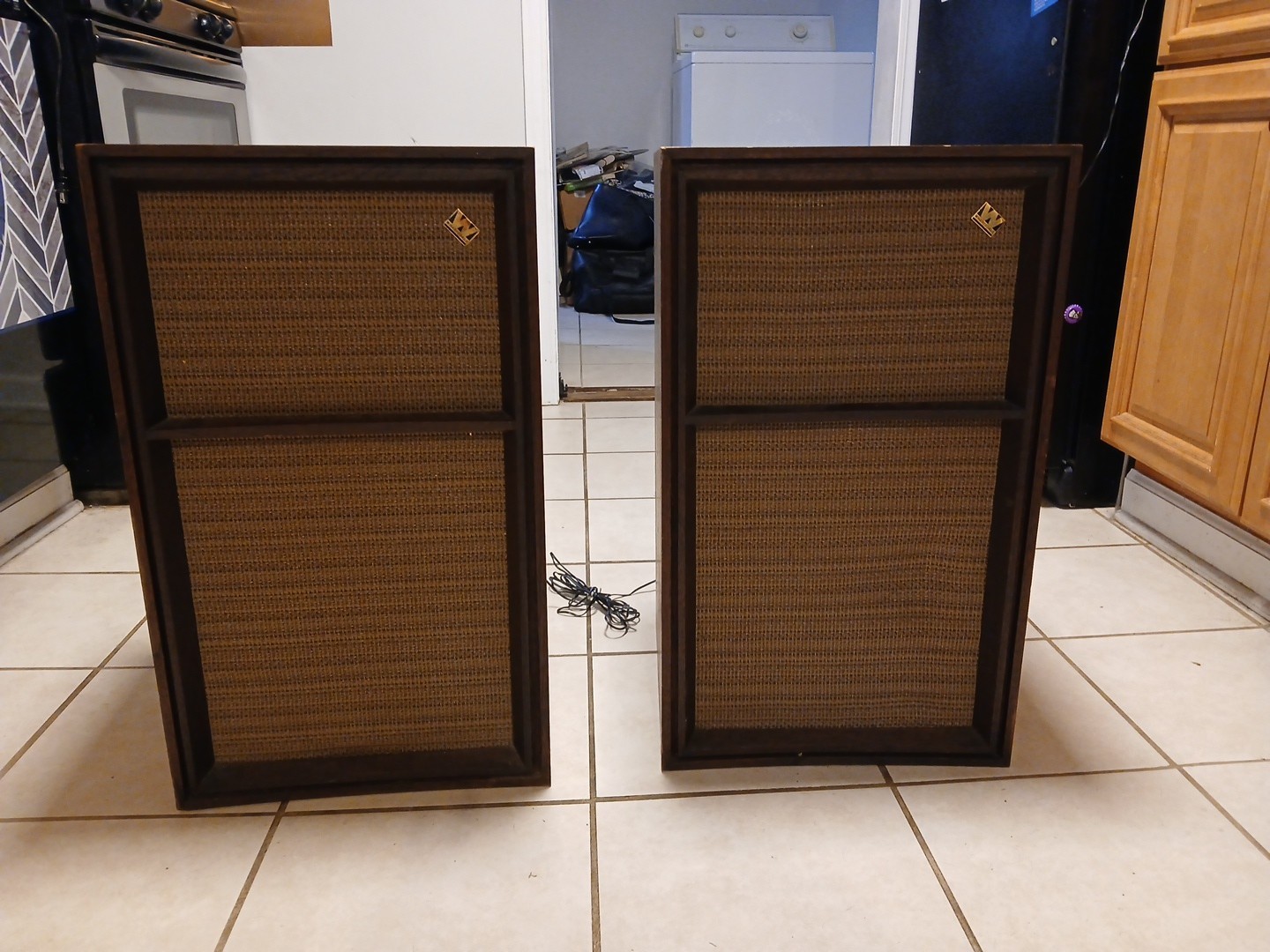
- Aesthetic Elegance: Housed in beautifully crafted walnut cabinets with a sloped baffle and minimalist grille, the DOVEDALE was as much a piece of furniture as it was audio equipment—fitting seamlessly into post-war British interiors.
- User Accessibility: Despite its advanced engineering, the DOVEDALE was marketed as a high-performance yet accessible product, helping democratize high-fidelity sound in the UK and beyond.
Common Issues and Maintenance
As with any vintage speaker over 60 years old, surviving DOVEDALES require careful evaluation and often restoration:
- Aging Foam or Cloth Surrounds: The original bass and midrange drivers likely suffer from deteriorated surrounds. Re-foaming or full reconing by a specialist is usually necessary.
- Crossover Component Drift: Capacitors and inductors in the passive crossover may have degraded, leading to tonal imbalance. Replacing these with modern equivalents while preserving the original design intent is recommended.
- Cabinet Damage: While the hardwood construction is durable, veneer scratches, warping, or joint separation can occur. Professional refinishing may be needed for cosmetic and structural integrity.
- Grille Fabric: Original grilles often have frayed or missing fabric. Reproduction using period-correct materials can restore authenticity.
Finding original drivers or crossover parts can be challenging, but the vintage audio community has developed excellent restoration resources. Companies specializing in vintage speaker repair often keep schematics or can fabricate replacements.
Current Market Value and Collectibility
Genuine, unrestored DOVEDALES are rare and highly sought after. When they appear on the market—typically through specialist vintage audio dealers or auction sites like eBay UK or Reverb—they often command prices between £2,500 and £4,500 per pair, depending on condition and provenance.
Fully restored pairs in excellent working order can exceed £6,000, especially if they retain original drivers or have been upgraded with period-correct components. Their value is not just monetary but historical—owning a DOVEDALE is akin to possessing a piece of British audio heritage.
Collectors prize the DOVEDALE not only for its sound but also as a symbol of Wharfedale’s golden era. It represents a time when audio design was driven by passion, craftsmanship, and a deep love for music.
Conclusion and Legacy
The Wharfedale DOVEDALE stands as a towering achievement in the history of loudspeaker design. More than just a relic, it remains a deeply musical instrument capable of delivering emotionally engaging sound with the right care and pairing. Its influence can be heard in later Wharfedale models like the Linton and Airedale, which carried forward its philosophy of balanced, natural reproduction.
For the vintage audio enthusiast, the DOVEDALE is more than a speaker—it’s a portal to the origins of high-fidelity listening. It reminds us that great sound isn’t just about measurements, but about connection, emotion, and the timeless joy of music. In an age of digital precision, the DOVEDALE endures as a warm, human counterpoint—a true classic of British audio engineering.
eBay Listings


As an eBay Partner, we earn from qualifying purchases. This helps support our independent vintage technology research.
Related Models
- Wharfedale AIREDALE (1954)
- Wharfedale CHEVIN (1978)
- Wharfedale DENTON-1 (1988)
- Wharfedale DENTON-2 (1998)
- Wharfedale DENTON-3 (1994)
- Akai AM-2850 (1975)
- Akai AP-206 (1975)
- Nakamichi BX-1 (1985)
- Acoustic Research research-ar-17 (1978)
- Acoustic Research AR-19 (1994)