Western Electric 594A (1933)
It’s not just a driver—it’s a time machine bolted to a horn, humming with the ghost of cinema’s golden age.
Overview
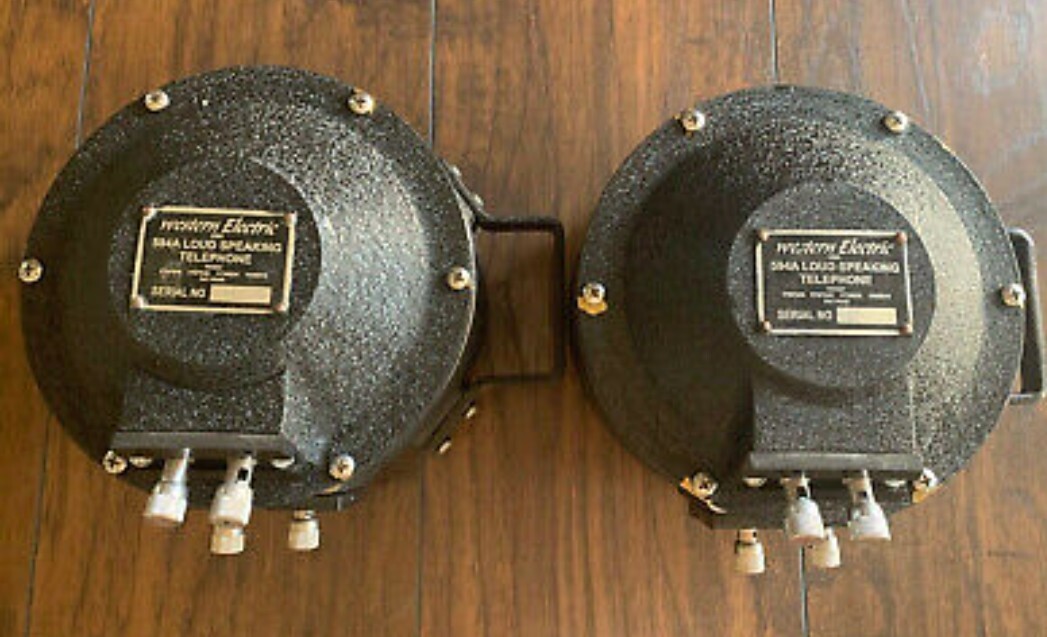
The Western Electric 594A isn’t the kind of gear you casually pick up at a flea market. It’s a field coil compression driver that feels less like audio equipment and more like industrial archaeology—something forged in a lab where sound met steel, not plastic. Built for theaters, not living rooms, this was the business end of Western Electric’s second-generation Mirrophonic systems, the ones that made movie palaces roar with clarity when “talkies” were still a novelty. You don’t listen to a 594A so much as witness it, especially when it’s bolted to a proper horn like the ES290 Biradial No.1955. Owners report a smoothness, a kind of effortless authority in the midrange, that modern drivers still chase but rarely catch. One reviewer put it plainly: “You can truly hear the quality and smoothness—even over the poor 16 bit camera mic!” That’s not just nostalgia talking. That’s someone who’s stood in front of one, ears wide open.
And let’s be clear—this isn’t some forgotten prototype. The 594A has a cult that borders on reverence. On forums, you’ll find audiophiles calling it “the BEST compression driver ever made,” not with hyperbole, but with the quiet conviction of someone who’s heard it. It’s the kind of gear that becomes a reference point, not just for sound, but for what’s possible when engineering isn’t chasing cost targets. As one collector put it: “it is good to have those Western Electric sounds cataloged in my head as a reference library.” That says more than any spec sheet ever could.
Specifications
| Manufacturer | Western Electric |
| Product type | Field coil compression driver |
| Field coil resistance | 17.5 ohms (tested) |
| Voice coil resistance | 13 ohms (tested) |
| Approximate dimensions | 17 x 21 x 23 cms |
| Weight with packing | 20 kgs |
Key Features
Field Coil Magnet System
The 594A runs on a field coil magnet, not a permanent magnet—meaning it needs external DC power to energize the magnetic field. That’s not just a quirk; it’s the core of its character. Field coils were the high-end solution in the 1930s, offering stronger, more stable magnetic fields than early permanents, which translated to tighter control and lower distortion. It’s also why these drivers are a pain to integrate today—no plug-and-play here. You need a power supply, wiring, and patience. But owners who’ve gone through the trouble say it’s worth it. The driver tested in one account was described as “all original,” and that purity matters. With field coils, corrosion, degraded windings, or replaced parts can kill the magic fast.
Compression Driver Design
As a compression driver, the 594A doesn’t move air directly. Instead, it pressurizes a small chamber behind a diaphragm, funneling sound through a narrow throat into a horn. That’s how it achieves high efficiency and directivity—critical when you’re filling a 2,000-seat theater with dialogue and music. The throat diameter of the compatible ES290 Biradial horn is 2.000" (50.80mm), though the driver itself doesn’t have a published throat spec. Still, the pairing is legendary. This isn’t a tweeter or a midrange in the modern sense; it’s a sonic cannon, built to project without strain. And unlike later Altec designs that leaned on brute force, the 594A is said to deliver its power with refinement—a rare combo in any era.
Historical Context
The 594A was part of Western Electric’s second-generation Mirrophonic systems, an engineering push that aimed to dominate cinema sound when the industry was still figuring out what “good” even meant. These weren’t home units—they were installed in real theaters, part of a complete system designed from the ground up. But the run was short. As one account puts it: “They were only out for two years or so before WE abandoned the theater business.” That abrupt exit is a big reason these drivers are so rare today. Unlike the longer-lived 555, which became a staple, the 594A was here, then gone—caught in a corporate pivot that left only a handful behind. Altec would later rise as a competitor in professional sound, but in the early 1930s, Western Electric was the benchmark. The 594A was one of their final theater statements before they walked away.
Collectibility & Value
If you’re looking for a bargain, keep walking. The 594A is “famous and scarce,” and “far more scarce than 555 drivers,” according to collectors. One user paid $500 for a 594A in 1989—a hefty sum at the time—and today, the market’s only gotten more intense. As one owner put it: “the price is nuts but there is BIG money chasing this stuff.” Another called it “definitely the sport of kings.” That’s not an exaggeration. These aren’t just vintage curios; they’re trophies. Finding one “all original” is a minor miracle. And while no recent sale prices are documented, the consensus is clear: if you see one, and you can afford it, think hard before passing. Restoration is possible, but authenticity is everything. Once the field coil is compromised, you’re not just losing output—you’re losing history.
eBay Listings


As an eBay Partner, we earn from qualifying purchases. This helps support our independent vintage technology research.
Related Models
- Western Electric 12A (1926)
- Western Electric 13A (1928)
- Western Electric 15A (1930)
- Western Electric 22A Horn (1933)
- Western Electric 24A Horn (1935)
- Akai AM-2850 (1975)
- Akai AP-206 (1975)
- Nakamichi BX-1 (1985)
- Acoustic Research research-ar-17 (1978)
- Acoustic Research AR-19 (1994)