Thorens TD 160 (1972–1985)
At 8.5 kg, it settles on the shelf like something built to last—no frills, just precision in motion.
Overview
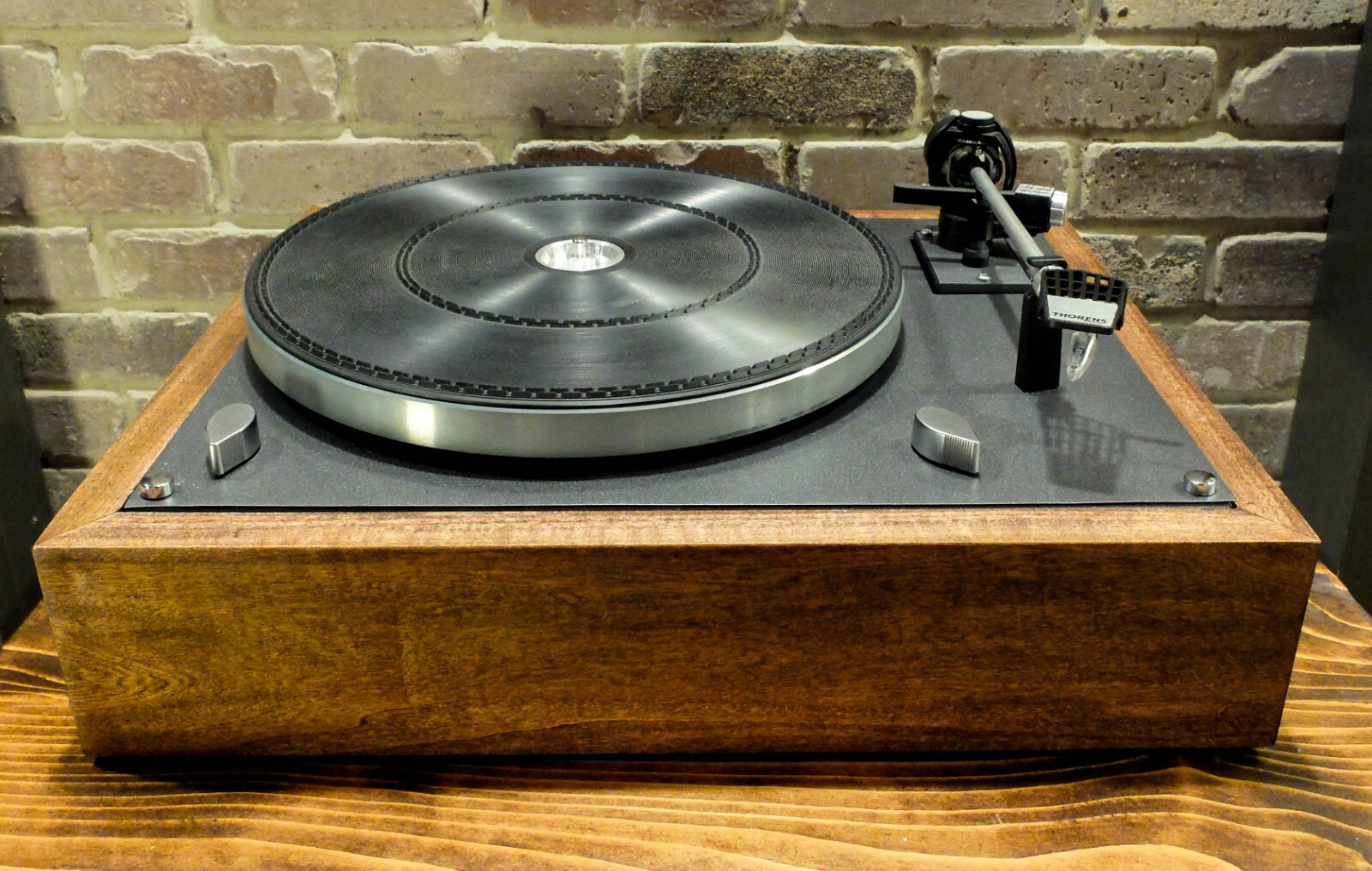
The Thorens TD 160 isn’t flashy, but it doesn’t need to be. Introduced in 1972 as a refined evolution of the TD-150, this belt-drive turntable with suspended subchassis quickly became Thorens’ best-selling model, carving out a reputation as a benchmark for affordable high-end performance. It delivered what mattered: stability, isolation, and a musical presentation that felt more expensive than its original $299.99 price tag suggested. Owners report a quiet background, excellent detail retrieval, and a natural warmth—qualities that still resonate with analog enthusiasts decades later.
Built around a wooden plinth and a floating sub-chassis suspended by three springs, the TD 160 isolates the platter and tonearm from external vibrations with surgical intent. The 1.5kg non-ferrous alloy platter spins via a belt-drive system powered by a 16-pole synchronous motor, contributing to its remarkably low wow and flutter of less than 0.04% (DIN 45507). Rumble is suppressed to beyond –70dB (DIN 45539A), making it exceptionally quiet for its class. It supports 33⅓ and 45 RPM speeds, with no automatic functions—just a manual tonearm lift and non-contact magnetic anti-skating, keeping the design focused on core performance.
The stock tonearm across most variants is the TP 16, available in Mk I, Mk II, and Mk III iterations. While some users feel the standard TP 16 doesn’t fully exploit the turntable’s potential, others regard it as a capable, well-balanced arm—especially on properly set-up units. The TD 160 Super, a later variant with the improved TP 16 Mk II and other refinements, is widely considered a step up and commands higher prices on the secondary market. Modifications are common, with many upgrading to arms like the SME 3009 II to unlock even greater resolution.
Specifications
| Manufacturer | Thorens |
| Model | TD 160 |
| Product type | Belt-drive turntable with suspended subchassis |
| Production years | 1972–1985 |
| Speeds | 33⅓, 45 RPM |
| Drive system | Belt-drive |
| Motor | 16-pole synchronous motor |
| Platter | 1.5kg non-ferrous alloy |
| Wow & Flutter | <0.04% (DIN 45507) |
| Rumble | > -70dB (DIN 45539A) |
| Tonearm | TP 16 (variants: TP 16, TP 16 Mk II, TP 16 Mk III) |
| Dimensions (W x H x D) | 445 x 150 x 360 mm |
| Weight | 8.5 kg |
| Chassis | Wooden plinth |
| Design | Suspended subchassis design on three springs |
Key Features
Suspended Subchassis on Three Springs
The heart of the TD 160’s performance lies in its sprung sub-chassis, a design philosophy carried over and refined from the TD-150. Supported by three adjustable springs, the entire platter and tonearm assembly floats independently from the outer plinth, effectively decoupling it from floor and cabinet vibrations. This mechanical isolation is not theoretical—it’s immediately audible in the lowered noise floor and improved clarity. However, the system demands careful leveling and is sensitive to placement; a wobble or uneven surface will compromise tracking and stability.
1.5kg Non-Ferrous Alloy Platter
Mass matters in turntable design, and the 1.5kg platter contributes significantly to speed stability. Made from non-ferrous alloy, it avoids magnetic interference with the cartridge and motor, while its weight helps smooth out minor motor inconsistencies. Combined with the belt-drive system and 16-pole synchronous motor, it achieves the sub-0.04% wow and flutter rating—a figure that rivals more expensive contemporaries. The platter’s inertia supports a relaxed, flowing presentation, especially with complex passages.
TP 16 Tonearm Variants
The TP 16 tonearm, in its various iterations, is a point of debate among collectors. The original TP 16 is functional but considered by some as the weakest link in an otherwise strong chain. The Mk II and Mk III versions included improvements and refinements.
Non-Contact Magnetic Anti-Skating
Rather than a physical thread or spring, the TD 160 employs a non-contact magnetic anti-skating system. This reduces friction and wear over time, and when calibrated correctly, it applies consistent force across the record’s surface. It’s a clever solution that aligns with the turntable’s minimalist, reliability-focused ethos. However, improper setup—such as misaligned magnets or incorrect distance—can lead to uneven tracking, so precision during installation is critical.
Historical Context
It became part of a broader series of Thorens turntables that established the brand as a leader in high-value analog playback. As Thorens’ best-selling model, it helped define what “affordable high-end” meant in the 1970s and early 1980s. Its design lineage is clear: a direct descendant of the TD-150, refined for broader appeal without sacrificing fundamental engineering principles.
Collectibility & Value
The Thorens TD 160 remains a sought-after classic, particularly in well-maintained or upgraded condition. The standard model originally sold for $299.99 in 1971, a competitive price for its performance tier. Today, the TD-160 Super—recognized for its improved TP 16 Mk II tonearm and other refinements—commands a premium, with asking prices reaching $995 plus shipping for original examples. Standard models appear on the used market under $270, though fully serviced units with new belts and lubrication can exceed that.
Common issues include aging suspension springs, which may sag or harden over decades, leading to instability. Perished drive belts are nearly universal in unrefurbished units and require replacement—owners note that belts come in A, B, and C variants, so correct identification is essential. Dried lubrication in the main bearing and motor pulley can cause binding or speed irregularities. The tonearm cueing mechanism is another point of wear, often needing cleaning or adjustment. Despite these age-related concerns, the TD 160 is regarded as a complicated but rewarding machine for those willing to invest time and care.
eBay Listings
As an eBay Partner, we earn from qualifying purchases. This helps support our independent vintage technology research.