Thorens TD 190-1 / TD 190-2 (2003–?)
At 440 mm wide, it occupies desk space like a statement piece—compact enough for apartments, substantial enough to feel serious.
Overview
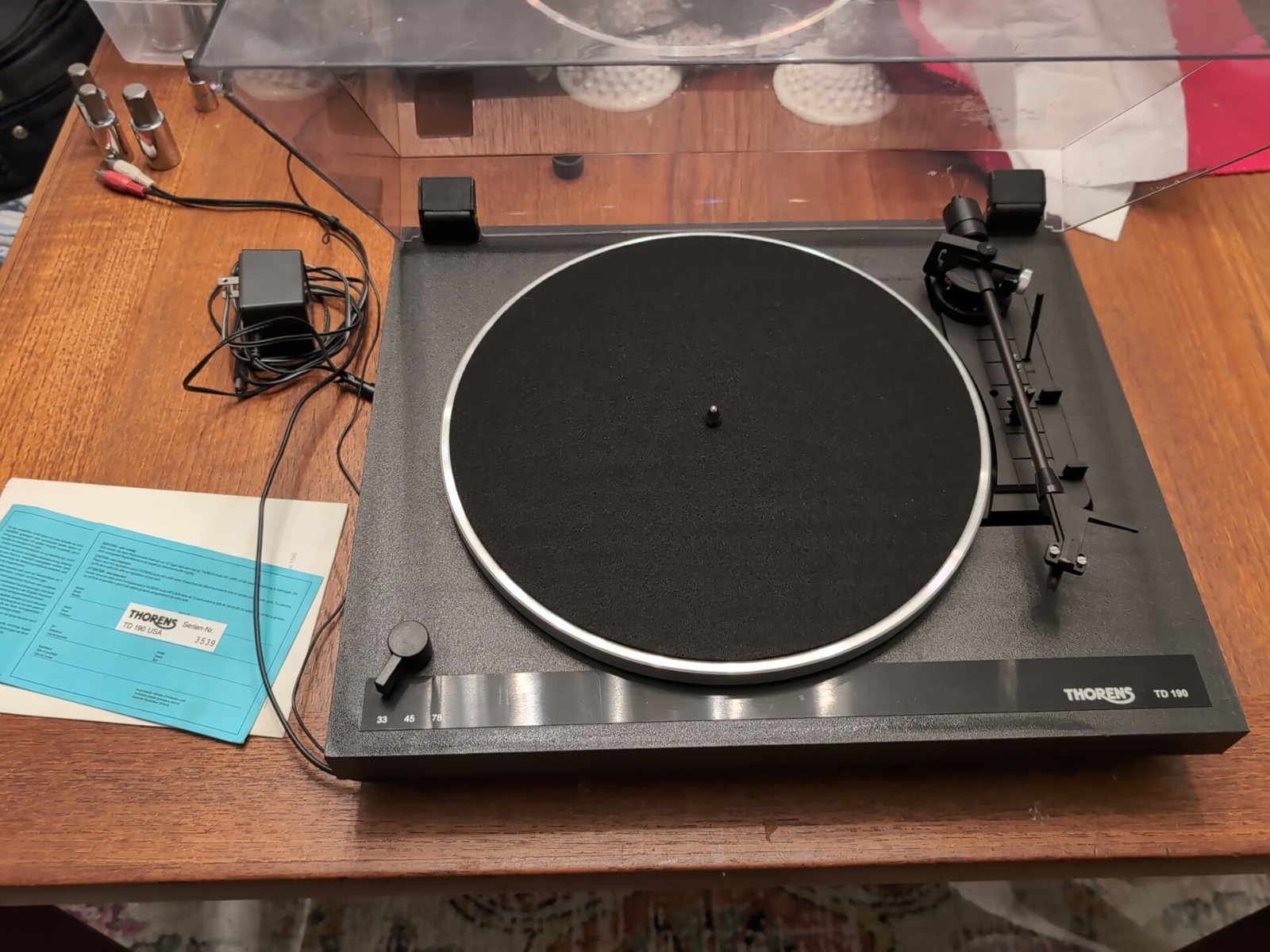
The Thorens TD 190 isn’t one turntable—it’s a lineage quietly reborn in the early 2000s, split into at least two distinct variants: the TD 190-1 and the TD 190-2. The first known iteration, the TD 190-1, appeared in 2003 and carried a $599 price tag, positioning itself as an accessible entry into the Thorens nameplate, a brand long associated with precision engineering. Owners report it arrived with an Ortofon OMB 10 cartridge, a modest but capable elliptical stylus setup designed to track both modern LPs and vintage 78s with a dedicated conical tip. It was marketed as a fully automatic machine—belt-driven, with an electronically controlled DC motor, and built in Germany, a detail emphasized in promotional materials and service documentation.
While the TD 190-1 offered solid specs on paper—wow and flutter measured at an impressive ±0.07% (DIN/WRMS), rumble performance at 46 dB unweighted, and a claimed frequency response stretching from 10 Hz to 22 kHz—it drew mixed reactions. Some praised its ease of setup and turnkey appeal, with one owner noting it took just ten minutes to get the TD 190-2 spinning records. Others were less forgiving. On enthusiast forums, critiques emerged: “The 190 is pretty much a dud sound-wise,” one user wrote, summarizing a sentiment echoed in scattered reviews ranging from “fair” to “poor.” Yet counterpoints exist—another owner declared, “It’s a great turntable,” highlighting the subjectivity baked into budget-friendly gear.
The TD 190-2, while visually similar, diverges in key areas. It too is fully automatic and shares the 304 mm platter diameter, but it’s slightly more compact at 420 x 115 x 340 mm and heavier at 6.5 kg. It shipped with the more widely known Ortofon OM 10 cartridge and a TP 42 tonearm. According to Ma Platine, the TD 190-2 functions as an upgraded successor to the TD 170-1, suggesting incremental refinements in damping or motor control. Its specs list slightly looser wow and flutter at <0.15%, but improved rumble rejection—over 55 dB unweighted and 70 dB weighted—implying a stiffer chassis or better isolation.
Both models rely on a belt-drive system with an external power supply (noted as a mains adaptor in the TD 190-2 documentation), a design choice favoring speed stability over torque. The TD 190-1’s tonearm geometry is precisely defined: 211 mm effective length, 26° offset angle, 19.5 mm overhang, and a tangential tracking error of just 0.15° per cm—numbers that suggest Thorens didn’t cut corners on alignment fundamentals, even at this price point. The tonearm’s total capacitance is approximately 160 pF, a value that pairs well with MM cartridges like the supplied Ortofon without requiring exotic loading.
Specifications
| Manufacturer | THORENS |
| Product type | turntable |
| Mains voltage | 100 - 240 V (AC) |
| Line frequency | 50 / 60 Hz |
| Power requirement | 1.5 W |
| Platter speeds | 33⅓, 45, 78 rpm |
| Wow and flutter (DIN/WRMS) | ± 0.07/0.04 % |
| Platter diameter | 304 mm |
| Signal-to-noise ratio (DIN 45500) Rumble unweighted | 46 dB |
| Rumble weighted signal-to-noise ratio | 72 dB |
| Effective tonearm length | 211 mm |
| Offset angle | 26° |
| Overhang | 19.5 mm |
| Tangential tracking error | 0.15° / cm |
| Factory-installed cartridge | Ortofon OMB 10 |
| Cartridge stylus (elliptical) | Diamond elliptical stylus 10 18 x 8 μm |
| Cartridge stylus (for 78 rpm) | Diamond conical stylus 78 65 μm |
| Tracking force (for OMB 10) | 15 mN (1.5 gf) |
| Frequency range | 10 Hz - 22000 Hz |
| Output | 4 mV / 5 cm/s / 1 kHz |
| Tracking capability (315 Hz) | 80 μm |
| Cartridge weight | 2.5 g |
| Total capacitance (Tonearm leads and audio cables) | approx. 160 pF |
| Dimensions (W x H x D) | 440 x 119 x 360 mm |
| Weight | 6,5 Kg |
| Finish | black structured enamel |
| Function | fully automatic |
| Drive system | belt drive with electronically-controlled DC motor |
| Tonearm | TP 42 |
| Cartridge | Ortofon OM 10 |
| Scope of delivery | mains adaptor |
| Platter weight | 0.8 kg |
| Platter material | non-magnetic |
| Wow & Flutter | < 0,15 % |
| Rumble unweighted | > 55 dB |
| Rumble weighted | > 70 dB |
| Production years for TD 190-1 | 2003 - [VERIFY: end year not confirmed] |
| Original price for TD 190-1 | $599 |
| Original price for TD 190-1 | around 370 € (470 $) |
Key Features
Belt Drive with Electronically-Controlled DC Motor
Thorens stuck to its core philosophy here—belt drive for isolation, paired with a regulated DC motor. Unlike cheaper idler-wheel designs or AC synchronous motors prone to speed drift, this system uses electronic feedback to maintain consistent platter rotation. The motor is decoupled from the chassis and powered via an external adaptor, reducing vibration transmission. Owners note the motor hum is minimal, though not entirely silent under quiet conditions. The 1.5 W power draw reflects its efficiency, but also hints at limited torque—something that could affect startup inertia with heavier records or worn belts.
304 mm Non-Magnetic Platter with 0.8 kg Mass
The 304 mm platter—slightly smaller than the full 305 mm standard—is made from non-magnetic material, likely aluminum or a composite, and weighs 0.8 kg. That mass helps stabilize rotational speed, though it’s not exceptionally heavy by modern audiophile standards. The lack of magnetic materials prevents interference with cartridge coils, a small but meaningful detail. Paired with the belt drive, it delivers the ±0.07% wow and flutter performance in the TD 190-1, a figure that rivals some mid-tier turntables of the era.
TP 42 Tonearm with Precise Geometry
The TP 42 tonearm, used on the TD 190-2, is a straight aluminum tube with adjustable counterweight and anti-skate. Its 211 mm effective length and 26° offset angle are calculated to minimize tracking error across the record surface. At 0.15° per cm, the tangential error is low—on par with many manual arms costing more. The tonearm wiring presents approximately 160 pF of capacitance, a safe match for the Ortofon OM 10 and similar MM cartridges. Setup is reportedly straightforward, with clear markings and a well-damped cueing mechanism.
Ortofon OMB 10 and OM 10 Cartridges
The TD 190-1 shipped with the Ortofon OMB 10, a moving magnet cartridge featuring an 18 x 8 μm elliptical diamond stylus and a 65 μm conical tip for 78s. Output is 4 mV at 5 cm/s, standard for MM cartridges, and tracking force is set at 1.5 gf. The OMB 10 is a slight variant of the widely available OM 10, possibly tailored for Thorens’ tonearm resonance characteristics. The TD 190-2’s use of the standard OM 10 simplifies replacement. Both cartridges are lightweight at 2.5 g, requiring careful tonearm balance but minimizing record wear.
Fully Automatic Operation with External Mains Adaptor
Both models are fully automatic: pressing a button lifts the arm, moves it over the record, and lowers it at the lead-in groove. At the end, it lifts and returns. This convenience comes at a cost—owners report the start/stop mechanism is a common failure point. When it fails, some users reset it for manual operation, bypassing automation entirely. The external mains adaptor (included) steps down voltage and reduces electrical noise, but also adds cable clutter. It’s a trade-off between clean power and minimalist setup.
Collectibility & Value
The TD 190 series occupies an awkward niche: too new for vintage collectors, too underwhelming for audiophiles. No current market price data exists, and spare parts availability is undocumented. The automatic mechanism’s tendency to fail undermines long-term reliability, though manual override is possible. Cosmetic issues are common—eBay listings note “dust cover is marked up” and “base edge vinyl is peeling,” suggesting the finish doesn’t age gracefully. While The Absolute Sound claimed the TD 190-1 “more than holds its own” among entry-level decks, other voices dismiss it as sonically mediocre. Its value today lies primarily in being a functional, German-built gateway to vinyl, not as a collectible.
eBay Listings
As an eBay Partner, we earn from qualifying purchases. This helps support our independent vintage technology research.