Technics SU-7 (1982)
At just 5.0kg, this compact amplifier punches far above its weight—both physically and sonically.
Overview
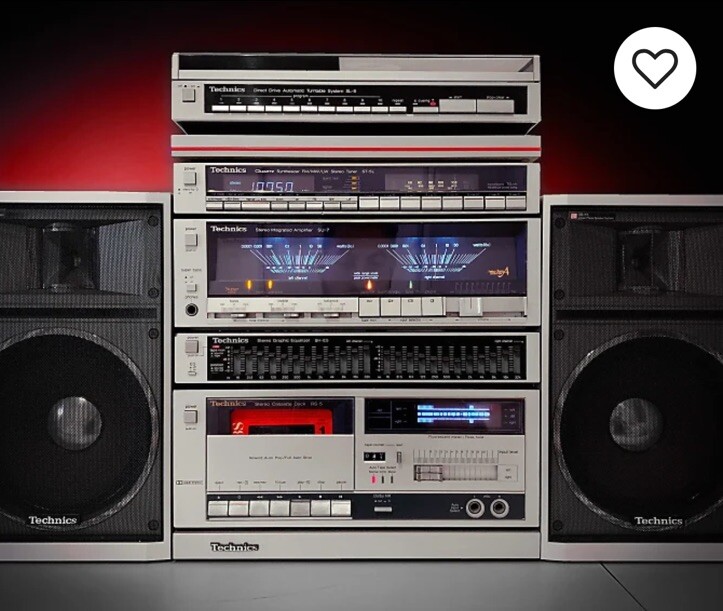
The Technics SU-7 isn’t the kind of amplifier that announces itself with heft or flash. Released in October 1982 by Technics (a brand under Panasonic), it’s a transistorized stereo integrated amplifier that fits the 315 mm “jacket size” standard, meaning it was designed to slide neatly into custom racks or furniture built for high-end audio components of the era. Priced at ¥52,600 at launch—roughly 500 DM according to manual references—it targeted audiophiles who valued precision engineering over ostentation. Despite its modest footprint and weight, the SU-7 was engineered with serious intent, incorporating Technics’ proprietary synchronous bias circuit to deliver a unique class A performance without the usual heat and power demands. It’s a pre-main amplifier, meaning it combines both preamp and power amp stages in one chassis, and it includes a built-in phono stage for MM cartridges, two tape loops, and a side-terminal layout that promotes a clean, direct signal path. Owners report it being part of the Technics Jacket System 5 series, suggesting it was meant to work seamlessly with other components like the ST-5 tuner and SH-E5 equalizer, connected via a proprietary direct connector that eliminates the need for pin cables.
Specifications
| Manufacturer | Technics/Panasonic |
| Product type | Integrated amplifier / stereo integrated amplifier |
| Production years | Released in October 1982 |
| Original price | ¥52,600 |
| Effective power (EIAJ) | 50W + 50W (8 Ω) |
| Total harmonic distortion factor | 0.005% (Rated Output -3dB, 1 khz) |
| Frequency characteristic | 10 Hz to 140 kHz -3dB |
| Signal-to-noise ratio (IHF-A) | 99dB |
| Residual noise | 0.7mV |
| Damping factor | 30 (8 Ω) |
| Load impedance | Main or remote : 8 Ω ~ 16 Ω |
| Input Sensitivity / Impedance Phono MM | 2.5mV/47k Ω |
| Input Sensitivity / Impedance Tuner, Aux, Tape | 150mV/27k Ω |
| Phono SN ratio MM | 81 dB (2.5 mV input) |
| Phono frequency characteristics | 20 Hz to 20 kHz, RIAA ± 0.8 dB |
| Tone control Bass | ± 10 dB (50 Hz) |
| Tone control Treble | ± 10 dB (20 kHz) |
| Power | 100 VAC, 50Hz/60Hz |
| Power consumption | 87W |
| External dimensions | Width 315x Height 98.9x Depth 248 mm |
| Weight | 5.0kg |
Key Features
Synchronous Bias Circuit for True Class A Operation
At the heart of the SU-7 is Technics’ synchronous bias circuit—a design intended to eliminate both switching and crossover distortion by maintaining a constant bias current to the output transistors. Unlike traditional class A amplifiers, which run hot and consume significant power, this system keeps the output stage perpetually active without tying the bias current directly to the signal path. Paired with a fast-response diode exhibiting nearly ideal square characteristics, the amplifier achieves a class A-like performance with greater efficiency. The result is a signal path free from the glitches that can occur during transistor switching, contributing to the amplifier’s exceptionally low distortion rating of 0.005% at rated output.
Side-Terminal Layout with Straight Signal Path
The SU-7’s physical layout is more than just aesthetic—it’s functional. All input jacks are grouped on the right side, while the speaker terminals are on the left. This side-terminal arrangement allows for a direct, uncluttered signal path from input to output, minimizing internal crosstalk and interference. Combined with the unit’s service-friendly design, this layout makes internal access and maintenance relatively straightforward for technicians, a rarity in compact integrated amplifiers of the period.
High-Precision Dual Power Meters
Flanking the central slide-type volume control are dual VU meters, not just for show but for precision. These are described as high-precision large power meters capable of reading output levels as low as 0.001W, giving users real-time feedback on amplifier performance. The meters are part of the amplifier’s broader emphasis on transparency and control, reinforcing its identity as a tool for critical listening rather than passive background playback.
Super Base Circuit for Speaker Resonance Optimization
One of the more distinctive features is the “Super Base” circuit, which automatically detects the fo—the lowest resonance frequency—of the connected speaker and enhances that region. This isn’t a fixed bass boost; it’s an adaptive system designed to align the amplifier’s low-end response with the speaker’s natural tuning. While the exact implementation isn’t detailed in available documentation, collectors note its presence as a hallmark of Technics’ forward-thinking approach to system synergy.
Integrated Phono Stage with RIAA Equalization
The inclusion of a dedicated MM phono input means the SU-7 was built for turntable users from the ground up. With an input sensitivity of 2.5mV and impedance of 47k Ω, it’s compatible with a wide range of moving magnet cartridges. The phono stage adheres to RIAA equalization standards with a tolerance of ±0.8 dB across the 20 Hz to 20 kHz range and delivers an 81 dB signal-to-noise ratio at 2.5 mV input—solid performance for an integrated design of this era.
Direct Connector for ST-5 and SH-E5 Integration
As part of the Jacket System 5 series, the SU-7 uses a unique direct connector to link with the ST-5 tuner and SH-E5 equalizer. This eliminates the need for traditional RCA pin cables, reducing connection points and potential signal degradation. It’s a system-oriented design choice, reflecting Technics’ vision of a modular, high-fidelity ecosystem where components communicate cleanly and efficiently.
Collectibility & Value
Despite limited documentation on long-term reliability or common failure modes, the SU-7 has developed a quiet reputation among vintage audio enthusiasts. Marketed as a rare gem and even described as “legendary Japanese” and “super hi-end” in social media posts, it has begun to attract attention in the collector market. Recent listings on Instagram and Facebook from European dealers show the amplifier selling for €850 to €900, often as part of a matched system with the ST-5 and SH-E5. While no data exists on spare parts availability or typical maintenance issues, its service-friendly design and transistorized construction suggest it should be more resilient than tube-based contemporaries—if kept in stable conditions and powered correctly.
eBay Listings
As an eBay Partner, we earn from qualifying purchases. This helps support our independent vintage technology research.
Related Models
- Technics SU-7300
- Technics SU-V22
- Luxman L-530 (1975)
- Luxman R-404 (1975)
- Luxman RV-371 (1975)
- Luxman SQ-38U (1975)
- Luxman T-14 (1972)
- Luxman T-530 (1975)
- Luxman TX-101 (1975)
- Denon PMA-350Z (1980)