Technics SL-1600MK2 (1979)
At 10 kg, it is no casual spinner. It is a precision instrument in an industrial case.
Overview
The Technics SL-1600MK2 is the fully automatic top model of the MK2 series. It was built for users who wanted broadcast-level accuracy without giving up convenience. Released in 1979, it shares its core with the SL-1200MK2 but adds microcomputer-controlled automation and quartz-synthesized pitch stability. The manual SL-1200MK2 needs a hand for start, play and return. The SL-1600MK2 does all three on its own, using infrared sensors and optical detection. There are no mechanical levers and no wear-prone switches. It was built for repeatable, silent operation in professional environments where consistency matters more than flair.
The engineering here is all about isolation. The whole core assembly - motor, platter and tonearm - floats on a double insulator system of viscoelastic dampers and metal springs. That decouples it from cabinet resonance. The chassis is die-cast aluminum, damped further with TNRC (Technics Non Resonance Compound) on both base and top plate. TNRC is a proprietary material meant to absorb high-frequency feedback before it reaches the stylus. The 33.2 cm die-cast aluminum platter has a rubber damping layer on its underside to cut howling and internal vibration.
Speed is held by quartz phase-locked control. Wow and flutter is 0.025% WRMS (JIS C5521), a figure HiFi-Stereo (November 1979, p.17) confirmed as part of Technics' push toward "uncommonly accurate turntables" favored by FM stations. The 4-row Mizutama strobe, visible through the platter's edge, gives instant visual feedback at +6%, +3.3%, 0%, and -3.3%. A bar-graph LED display shows pitch deviation in 1% increments. Continuous pitch control across ±6% comes from a newly developed IC. It adjusts without stepping or drift, which helped when aligning playback with master tapes or correcting pressing inconsistencies.
It is not immune to age. Owners report auto-return malfunctions, cueing dropouts and erratic pitch control. IC201 (AN6680) is frequently cited as a weak point, and the SL-1200MK2 shares the flaw. Repair often means consulting the service manual, particularly for faults tied to switch S408 beneath the tonearm assembly. The muting circuit suppresses contact noise during cueing, but it can fail silently and leave pops and thumps.
Key Features
Microcomputer-Controlled Automation with Infrared Record Detection
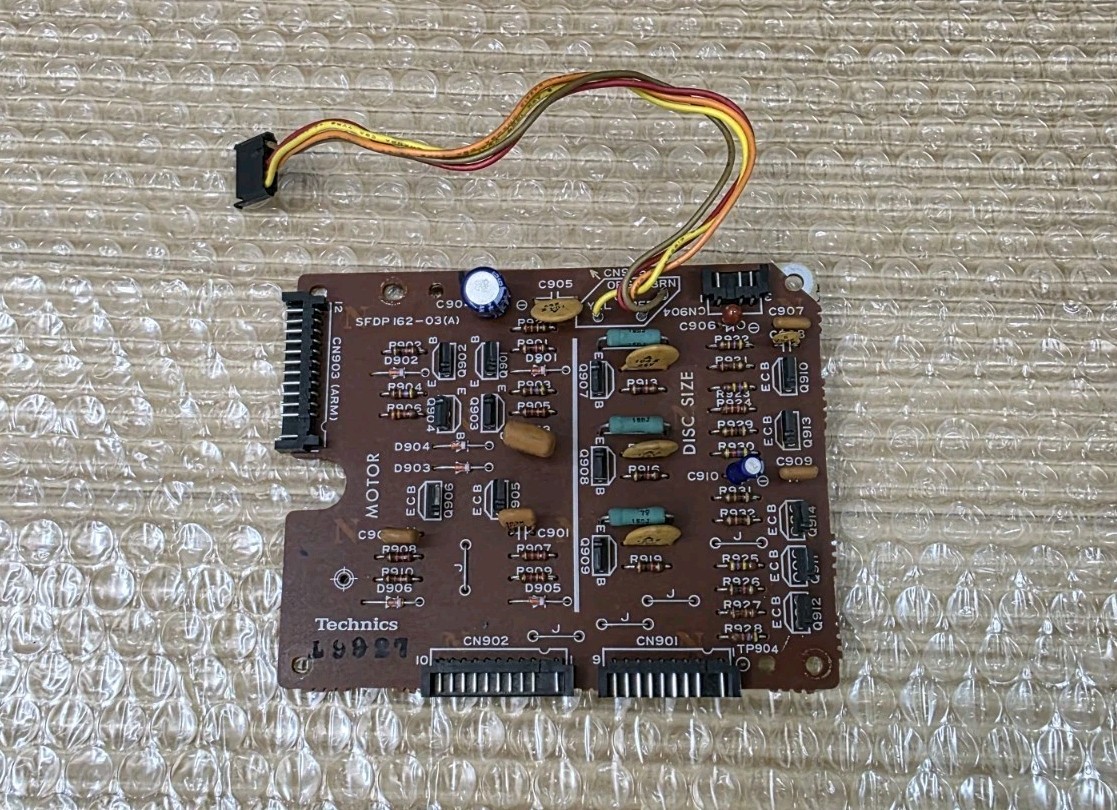
A microcomputer and opto-electronics manage every motion - start, play, return - with no mechanical linkages. Three LEDs beneath the platter emit infrared light through prism slots cut into the turntable. An optical sensor reads that light to determine record size and presence. The data triggers the correct lead-in tracking and return behavior, whether the record is a 7" single or a 12" LP. The tonearm lifts, tracks and returns via a DC servo motor with optical feedback. The movements are fluid, deliberate and nearly silent. The user only has to handle power, speed selection and pitch adjustment.
Quartz-Synthesized Continuous Pitch Control with ±6% Adjustment
The pitch control circuit uses a newly developed IC to synthesize speed adjustments across the full ±6% range with quartz precision. It avoids the stepped or coarse behavior of lesser decks. The system locks rotational speed to the quartz oscillation frequency, so timing stays accurate even during fine adjustments. A bar-graph LED display shows pitch deviation in real time - green at 0%, red in 1% increments for ± deviation. The 4-row Mizutama strobe confirms speed at key reference points. This level of control was rare in fully automatic decks, and it made the SL-1600MK2 a favorite among users who needed exact speed alignment.
Double Insulator Cabinet with TNRC Damping
The core assembly is mounted on a main base that floats on a dual-layer isolation system of viscoelastic material and metal springs. This decouples the motor and platter from external vibration and cabinet resonance. The base and top plate are treated with TNRC (Technics Non Resonance Compound), a proprietary damping material that absorbs high-frequency feedback before it reaches the stylus. Add the mass of the die-cast aluminum platter and its internal rubber damping layer, and the platform is very inert. That suits high-gain phono stages, where even minor resonance can become audible.
Gimbal Suspension Tonearm with 4-Point Precision Bearings
The universal S-shaped tonearm uses a gimbal suspension with a 4-point support structure of precision ball bearings and pivots. The horizontal and vertical rotation axes intersect at a single point. Rotational axis sensitivity is 7 mg or less, which keeps friction and wobble down. Effective mass is 12g (without cartridge). It pairs well with a wide range of moving magnet and moving coil cartridges, particularly those weighing 6-10g. The 6-row helicoid mechanism allows precise 6mm arm height adjustment, useful for aligning non-standard cartridges or compensating for warped records.
Quick Repeat Function and Storable Stylus Illuminator
For repeated listening, common in mastering, transcription or critical evaluation, the SL-1600MK2 has a quick repeat function. It returns the arm directly to the lead-in groove after the final track and skips the full auto-return cycle. There is also a built-in, storable stylus illuminator for low-light use. A pure electronic brake stops the platter instantly. A muting circuit suppresses contact noise when the stylus touches down or lifts off.
Historical Context
The SL-1600MK2 was the high-end, fully automatic model in the MK2 series, sitting above the manual SL-1800MK2 and semi-automatic SL-1700MK2. High-Fidelity Trade News (March 1980, p.5) listed it at $400 and described the MK2 series as offering "performance good enough for a radio station" at consumer-accessible prices. It was marketed under Technics' "quartz-synthesizer" banner as part of a push to bring studio-grade turntable performance to home and broadcast users. The original Japanese retail price was ¥75,000. Some sources cite a 1978 release, but the manufacturer documentation and period reviews support a 1979 launch.
Collectibility & Value
Market prices vary widely. One working example sold for $80, while another was listed at $755, which prompted a commenter to label the price "Crazy Inflated." It lacks the universal demand of the SL-1200MK2 but holds steady appeal among studio restorers and audiophiles who value its automation and precision. Common failures include humming noise, auto-start malfunctions, cueing issues and erratic pitch control, often traceable to IC201 (AN6680). No formal data on spare parts availability exists. The shared architecture with the SL-1200 series may allow cross-compatibility for certain components like feet, power switches and motor boards, which appear individually on the aftermarket at prices ranging from $15 to $30.
eBay Listings


As an eBay Partner, we earn from qualifying purchases. This helps support our independent vintage technology research.
Related Models
- Technics EAH-220
- Technics SL-110
- Technics SL-1200 Mk2
- Technics SL-1200GME
- Technics SL-1210
- Garrard SP (1975)
- Luxman PD-310 (1981)
- Luxman PD-555 (1983)
- Thorens TD-124 (1957–1967)
- Harman Kardon kardon-turntables (1975)