Teac W-470: The Quiet Masterpiece of Open-Reel Recording
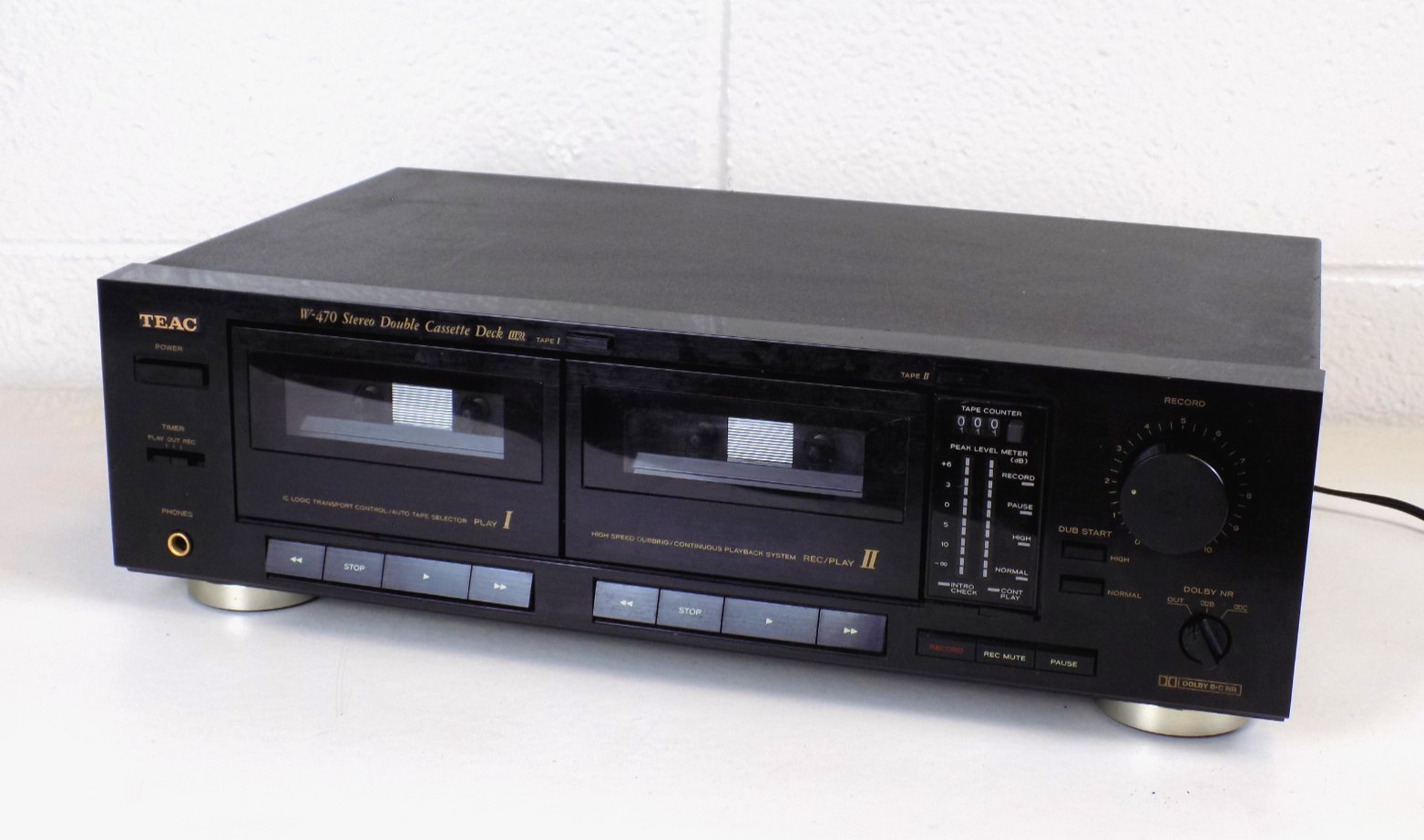
In the late 1970s, when cassette decks were gaining popularity for home use and portability, Teac stood apart by continuing to refine the art of open-reel (reel-to-reel) tape recording. The Teac W-470, introduced around 1979, was not a flashy flagship like the legendary A-3340, but rather a refined, professional-grade recorder aimed at serious audiophiles, semi-pro studios, and broadcast engineers who valued precision, reliability, and sonic fidelity. Though less celebrated than its siblings, the W-470 has quietly earned a devoted following among vintage tape enthusiasts for its understated excellence and exceptional build quality.
Part of Teac’s W-series of reel-to-reel recorders, the W-470 represented the company’s commitment to analog excellence during a transitional period in audio technology. While digital recording was on the horizon, Teac doubled down on mechanical precision and analog circuit design—hallmarks of Japanese engineering at its finest. The W-470 may not have made headlines, but in the hands of discerning users, it delivered performance that rivaled more expensive models from Studer, Revox, and even Tandberg.
Technical Specifications
The Teac W-470 was engineered for versatility and high-fidelity operation. It supported both 7.5 and 15 inches per second (ips) tape speeds, allowing users to balance recording time with audio quality. It was a 4-track, 2-channel stereo recorder, meaning it could record and playback two tracks at a time across a 1/4-inch tape—ideal for stereo recording and basic multitrack applications.
| Specification | Detail |
| Model | Teac W-470 |
| Year Introduced | 1979 |
| Format | 1/4-inch open-reel tape |
| Tracks | 4-track, 2-channel stereo |
| Tape Speeds | 7.5 ips, 15 ips |
| Heads | Separate record, playback, and erase |
| Motor Type | Dual capstan servo-controlled motors |
| Frequency Response | 30Hz – 18kHz (15 ips, ±3dB) |
| Wow and Flutter | < 0.15% (WRMS) |
| Signal-to-Noise Ratio | > 60dB (Dolby B) |
| Inputs | Line (RCA), Mic (XLR and 1/4") |
| Outputs | Line (RCA), Headphones (1/4") |
| Equalization | 120µs, 180µs (switchable) |
| Noise Reduction | Dolby B (record and playback) |
| Power | 120V AC, 60Hz (region-specific variants) |
| Dimensions | 440mm (W) × 145mm (H) × 355mm (D) |
| Weight | 14.5 kg (approx. 32 lbs) |
The W-470 featured three dedicated tape heads—record, playback, and erase—ensuring optimal alignment and minimizing crosstalk. Its dual capstan transport system, driven by precision servo motors, delivered excellent speed stability and low wow and flutter, critical for professional-grade recording. The machine also included front-panel controls for bias and level calibration, allowing users to optimize performance for different tape formulations (e.g., normal, high-bias).
Sound Characteristics and Performance
The Teac W-470 is renowned for its smooth, warm, and detailed sound signature—a hallmark of well-engineered analog tape recorders from this era. At 15 ips, the frequency response is impressively extended, with tight bass, clear mids, and a gentle high-end roll-off that avoids harshness. The inherent tape compression and saturation characteristics add a pleasing "glue" to recordings, making the W-470 a favorite for mastering, voiceover work, and analog-style music production.
Its use of Dolby B noise reduction helps suppress tape hiss without introducing the "pumping" artifacts sometimes associated with early noise reduction systems. When properly calibrated, the W-470 delivers a signal-to-noise ratio that rivals many professional machines of the time. The separate playback and record heads allow for precise monitoring during recording—a feature essential for studio use.
Notable Features and Innovations
While not as feature-laden as some of its contemporaries, the W-470 stands out for its thoughtful design and user-centric features:
- Independent Head Design: Unlike many consumer-grade machines that use a combined record/play head, the W-470’s separate heads ensure optimal performance in both modes.
- Servo-Controlled Transport: The dual capstan system with servo motors maintains consistent tape tension and speed, critical for low wow and flutter.
- Front-Panel Calibration Controls: Users can adjust record level and bias for different tape types, a feature typically found on higher-end studio recorders.
- Professional I/O: Balanced XLR mic input, RCA line I/O, and a high-impedance headphone output make it suitable for studio environments.
- Selectable Equalization: Switchable time constants (120µs and 180µs) allow compatibility with various tape formulations and regional standards.
The front panel is clean and functional, with large VU meters for level monitoring, tactile transport controls, and clear labeling. The chassis is constructed from heavy-gauge steel with a brushed aluminum faceplate, exuding the solidity and durability Teac was known for.
Common Issues and Maintenance
Like all vintage tape machines, the Teac W-470 requires regular maintenance to perform at its best. Common issues include:
- Deteriorated Rubber Components: Pinch rollers, idler tires, and drive belts can harden or crack over time. Replacement with modern equivalents is essential.
- Head Alignment and Wear: Misaligned or worn heads lead to poor frequency response and crosstalk. Professional demagnetization and alignment are recommended.
- Capstan Bearing Dryness: After decades of storage, capstan bearings may seize or become noisy. Lubrication with appropriate oil can restore smooth operation.
- Capacitor Aging: Electrolytic capacitors in the power supply and audio circuits may leak or lose capacitance, potentially causing noise or failure.
A full recap and mechanical service by a qualified technician is strongly advised before regular use. Cleaning with isopropyl alcohol and using fresh, high-quality tape (e.g., Ampex 456 or RMGI SM900) will ensure optimal performance.
Current Market Value and Collectibility
The Teac W-470 is not as widely collected as the A-3340 or the W-3000 series, but its reputation among tape enthusiasts is growing. In good working condition, it typically sells for $600–$1,000, depending on completeness, service history, and cosmetic condition. Machines with original manuals, calibration tapes, and accessories command a premium.
Its value lies in its rarity, build quality, and sonic performance. While not a showpiece, the W-470 is a "musician’s machine"—valued more for what it does than how it looks. As interest in analog recording resurges, particularly in indie and lo-fi music circles, the W-470 is gaining recognition as a capable, no-nonsense recorder that delivers professional results.
Conclusion and Legacy
The Teac W-470 may not have the fame of its siblings, but it embodies the quiet excellence that defined Teac’s golden era. It’s a machine built for those who care more about sound than specs, about reliability than flash. In an age of digital perfection, the W-470 offers something rare: analog soul.
For the home studio engineer, the archivist, or the audiophile seeking the warmth of tape, the W-470 remains a compelling choice. It’s a testament to Japanese engineering, analog craftsmanship, and the enduring appeal of reel-to-reel recording. If you find one in good condition, treat it right, and it will reward you with decades of beautiful sound.
In the world of vintage audio, some legends shout. The Teac W-470 simply speaks—clearly, honestly, and with authority.
eBay Listings


As an eBay Partner, we earn from qualifying purchases. This helps support our independent vintage technology research.
Related Models
- Teac A-6700DX (1980)
- Teac A-105 (1975)
- Teac A-106 (1975)
- Teac A-170 (1976)
- Teac A-2300 (1978)
- Sony TC-2050SD (1978)
- Aiwa AD-F990 (1993)
- Kenwood KX-3060 (1982)
- Sony TC-2130A (1974)
- Sony TC-2220 (1972)