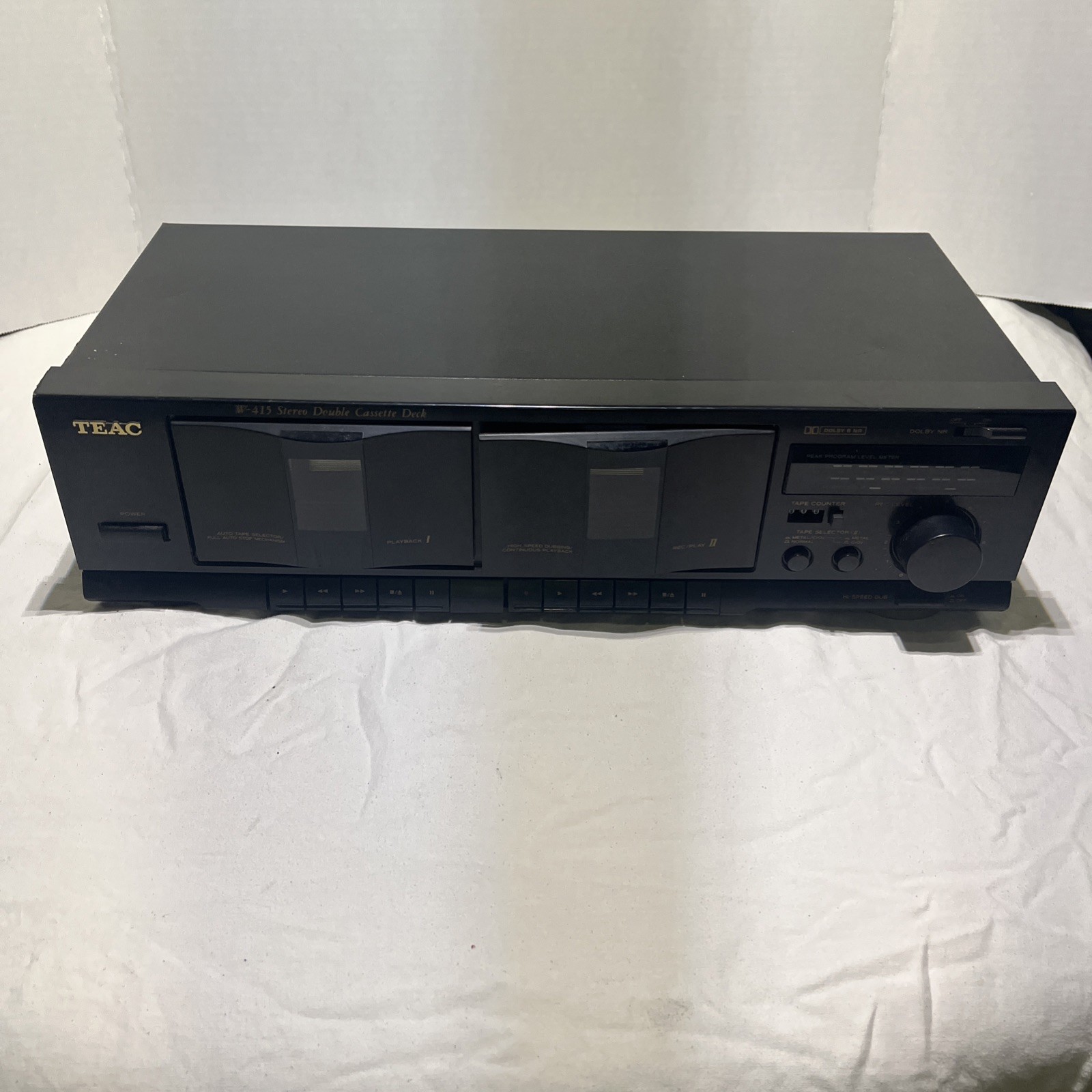
Teac W-415 Reel-to-Reel Tape Deck: A Classic Analog Workhorse
In the mid-1970s, when high-fidelity audio was undergoing a golden renaissance, Teac emerged as one of the most respected names in reel-to-reel tape technology. Among their lineup of precision tape decks, the Teac W-415 stands out as a quintessential example of Japanese engineering excellence, offering audiophiles and recording enthusiasts a reliable, high-performance machine that balanced professional-grade features with home-user accessibility. Though not as widely discussed today as some of its more famous siblings like the A-3340, the W-415 carved out a loyal following for its robust construction, accurate tape handling, and rich, musical sound reproduction.
Historical Context and Overview
Introduced in 1975, the Teac W-415 arrived during a pivotal moment in audio history. Reel-to-reel tape was still the medium of choice for serious listeners and semi-professional studios, prized for its superior dynamic range and low distortion compared to cassette tapes or vinyl. Teac, already renowned for its innovative designs and commitment to quality, positioned the W-415 as a mid-to-high-tier deck that offered many of the features found in more expensive models at a more accessible price point.
The W-415 was part of Teac’s broader W-series, which emphasized precision mechanics and user-friendly operation. It was designed for both home taping enthusiasts and semi-professional users, making it a versatile machine capable of high-quality music duplication, field recording, and even basic multitrack applications when paired with compatible equipment.
Technical Specifications
| Feature | Specification |
| Year Introduced | 1975 |
| Format | 1/4" open-reel tape |
| Tape Speeds | 7.5 ips, 15 ips (standard) |
| Tracks | 4-track / 2-channel stereo (full-track mono also supported) |
| Head Configuration | 3-head (record, playback, erase) |
| Recording System | AC bias, crystal sync motor control |
| Motors | Dual capstan servo-controlled DC motors |
| Frequency Response | 30Hz – 18kHz @ 15 ips (±3dB) |
| Signal-to-Noise Ratio | 62 dB (Dolby B optional) |
| Total Harmonic Distortion | <1.5% @ 15 ips |
| Wow and Flutter | <0.25% (WRMS) |
| Input/Output | Line In/Out (RCA), Mic In (¼"), Phones (¼") |
| Equalization Settings | 120µs / 180µs (switchable for tape type) |
| Power Requirements | 120V AC, 60Hz (NTSC regions) |
| Dimensions | 440mm (W) × 145mm (H) × 330mm (D) |
| Weight | 11.5 kg (approx. 25.3 lbs) |
Sound Characteristics and Performance
The Teac W-415 is celebrated for its warm, natural tonality—a hallmark of well-designed analog tape decks from this era. Its 3-head design ensures that what you record is precisely what you hear during playback, eliminating the calibration drift common in 2-head machines. The frequency response is impressively flat across the audible spectrum, with a smooth roll-off at the extremes that many listeners describe as "musical" rather than clinical.
At 15 inches per second (ips), the W-415 delivers studio-grade sound quality, capturing fine detail and offering excellent stereo imaging. Even at 7.5 ips, the deck performs admirably, making it ideal for longer recordings where tape economy was a concern. The inclusion of switchable equalization (120µs for Type I tapes, 180µs for high-bias tapes) allows users to optimize performance based on tape formulation.
When paired with Dolby B noise reduction (available as an optional external unit or via later modified internal kits), the W-415 achieves a remarkably clean signal path, reducing tape hiss without the "pumping" artifacts sometimes associated with early noise reduction systems.
Notable Features and Innovations
The W-415 was packed with features that set it apart from budget-oriented reel-to-reel decks:
- Dual Capstan Transport: Ensures stable tape tension and minimal slippage, critical for low wow and flutter.
- Crystal-Controlled Speed Stability: Uses a quartz crystal oscillator to maintain precise tape speed, a feature typically found in professional decks.
- 3-Head Design: Allows for separate record and playback heads, enabling real-time monitoring of recordings with zero latency.
- Front-Panel Tape Type Selector: Simplifies bias and EQ matching for different tape formulations.
- VU Meters with Peak Hold: Large, easy-to-read analog meters provide accurate level monitoring during recording.
- Direct Drive Capstans: Reduce mechanical noise and improve speed consistency over belt-driven systems.
These features made the W-415 a favorite among users who valued accuracy and repeatability—qualities essential for mastering, archiving, or creating high-fidelity copies of vinyl records or live performances.
Common Issues and Maintenance
Like all vintage tape decks, the Teac W-415 requires regular maintenance to perform at its best. Over time, several components are prone to wear or degradation:
- Pinched or Worn Tape Path Guides: These can cause tape skewing or head misalignment. Regular cleaning with isopropyl alcohol and demagnetizing are essential.
- Deteriorated Rubber Parts: Idler tires, drive belts (if present in certain submodels), and pressure pads may harden or crack. Replacement with modern equivalents is recommended.
- Capstan and Pinch Roller Buildup: Oxide shedding from tapes can accumulate, affecting speed stability and tape contact.
- Head Wear: While the W-415 uses durable permalloy heads, they can wear over decades of use. Light resurfacing by a technician may be needed.
A full recap (capacitor replacement) is often advised for units that haven’t been serviced in decades, as dried-out electrolytics can affect power delivery and audio quality. Additionally, ensuring the crystal sync oscillator is functioning correctly is vital for maintaining accurate tape speed.
Despite these aging concerns, the W-415 is known for its mechanical durability. Its heavy-duty chassis and precision engineering mean that, with proper care, it can continue to deliver outstanding performance for years.
Current Market Value and Collectibility
The Teac W-415 is not as widely collected as some of Teac’s more iconic models, but it has seen growing interest among analog audio enthusiasts and reel-to-reel restoration hobbyists. In working condition, with recent maintenance, the W-415 typically sells for $400–$700 on the secondary market, depending on cosmetics and included accessories.
Fully restored units with replaced rubber parts, cleaned heads, and calibrated electronics can command higher prices, especially if accompanied by original manuals or matched Teac speakers and amplifiers. Its relative rarity compared to the A-series models adds to its appeal for collectors seeking under-the-radar gems from Teac’s golden age.
Conclusion and Legacy
The Teac W-415 may not have the name recognition of some of its contemporaries, but it represents the very best of 1970s Japanese audio engineering—a time when precision, craftsmanship, and musicality were paramount. It bridges the gap between consumer and professional audio, offering a level of performance that rivals much more expensive machines.
For today’s audiophiles, the W-415 is more than just a vintage curiosity; it’s a functional piece of audio history that delivers a listening experience impossible to replicate digitally. Whether you're transferring old tapes, recording live music, or simply enjoying the warmth of analog playback, the Teac W-415 remains a worthy centerpiece in any vintage audio setup.
If you’re lucky enough to find one in good condition—or are willing to invest in its restoration—the W-415 will reward you with decades of faithful service and the timeless sound of true analog fidelity.
eBay Listings


As an eBay Partner, we earn from qualifying purchases. This helps support our independent vintage technology research.
Related Models
- Teac A-6700DX (1980)
- Teac A-105 (1975)
- Teac A-106 (1975)
- Teac A-170 (1976)
- Teac A-2300 (1978)
- Sony TC-2050SD (1978)
- Aiwa AD-F990 (1993)
- Kenwood KX-3060 (1982)
- Sony TC-2130A (1974)
- Sony TC-2220 (1972)