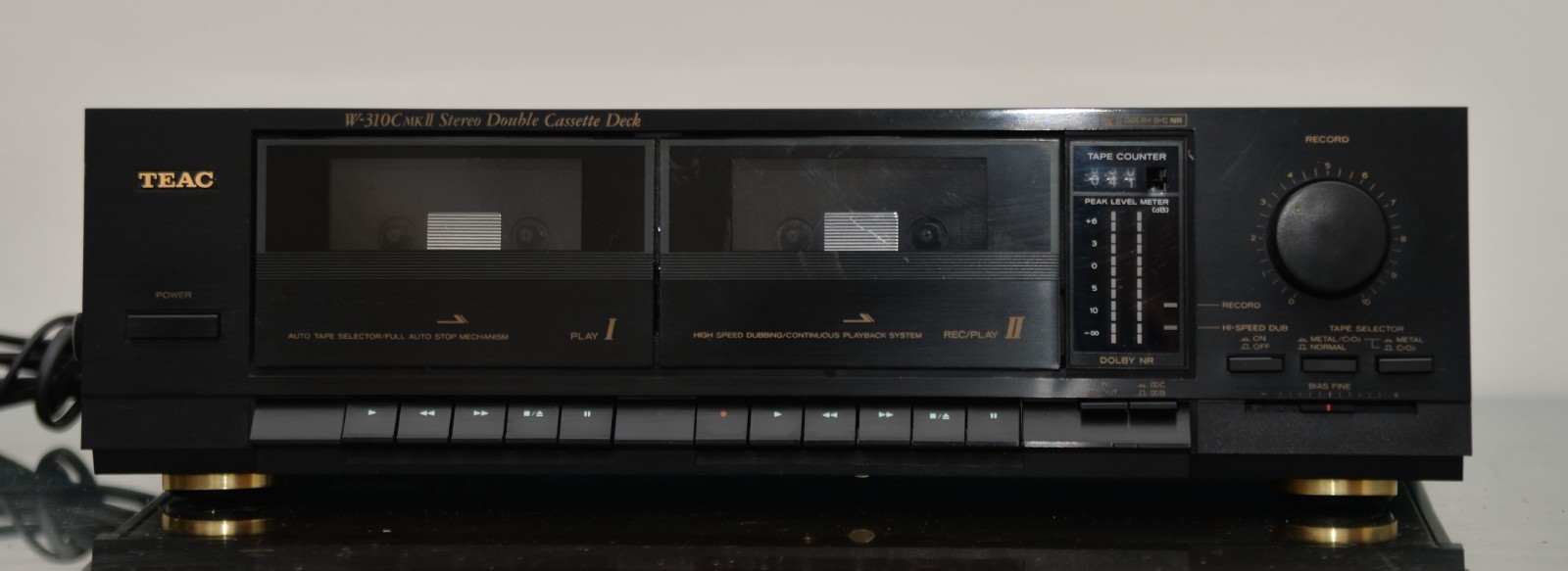
Teac W-310-C-MK-II: Compact Precision in Reel-to-Reel Form
In the late 1970s, as cassette tapes began to dominate the consumer audio landscape, Teac stood firmly behind the enduring appeal of analog reel-to-reel recording with its refined W-series tape decks. Among these, the Teac W-310-C-MK-II emerged as a compact yet serious contender in the semi-professional and high-fidelity home audio market. Though not as widely celebrated as its larger siblings like the W-3000 or W-4300, the W-310-C-MK-II carved out a loyal following among audiophiles who valued space-saving design without sacrificing performance.
Released around 1979, the W-310-C-MK-II was part of Teac’s strategy to offer accessible, well-engineered reel-to-reel machines for the discerning listener. It was designed for those who appreciated the sonic depth and dynamic range of analog tape but didn’t have room—or budget—for full-sized studio decks. With its sleek silver-and-black chassis, precision transport, and thoughtful engineering, the W-310-C-MK-II exemplifies the Japanese audio industry’s golden era of analog innovation.
Technical Specifications
Despite its compact footprint, the W-310-C-MK-II is packed with features that reflect Teac’s commitment to quality. Built with audiophile-grade components and a robust mechanical design, it delivers performance that belies its size.
| Specification | Detail |
| Model | W-310-C-MK-II |
| Manufacturer | TEAC Corporation, Japan |
| Year of Release | 1979 |
| Format | 1/4" Reel-to-Reel Tape |
| Tape Speeds | 7.5 ips, 3.75 ips (selectable) |
| Tracks | 4-track, 2-channel stereo (half-track) |
| Head Configuration | Separate record, playback, erase heads |
| Recording Modes | Stereo, monophonic |
| Input Level | -10 dB (line) |
| Output Level | 0.34 V (for 50 mV input, 400 Hz) |
| Frequency Response | 40 Hz – 15 kHz (7.5 ips, ±3 dB) |
| Signal-to-Noise Ratio | 58 dB (Dolby B NR enabled) |
| Wow and Flutter | < 0.25% (WRMS) |
| Motor Type | Dual capstan servo-controlled motors |
| Power Requirements | 120V AC, 60 Hz (North American version) |
| Dimensions (W×H×D) | 430 × 125 × 305 mm (approx. 17" × 5" × 12") |
| Weight | 7.5 kg (16.5 lbs) |
| Included Features | Dolby B noise reduction, level meters, tape type selector (normal/ferro-chrome), auto-reverse (C-MK-II variant) |
One of the standout aspects of the W-310-C-MK-II is its auto-reverse function, a rare feature in reel-to-reel decks of this era. This allowed users to play or record in both directions without manually flipping the reel—a convenience borrowed from the cassette world but executed here with mechanical precision. The "C" in the model name is believed to denote this capability, distinguishing it from earlier non-reversing variants.
Sound Characteristics and Performance
The W-310-C-MK-II delivers the rich, warm, and three-dimensional sound that reel-to-reel enthusiasts cherish. At 7.5 inches per second (ips), the frequency response extends cleanly into the upper treble with minimal distortion, while the bass remains tight and well-controlled. The use of separate playback and record heads ensures optimal fidelity during playback, avoiding the compromises of combined heads.
With Dolby B noise reduction onboard, tape hiss is significantly reduced, especially on standard ferric tapes—making the W-310-C-MK-II ideal for duplicating vinyl records or archiving audio with a high signal-to-noise ratio. When paired with high-quality tapes like Ampex 406 or Sony UX-S, the deck reveals impressive detail and spatial imaging, rivaling much larger and more expensive models.
Though it lacks the 15 ips speed option found on higher-end Teac decks, the 7.5 ips setting is more than sufficient for home listening and mastering, offering a superb balance between tape consumption and audio quality.
Notable Features and Innovations
The W-310-C-MK-II shines through its thoughtful engineering and user-centric design:
- Auto-Reverse Mechanism: A rarity in reel-to-reel decks, this feature allows uninterrupted playback by automatically switching direction when the tape reaches the end. This made the W-310-C-MK-II a favorite for background music systems and continuous listening sessions.
- Three-Head Configuration: Separate record, playback, and erase heads ensure optimal performance in both recording and playback modes. This setup allows for accurate monitoring during recording (via the playback head) and clean signal erasure.
- Precision Capstan Drive: Dual servo-controlled motors provide stable tape speed with minimal wow and flutter, essential for maintaining pitch accuracy and rhythmic integrity.
- Tape Type Selector: Enables optimization for normal (ferric) or high-bias (chrome) tapes, improving recording levels and frequency response.
- VU Meters: Large, centrally located VU meters provide real-time monitoring of input levels, helping users avoid distortion during recording.
- Compact Chassis: Designed for shelf-friendly placement, the W-310-C-MK-II fits easily into modest living rooms or desktop setups—unlike bulkier reel-to-reel units that demand dedicated space.
Common Issues and Maintenance
Like all vintage tape decks, the Teac W-310-C-MK-II requires periodic maintenance to perform at its best. Common issues include:
- Deteriorated Rubber Components: The pinch roller, capstan tires, and belts (if present in transport mechanisms) can harden or crack over time. Replacement with modern equivalents is essential for proper tape tension and speed stability.
- Dirty or Worn Tape Heads: Accumulated oxide residue can dull sound quality. Regular cleaning with isopropyl alcohol and demagnetizing with a tape head demagnetizer are recommended.
- Capacitor Aging: Electrolytic capacitors in the power supply and signal path may dry out, leading to noise, hum, or channel imbalance. A recap by a qualified technician can restore full performance.
- Auto-Reverse Mechanism Wear: The complex mechanics of the auto-reverse system may suffer from misalignment or sluggish operation after decades of use. Lubrication and calibration are often needed.
Given Teac’s reputation for build quality, most W-310-C-MK-II units respond well to servicing and can deliver decades more of reliable use.
Current Market Value and Collectibility
The Teac W-310-C-MK-II is not as widely collected as flagship models like the W-3000, but it holds a quiet reputation among reel-to-reel enthusiasts for its blend of innovation and practicality. Units in good working condition typically sell for $300 to $500, depending on cosmetics, functionality, and included accessories.
Fully serviced decks with replaced rubber parts and calibrated heads command a premium, especially given the rarity of auto-reverse functionality in reel-to-reel format. While not a "blue chip" vintage item like a Studer or Revox, the W-310-C-MK-II is increasingly appreciated as a smart entry point into reel-to-reel ownership—offering genuine high-fidelity performance in a manageable form factor.
Conclusion and Legacy
The Teac W-310-C-MK-II stands as a testament to Teac’s engineering philosophy: high performance without unnecessary complexity. In an era when reel-to-reel was becoming niche, Teac delivered a machine that balanced audiophile aspirations with real-world usability. Its auto-reverse feature, compact design, and excellent sound quality make it a unique and rewarding piece of vintage gear.
Today, the W-310-C-MK-II appeals to analog lovers, home archivists, and retro-tech collectors who appreciate the tactile ritual of threading tape and the unmatched warmth of magnetic recording. While it may not dominate collector conversations, it remains a quietly brilliant example of late-1970s Japanese audio craftsmanship—where precision, innovation, and musicality were threaded onto every reel.
eBay Listings


As an eBay Partner, we earn from qualifying purchases. This helps support our independent vintage technology research.
Related Models
- Teac A-6700DX (1980)
- Teac A-105 (1975)
- Teac A-106 (1975)
- Teac A-170 (1976)
- Teac A-2300 (1978)
- Sony TC-2050SD (1978)
- Aiwa AD-F990 (1993)
- Kenwood KX-3060 (1982)
- Sony TC-2130A (1974)
- Sony TC-2220 (1972)