Teac V-9: The Forgotten Pioneer of Early Video Recording
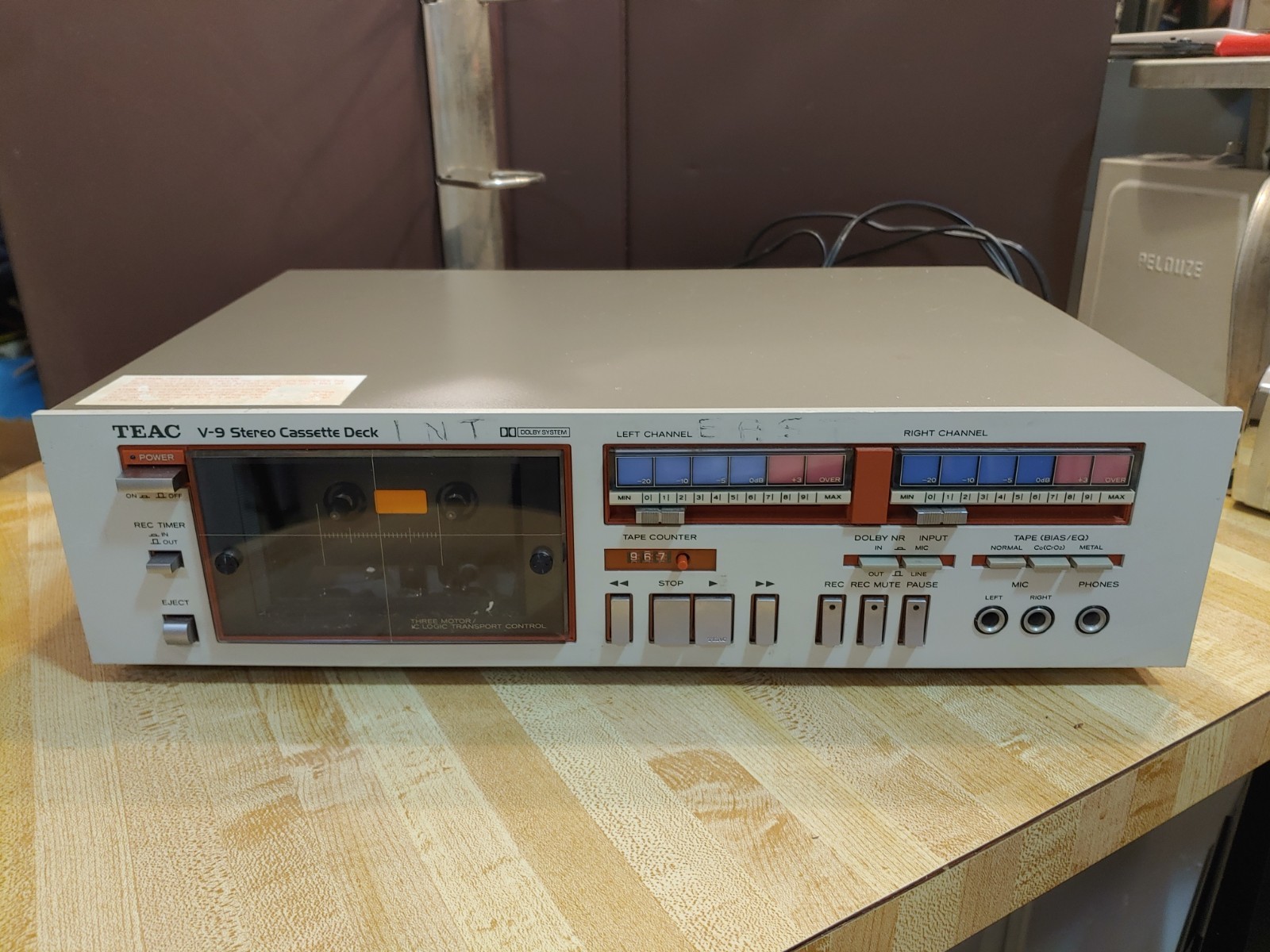
In the late 1960s, as television broadcasting expanded and video production began to move beyond the exclusive domain of major networks, a new wave of Japanese electronics manufacturers sought to enter the professional video equipment market. Among them was TEAC Corporation (originally Tokyo Electro-Acoustic Company), already gaining recognition for its high-quality audio tape recorders. In 1969, Teac introduced the V-9, a 2-inch quadruplex open-reel video tape recorder (VTR) aimed at educational institutions, industrial users, and small broadcast studios. While overshadowed by giants like Ampex and Sony, the Teac V-9 represented a bold step into video technology and remains a rare and historically significant machine for vintage video equipment enthusiasts.
Historical Context: Teac’s Entry into Video
By the mid-to-late 1960s, quadruplex videotape recording had become the standard for broadcast television, with Ampex leading the field since the 1950s. However, these machines were expensive, complex, and required specialized maintenance. As demand grew for more accessible video recording solutions—especially in schools, corporate training, and regional TV stations—companies like Sony, RCA, and Panasonic began developing more compact and affordable systems. Teac, leveraging its expertise in precision tape transport mechanisms from its successful audio reel-to-reel recorders, entered this space with the V-9.
The Teac V-9 was not a consumer product. It was a professional-grade, 2-inch quadruplex VTR designed for black-and-white video recording and playback, operating at 15 inches per second (ips) using the transverse scanning method. It was intended for environments where high-fidelity video archiving and repeat playback were needed, but full broadcast specs weren’t mandatory. Its release in 1969 placed it at a pivotal moment—just before the rise of color portapaks and the eventual dominance of 1-inch Type C formats.
Technical Specifications
The Teac V-9 was engineered with reliability and serviceability in mind, reflecting Teac’s audio heritage. While detailed service manuals are scarce today, surviving units and technical brochures reveal the following key specifications:
| Specification | Detail |
| Format | 2-inch quadruplex (quad) analog video |
| Tape Speed | 15 ips (standard play) |
| Scanning Method | Transverse (rotating head drum) |
| Video Bandwidth | Approx. 3.2 MHz |
| Recording/Playback | Monochrome (black and white) only |
| Tape Width | 2 inches (50.8 mm) |
| Reel Capacity | Up to 14-inch reels (approx. 1 hour at 15 ips) |
| Head Configuration | 4 video heads on rotating drum |
| Audio Recording | FM audio track, longitudinal |
| Control Track | Yes, for stable playback and shuttle |
| Output Signals | Composite video (BNC), audio (XLR or RCA) |
| Power Requirements | 110–120V AC, 60 Hz (region-specific variants) |
| Dimensions | Approx. 28" W × 14" H × 22" D |
| Weight | Approx. 120 lbs (54 kg) |
| Primary Use | Industrial, educational, and non-network broadcast |
The V-9 used a stationary video head assembly with a rotating scanner drum, typical of quad machines, allowing for high-bandwidth video recording by writing across the tape in diagonal tracks. Its transport system featured precision capstans and vacuum columns—technology refined from Teac’s audio tape decks—to ensure stable tape motion and minimize dropouts.
Performance and Video Quality
For its time, the Teac V-9 delivered solid monochrome video performance, capable of recording and playing back video with sufficient resolution for educational films, training videos, and local programming. With a video bandwidth of around 3.2 MHz, it offered good detail—though slightly below the 4–5 MHz of high-end Ampex machines. The FM audio track provided clear sound, suitable for voiceovers and narration.
One of the V-9’s strengths was its ease of operation compared to earlier quad machines. It featured simplified control logic, mechanical interlocks to prevent tape damage, and modular circuitry that allowed for easier troubleshooting. While not as fast or feature-rich as later helical-scan recorders, the V-9 was praised in period reviews for its reliability and low maintenance needs—a testament to Teac’s engineering discipline.
Notable Features and Innovations
Though not revolutionary, the Teac V-9 introduced several user-friendly features that set it apart in the professional video landscape:
- Modular Electronics Design: Circuit boards were plug-in and labeled for quick replacement, a forward-thinking approach that reduced downtime.
- Integrated Vacuum Column System: Borrowed from audio tape decks, this ensured consistent tape tension and reduced wear on expensive 2-inch tape.
- Front-Panel Monitoring: Allowed operators to view video output and audio levels without external equipment.
- Shuttle and Still-Frame Capability: Enabled basic editing functions and frame-by-frame review—rare in non-broadcast machines at the time.
- Robust Chassis Construction: Heavy-duty steel frame minimized vibration and improved head-to-tape alignment.
Teac also marketed optional accessories, including a remote control unit, sync generator, and external time base corrector (TBC), allowing integration into multi-machine setups.
Common Issues and Maintenance
Today, the Teac V-9 is a rare find, and operational units are even rarer. As with all 2-inch quad machines, maintenance is a significant challenge:
- Head Wear and Clogging: The rotating video heads are fragile and prone to wear. Cleaning requires isopropyl alcohol and delicate handling.
- Capstan and Pinch Roller Degradation: Rubber components harden over time and must be replaced to ensure proper tape speed.
- Vacuum Pump Failure: The vacuum columns rely on a small pump that often fails after decades of disuse.
- Lubrication Drying: Gear trains and bearings require complete relubrication with proper-grade grease.
- Tape Availability: 2-inch quad tape is no longer manufactured. Surviving reels are fragile and expensive.
Restoration requires specialized knowledge, alignment tools (like a vectorscope and waveform monitor), and access to obsolete parts. However, for video preservationists and museum curators, restoring a V-9 is a valuable effort in maintaining analog video history.
Market Value and Collectibility
The Teac V-9 is a niche collector’s item, primarily sought by broadcast historians, vintage video archivists, and analog technology museums. Fewer than 500 units are believed to have been produced, and most were decommissioned by the 1980s. As of 2024, non-working units sell for $800–$1,500, while fully restored, operational machines can fetch $3,000–$5,000, depending on condition and accessories.
Its value lies not in daily usability, but in its historical significance as one of the few Japanese-made quad VTRs and a symbol of Teac’s short-lived but ambitious foray into professional video.
Legacy
The Teac V-9 did not achieve commercial success on the scale of Sony’s later U-matic or Betacam systems, and Teac soon exited the professional video market to refocus on high-end audio and consumer electronics. Yet, the V-9 remains a testament to the era when audio engineering expertise was applied to the emerging field of video recording.
For collectors, the V-9 is more than a machine—it’s a bridge between the analog audio world and the dawn of accessible video technology. Its solid build, thoughtful design, and rarity make it a prized artifact of late-1960s innovation. While it never became a household name, the Teac V-9 stands as a quiet pioneer in the democratization of video recording, and a fascinating chapter in Teac’s storied history.
eBay Listings


As an eBay Partner, we earn from qualifying purchases. This helps support our independent vintage technology research.
Related Models
- Teac A-2340R (1975)
- Teac V-30 (1975)
- Teac W-416 (1975)
- Teac A-108-SYNC (1978)
- Teac A-110 (1978)
- Akai AM-2850 (1975)
- Akai AP-206 (1975)
- Nakamichi BX-1 (1985)
- Acoustic Research research-ar-17 (1978)
- Acoustic Research AR-19 (1994)